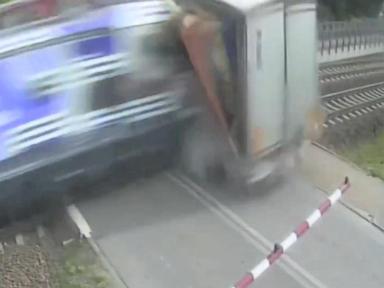
Railway crossings look simple on paper. You have a barrier, flashing lights, and a track meant for high-speed transit. Yet, every single year, massive commercial trucks wind up stranded in the exact path of oncoming locomotives. A viral video showing a train in Poland smashing straight into a semi-truck stuck on a crossing isn't an isolated fluke. It is a terrifying window into a systemic failure of physics, geometry, and infrastructure.
When you watch a heavy goods vehicle high-center on a raised rail grade, you are witnessing a nightmare scenario that drivers, civil engineers, and rail operators fail to prevent. Let's break down why these accidents happen, how the physics completely destroy any chance of a quick escape, and what needs to change before another avoidable catastrophe plays out on camera.
The Brutal Physics of Heavy Transport on Uneven Grades
Semi-trucks are long, heavy, and structurally inflexible. When a loaded trailer transitions from a standard asphalt road onto a raised rail crossing, the clearance underneath the chassis changes dramatically. Drivers often misjudge the slope. The tractor climbs onto the tracks, but the belly of the trailer bottoms out on the crown of the crossing.
Once a trailer high-centers, its drive wheels lose traction. They spin helplessly against the asphalt or gravel, while the multi-ton cargo stays locked in place.
Trains do not stop on a dime. A freight train traveling at standard operating speeds needs up to a mile or more of clear track to come to a complete emergency halt. When a locomotive engineer spots a white trailer blocking the corridor, pulling the brake lever is barely a gesture. The momentum carries the steel wheels forward with unstoppable kinetic energy.
Why Drivers Get Trapped
Most people assume a stuck driver can simply throw the truck into reverse and back off the tracks. Reality is far more complicated.
Grade crossings are often narrow. Drop-down gates descend automatically once the electronic circuits detect an approaching train. Once those metal arms hit the roof of a cab, panic sets in. Drivers face a claustrophobic trap. They have seconds to make a life-or-death choice.
- The tractor engine stalls under the sudden resistance of high-centering.
- Automated safety barriers trap the vehicle from behind.
- Oncoming warning systems leave barely twenty seconds of buffer time before impact.
People freeze under pressure. The instinct to save the multi-million-dollar rig often overrides the sensible choice to abandon the cab and run for safety. That hesitation turns a property damage incident into a fatal collision.
The Blind Spots of Rail Infrastructure Design
We put all the blame on the trucker, but civil engineering plays a massive role in these disasters. Many rural and industrial rail crossings across Europe and North America were designed decades ago for much smaller vehicles. They were never meant to handle modern 53-foot trailers or heavy low-boy haulers carrying oversized industrial components.
The approach angles are often too steep. Warning signs are placed too close to the hazard zone. By the time a long-wheelbase driver realizes the grade is too severe, the rear tandem axles are already dragging across the ballast.
Upgrading every single grade-crossing with modern multi-quadrant gates or obstacle detection systems costs millions. Municipalities drag their feet. They wait for a viral video or a tragic headline to force their hand.
What Actually Works in an Emergency
If you ever find yourself behind the wheel of a vehicle stuck on a rail line, throw away the rulebook. Forget the cargo. Forget saving the truck.
Look for the blue Emergency Notification System sign located near the crossing signal mast. That small metal placard contains a dedicated phone number and a specific crossing ID. Calling that number immediately alerts the rail dispatcher to halt all rail traffic on that specific line.
If a train is already bearing down on you and you cannot clear the tracks, run away from the crossing at a 45-degree angle toward the oncoming train. Debris from the impact flies forward in the direction the train is traveling. Staying near the truck or running away from the train puts you directly in the path of flying shrapnel.
Infrastructure improvements, better route planning for oversized loads, and smarter crossing designs will eventually reduce these incidents. Until then, respect the raw power of the rails. A train always wins.