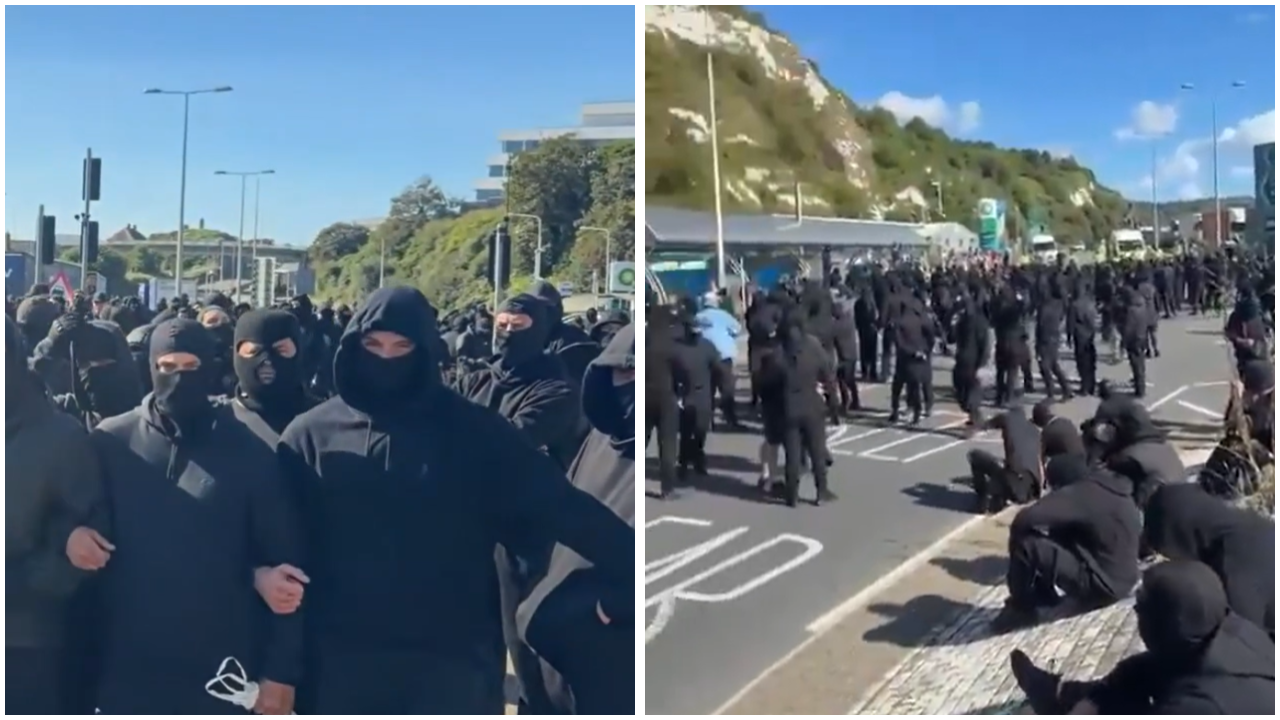
When hundreds of black-clad men wearing balaclavas marched onto the asphalt leading into the Port of Dover, they did not just create a traffic jam. They exposed a dangerous vulnerability in Britain's critical infrastructure.
Early Saturday morning, coordinated groups functioning under the banner of anti-immigration agitation brought Britain's busiest ferry port to a complete standstill. Linking arms across the A20 and blocking vital approach roads, the demonstrators chanted slogans focused on stopping migrant channel crossings. For local workers, travelers, and logistics operators, the surprise demonstration transformed a vital commercial artery into a stage for intimidation.
This incident was not an organic flare-up of local frustration. It was a calculated operational test by networked nationalist factions designed to paralyze a major trade gateway and command media attention.
The Logistics of Disruption
Dover is the jugular vein of the United Kingdom's supply chain with continental Europe. Handling millions of passengers and billions of pounds in freight annually, the port operates on razor-thin scheduling margins. When access roads are choked, the shockwaves hit supply chains instantly.
By mobilizing hundreds of masked individuals simultaneously at strategic choke points like Jubilee Way, the organizers bypassed traditional public demonstration protocols. Police forces, caught flat-footed by the sudden deployment, faced an immediate tactical dilemma. Dispersing a hostile, anonymous crowd blocking multi-lane highways without escalating into structural violence requires careful containment.
Local residents reported feeling deeply unsettled. Shift workers trying to leave the port area were trapped. Families in vehicles found themselves surrounded by an unidentifiable mass wearing paramilitary-style black clothing. The psychological impact on the town was immediate. Fear replaced routine.
The Political Architecture Behind the Mask
The timing of the Dover blockade reveals a broader political strategy taking shape across Europe. Just days prior, high-profile nationalist figures crossed ideological and geographic lines, signaling a hardening pan-European alignment on border enforcement.
Hard-right movements have successfully weaponized public anxiety surrounding maritime migration. Even though government statistics indicate that small boat crossings have experienced downward corrections during specific periods, perception often outpaces raw data in political discourse. Activists exploit this gap, framing state management of borders as total failure.
The organizations claiming credit for the blockade operate through decentralized digital networks. They mobilize quickly, maintain anonymity through facial coverings, and prioritize high-visibility disruptions over conventional democratic engagement. This paramilitary aesthetic is intentional. It projects strength, instills fear, and tests the limits of public order policing.
The Cost of Performing Border Security
Public officials were quick to condemn the disruption. Local parliamentarians and council representatives pointed out the sheer hypocrisy of choking a local economy under the guise of protecting it. Yet condemnation alone does little to prevent future actions.
Critical infrastructure protection in an open society relies on a fragile social contract. Citizens accept that roads will be open, trade will flow, and emergency services will operate without domestic blockades. When extremist groups breach that contract for theatrical effect, law enforcement agencies are forced onto the defensive.
If the state cannot secure the approach roads to its primary international gateway against a mob in balaclavas, the implications extend far beyond immigration policy. It invites copycat disruptions across energy, transport, and communication networks.
The smoke will clear from the A20, and the ferries will resume their schedules, but the structural weakness exposed in Dover remains entirely unaddressed.