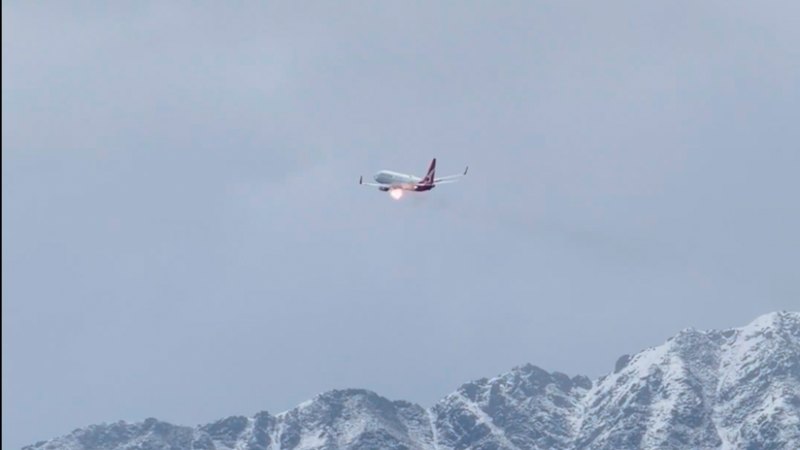
Commercial aviation incidents rarely materialize as sudden catastrophic failures; instead, they unfold through tightly bound sequences of mechanical stressors, localized environmental factors, and standardized flight-deck mitigation protocols. When Qantas flight QF122, a Boeing 737-800 operating between Queenstown, New Zealand, and Sydney, experienced a sharp mechanical anomaly shortly after takeoff on September 5, 2026, public perception fixated on eyewitness accounts of loud bangs and trailing orange flames. Strip away the sensory panic of ground observers, however, and the event reveals a textbook study in modern turbine engine behavior, multi-engine redundancy limits, and the spatial constraints of alpine airfield operations.
The Mechanics of Compressor Stalls in Alpine Environments
To understand why onlookers witnessed intermittent fireballs echoing across the Queenstown valley, one must examine the operational envelope of high-bypass turbofan engines, specifically the CFM56 powerplants standard to the Boeing 737-800. A compressor stall occurs when the aerodynamic angle of attack on the compressor blades exceeds critical thresholds, disrupting airflow through the core engine. This disruption causes a momentary flow reversal, expelling high-pressure air and unburnt fuel forward through the intake or backward through the exhaust, igniting signature flashes visible from the ground as successive loud bangs.
Queenstown Airport presents a unique geographical variable. Nestled in a rugged alpine valley, the airfield forces aircraft into high-thrust departures surrounded by complex terrain and variable wind shear profiles. While initial regulatory reviews pointed toward potential foreign object debris ingestion—commonly known as a bird strike—compressor surges can also be triggered by localized aerodynamic turbulence disrupting the uniform intake of air into the nacelle. The engine continued to function under operational limits, meaning the core structural integrity remained intact despite the transient pneumatic instability.
The Decision Calculus of Diversion and Transoceanic Risk Management
Flight crews facing a non-normal engine condition immediately transition from schedule execution to risk mitigation. In the case of QF122, the geographical location dictated the operational choice. Climbing away from Queenstown places an aircraft directly before a high-consequence transition: the Tasman Sea.
The cost function of continuing a multi-hour oceanic crossing on a single functional engine paired with a compromised or surging powerplant violates basic safety margins. Modern twin-engine aircraft, certified under Extended-range Twin-engine Operational Performance Standards, are mathematically capable of single-engine flight, but commercial aviation protocol prioritizes the minimization of cumulative risk exposure.
The flight deck elected to divert to Christchurch International Airport rather than execute an immediate return to Queenstown or continue to Sydney. This decision reflects several operational variables:
- Runway Infrastructure: Christchurch possesses an extended, heavy-duty commercial runway capable of handling heavy emergency response vectors and accommodating wide clearance margins.
- Support Ecosystem: Major hubs like Christchurch provide immediate access to maintenance engineering teams, replacement aircraft parts, and passenger logistics infrastructure that regional alpine fields lack.
- Weather and Airspace: Diverting across the South Island toward the east coast allowed the crew to maintain stable altitude profiles while running necessary diagnostic checklists without the immediate terrain constraints of the Southern Alps.
Systemic Redundancy versus Public Perception
The stark disparity between public panic and technical reality highlights the psychological friction inherent in modern air travel. To the untrained observer on the ground or in the cabin, visible flames and loud mechanical concussions signal imminent structural disintegration. To the flight deck and flight management computer, a compressor stall—while requiring procedural intervention—is a known, quantifiable anomaly managed through pre-engineered checklists.
Power was maintained across both engines throughout the event, meaning the aircraft never operated as a single-engine glider or faced a catastrophic rotor burst. The visual pyrotechnics observed by residents along Frankton Road were the byproduct of fuel igniting outside the combustion chamber within the exhaust duct, an alarming visual display that vastly outstripped the actual mechanical danger to the aircraft's structural frame.
Operational Execution of Passenger Logistical Recovery
When an unscheduled diversion occurs, the airline's ground-side infrastructure faces an immediate stress test. The operational response requires a simultaneous pivot across three distinct domains: air traffic coordination, maintenance isolation, and passenger re-accommodations.
In Christchurch, emergency services positioned themselves along the tarmac as a standard precautionary protocol rather than a reactive necessity. Once the aircraft touched down safely under priority clearance, the immediate engineering priority shifted to data retrieval. Flight data recorders and engine diagnostic ports are scrubbed to isolate the exact root cause—separating bird ingestion signatures from transient electronic fuel-control faults or mechanical wear. Simultaneously, customer operations teams must manage the inventory of displaced passengers, coordinating local hotel allotments, regulatory notifications, and delayed sector re-bookings across international boundaries.
To eliminate recurrence and maintain systemic reliability, the airline engineering division must quarantine the affected engine module, execute borescope inspections of the compressor blades for microscopic metal fatigue or foreign impact damage, and clear the airframe's electronic control units before returning the specific Boeing 737-800 hull to active commercial rotation.