Traditional coastal engineering relies on a high-impedance doctrine. Seawalls, bulkheads, and revetments are designed to meet extreme hydrodynamic forces with rigid, structural resistance. When Hurricane Matthew tracked up the Atlantic coast of Florida in October 2016, packing sustained winds near 90 miles per hour and driving significant storm surge, many of these rigid assets experienced catastrophic toe scour, flanking, and structural collapse. Conversely, engineered living shorelines—hybrid infrastructure combining native vegetation, oyster reef structures, coir logs, and low-profile stone sills—survived intact. This divergence in performance exposes a fundamental flaw in coastal risk management: rigidity under dynamic loading creates points of failure, whereas dissipation through distributed resistance preserves structural integrity.
Evaluating the performance of living shorelines during a category-scale meteorological event requires moving beyond anecdotal observations of survival and examining the underlying physical mechanics. The coastal protection mechanism of a living shoreline functions not as a monolithic barrier, but as a graduated energy attenuation system. Understanding why Florida coastal installations remained functional through Matthew requires a strict decomposition of hydrodynamic forces, material properties, and ecological feedback loops.
The Hydrodynamic Dissipation Matrix
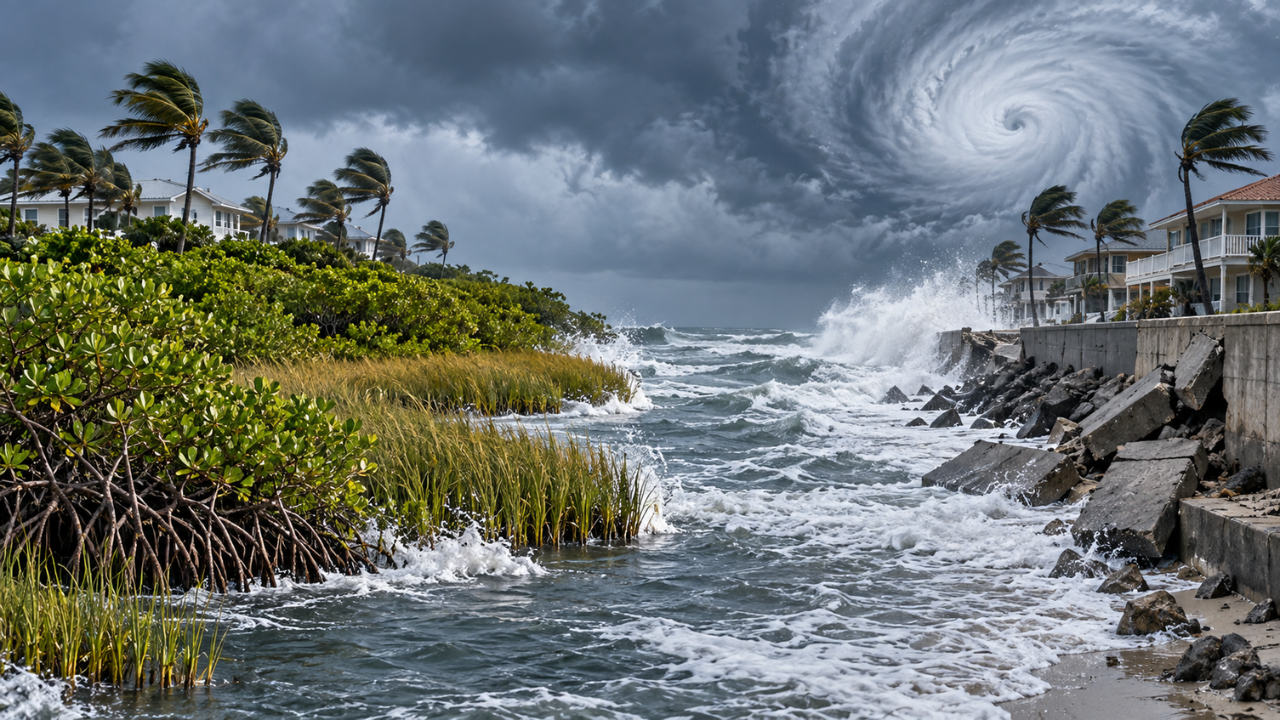
When a tropical cyclone impacts a coastline, energy is transmitted through three primary vectors: wind-driven waves, elevated still-water level (storm surge), and high-velocity return currents. Hardened infrastructure reflects wave energy, a process that concentrates turbulence at the base of the structure. This reflected energy scours sediment, undermines foundations, and accelerates erosion in adjacent unprotected zones.
Living shorelines mitigate these vectors through a multi-tiered dissipation matrix operating across three distinct zones:
The Subtidal Zone: Low-profile offshore breakwaters or restored oyster reefs intercept the primary swell. By forcing waves to break prematurely offshore, these structures reduce wave height before the energy reaches the intertidal slope. The incident wave energy is scattered across a rough, irregular surface rather than reflected off a smooth vertical wall.
The Intertidal Zone: A dense matrix of marsh grasses, such as smooth cordgrass (Spartina alterniflora) and mangroves, increases hydraulic friction. As water moves through the canopy, the drag coefficient of the flexible vegetation strips momentum from the water column. Unlike concrete panels, flexible stems bend with the flow, absorbing kinetic energy and converting it into mechanical flexure without structural failure.
The Supratidal Zone: Root systems bind the sediment matrix. The tensile strength of interlocking root networks acts as a biological geogrid, increasing the shear strength of the soil and preventing the retrogressive slumping typical of saturated upland banks during rapid drawdown.
Comparative Failure Modes: Rigid Versus Living Systems
To understand the resilience demonstrated during Hurricane Matthew, one must contrast the failure envelope of conventional bulkheads with the degradation pattern of living infrastructure.
Bulkheads operate on a binary threshold. They perform adequately until hydrodynamic pressure exceeds the passive earth pressure of the backfill or scour removes toe support. At that critical threshold, the structure fails catastrophically. The failure mode is sudden, total, and expensive to remediate.
Living shorelines operate on a continuous degradation and recovery curve. During Hurricane Matthew, high-energy wave action stripped certain sections of marsh vegetation and displaced loose sediment within coir fiber logs. However, because the system is modular and biologically active, the foundational elements—the root mats and stone sills—remained anchored. The system absorbed damage rather than resisting it to the point of structural fracture.
This characteristic introduces a critical economic variable: maintenance expenditure profiles. Conventional infrastructure demands high-capital, infrequent interventions that reset the depreciation clock to zero. Living shorelines require low-capital, frequent operational adjustments—such as sediment replenishment, invasive species management, and minor replanting—that align with natural ecological succession.
Variables Governing Performance Variance
Not all living shorelines installed along the Florida coast performed identically during the 2016 storm. Performance variance across different sites can be isolated to four core environmental variables:
Fetch and Exposure: Sites situated within high-fetch environments experienced greater cumulative wave energy. Installations featuring only herbaceous vegetation without an offshore breakwater experienced localized bank loss because the plants lacked sufficient structural maturity to withstand continuous high-frequency wave battering.
Substrate Composition: Sites characterized by high organic content or unconsolidated muck without prior stabilization suffered root shearing. Conversely, installations utilizing coarse sand or shell aggregate beneath the organic layer provided a stable anchor for early root development.
Installation Maturity: Shorelines established more than three years prior to Hurricane Matthew possessed dense, deep root architectures that extended below the depth of storm-induced scour. Installations less than one year old exhibited higher rates of displacement because the root matrix had not yet permeated the parent soil.
Sill Geometry and Placement: Where rock sills were integrated, elevation relative to the mean high water mark dictated success. Sills constructed too high acted as dams, trapping hyper-saline water and causing root rot; sills constructed too low failed to disrupt wave action effectively during peak surge.
The Economic Cost Function of Coastal Defense
The long-term viability of coastal protection is governed by a strict cost function that accounts for initial capital expenditure, ongoing maintenance, and catastrophic failure risk.
Conventional engineering models calculate cost over a projected design life assuming a stationary climate and stable sea-level baseline. As storm frequency and intensity increase, the maintenance interval for rigid structures compresses, rendering initial cost projections obsolete.
Living shorelines alter this financial architecture. While initial site preparation and biological establishment costs can rival traditional engineering, the asset appreciates over time. As oysters recruit naturally to hard substrates and vegetation spreads, the protective capacity of the installation increases organically. The asset self-heals, eliminating the catastrophic replacement cycle associated with concrete bulkheads.
The primary limitation of this infrastructure type is spatial requirement. Living shorelines require a gradual slope to dissipate energy effectively. In high-density urban settings where waterfront real estate is heavily constrained by vertical bulkheads and property lines, the horizontal footprint necessary for a functional marsh slope is often unavailable. In these constrained zones, hybrid designs—such as vertical sea walls fronted by engineered oyster reef balls—represent the only viable compromise between spatial limitations and hydrodynamic resilience.
Strategic Implementation Protocol
Deploying resilient coastal defenses along vulnerable coastlines demands a shift from reactive construction to proactive site engineering.
Conduct high-resolution hydrodynamic modeling to map local wave climate, peak surge velocity, and sediment transport dynamics before selecting structural components. Never rely solely on regional fetch calculations.
Prioritize composite structures in high-energy zones. Purely vegetative shorelines are inadequate for exposed coastal environments subject to direct tropical cyclone impacts. The integration of stone, coir, or concrete reef structures is mandatory to absorb the primary wave shock before energy reaches the biological zone.
Establish monitoring protocols with pre- and post-storm bathymetric surveys. Quantifying volumetric sediment loss following minor meteorological events provides the empirical data required to calibrate maintenance thresholds long before a major hurricane makes landfall.
Allocate capital for the establishment phase. The vulnerability window of a living shoreline spans the first eighteen to twenty-four months post-installation. Supplemental irrigation, protective fencing against herbivory, and immediate replanting of failed micro-zones during this window determine whether the asset survives its first major storm cycle.