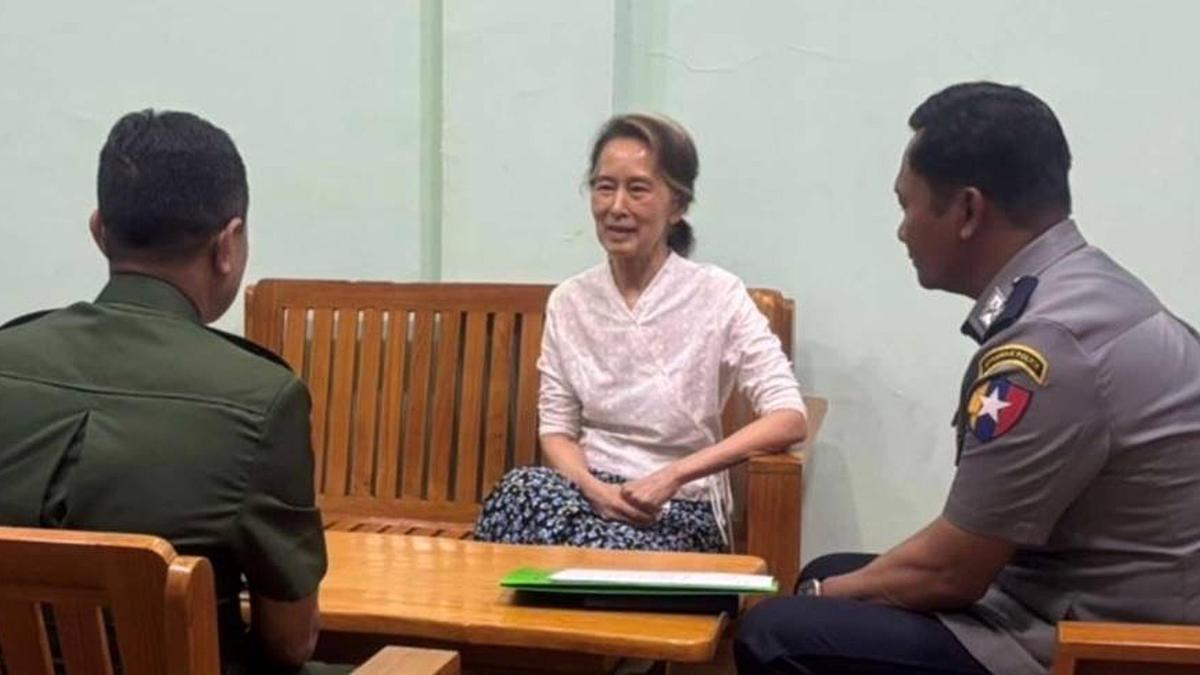
The military junta in Myanmar has moved Aung San Suu Kyi from the concrete isolation of a Naypyidaw prison to house arrest, a maneuver they claim is a humanitarian gesture necessitated by a blistering heatwave. It is a calculated retreat. By shifting the 78-year-old Nobel laureate to a private residence, the State Administration Council (SAC) is not signaling a softening of its grip or a return to democratic norms. Instead, this is a desperate attempt to utilize the physical frailty of an icon as a shield against a domestic insurgency that is currently tearing the military’s territorial control to shreds.
For three years, the woman who once symbolized the hope of a "discipline-flourishing democracy" has been buried in the legal system of a pariah state. Her transfer to house arrest does not vacate a single day of her multi-decade sentence. It does not allow her access to her legal team or the outside world. It merely changes the scenery of her captivity while the generals who overthrew her in 2021 try to figure out how to stop their frontline units from surrendering in record numbers.
Heat as a Diplomatic Tool
The official narrative focuses on the thermometer. Temperatures in Naypyidaw have soared past 40 degrees Celsius, and the junta’s spokesperson, Major General Zaw Min Tun, stated that "not only Aung San Suu Kyi... but all those who need necessary precautions, especially elderly prisoners, are being given priority to protect them from heatstroke."
This is a convenient truth that masks a larger strategic anxiety. The junta is currently facing its greatest existential threat since the coup. A coordinated offensive by ethnic armed organizations (EAOs) and the People’s Defence Forces (PDF)—the armed wing of the shadow National Unity Government (NUG)—has resulted in the loss of critical border towns and dozens of military outposts. The military is bleeding men and morale.
By moving Suu Kyi now, the SAC attempts to blunt international criticism and perhaps create a sliver of leverage with regional powers like Thailand and China. They are effectively holding a high-value asset in a more "presentable" cage. If her health were to fail entirely while in a prison cell, she would become a martyr of such magnitude that even the junta’s remaining lukewarm allies would find it impossible to look away.
The Logistics of a Golden Cage
House arrest in the context of Myanmar’s military history is a specific type of psychological warfare. During her previous fifteen years of detention under the former regime, Suu Kyi’s residence at 54 University Avenue became a site of pilgrimage. Today, her location is being kept secret. She is not back at her family home in Yangon; she is reportedly held in a government-owned residence within the fortified capital of Naypyidaw.
This distinction matters. In Yangon, she was a visible reminder of resistance. In Naypyidaw, she is a ghost in a fortress. The military controls the perimeter, the communications, and the medical staff. This isn't a release; it is a change in the conditions of her management. The junta is managing a declining asset that they can neither kill nor set free without risking their own total collapse.
A Fragmented Resistance and the Suu Kyi Factor
The political reality on the ground has shifted violently since 2021. While Suu Kyi remains a beloved figure for the older generation and a symbol of national identity, the youth-led resistance has moved beyond the "The Lady." The NUG and the PDF are no longer waiting for a non-violent, negotiated settlement. They are engaged in a full-scale civil war aimed at the total removal of the military from Myanmar’s political life.
There is a growing disconnect between the diplomatic obsession with Suu Kyi’s status and the tactical realities of the jungle. For the fighters on the front lines in Kayin State or Sagaing Region, her move to house arrest is a distraction. They see it as a "PR stunt" by Min Aung Hlaing, the junta leader, to buy time.
The military knows this. They are playing a dual game. To the West and ASEAN, they offer the "mercy" of house arrest. To their own rank and file, they maintain the facade of absolute control. But the cracks are showing. The loss of Myawaddy, a vital trade hub on the Thai border, has decimated the junta's revenue and proved that their "fortress" strategy is failing.
The China Connection and Regional Pressure
No major shift in Myanmar happens without a glance toward Beijing. China’s primary interest is stability and the protection of its massive infrastructure investments, including oil and gas pipelines and the proposed China-Myanmar Economic Corridor. The chaos of the last three years has been bad for business.
Recent reports suggest that Chinese officials have grown increasingly frustrated with the junta’s inability to quell the resistance or handle the rampant online scam centers operating in border regions. By moving Suu Kyi, the junta may be attempting to show Beijing that they are capable of "political flexibility," a prerequisite for any negotiated settlement that China might mediate.
The Failure of ASEAN’s Five-Point Consensus
The Association of Southeast Asian Nations (ASEAN) has been toothless in this crisis. Their "Five-Point Consensus," which calls for an immediate end to violence and dialogue among all parties, has been ignored by the SAC for years.
- Immediate cessation of violence: Ignored. The military continues its campaign of airstrikes against civilian targets.
- Dialogue among all parties: Ignored. Suu Kyi remains a prisoner, not a participant.
- Mediator from ASEAN: Limited access, often blocked from seeing key stakeholders.
- Humanitarian assistance: Weaponized by the junta to reward loyalist areas and starve resistance strongholds.
- Visit by a special envoy: Often restricted to staged tours.
Suu Kyi’s move to house arrest is the bare minimum the junta can do to pretend they are acknowledging this framework. It costs them nothing and buys them a news cycle of "softened" headlines.
The Health Crisis Behind the Curtain
Suu Kyi’s health has been a recurring concern. Her son, Kim Aris, has repeatedly sounded the alarm about her lack of access to independent doctors and her struggle with chronic dental issues that make eating difficult. In prison, these issues were life-threatening. Under house arrest, the junta can provide just enough care to keep her alive while ensuring she remains silenced.
It is a grim irony that the very people who imprisoned her are now acting as her "protectors" against the weather. This is the same military that has displaced over 2.3 million people and burned thousands of homes, leaving families to face the same record-breaking heat without roofs over their heads.
The survival of the 1991 Nobel Peace Prize winner is essential for the junta’s endgame, whatever that may be. They need her as a bargaining chip for a future where they might be forced to negotiate their own exit or a power-sharing agreement that protects them from prosecution for war crimes. A dead Suu Kyi is a permanent stain they cannot wash off; a living Suu Kyi is a dial they can turn up or down depending on the pressure.
Beyond the Cult of Personality
The international community’s focus on Suu Kyi often ignores the systemic nature of the Myanmar crisis. This is not just about one woman’s freedom; it is about the dismantling of a kleptocratic military institution that has held a nation hostage for six decades.
The resistance today is more diverse and more decentralized than it was during the 1988 or 2007 uprisings. Ethnic groups that were once at odds with the Bamar-majority NLD (Suu Kyi’s party) are now fighting alongside the PDF. They are not fighting for a return to the 2008 constitution that gave the military 25% of parliament; they are fighting for a new federal democracy.
In this new landscape, Suu Kyi is a legacy figure. Her release to house arrest is a relic of an older political era. The generals are using an old playbook in a world where the rules have fundamentally changed. They believe that by moving the pieces on the board, they can change the outcome of a game they have already lost on the ground.
The Real Stakes
As the heat intensifies, the true test will be whether this move leads to any actual concessions. Will she be allowed to meet with the ASEAN envoy? Will she be allowed to speak to her party members? The answer, based on the SAC’s track record, is almost certainly no.
The junta is betting that the world has a short memory and a low bar for "progress." They are betting that the image of an elderly woman being moved to a house will be enough to satisfy the advocates of "quiet diplomacy." They are wrong.
The move from a prison cell to a government house is a change in the degree of her suffering, not the nature of her status. She remains a political hostage in a country where the jailers are running out of places to hide. The "humanitarian" explanation is a thin veil for a military that is sweating under a heat more intense than any sun: the heat of a population that has finally decided it has nothing left to lose.
The revolution in Myanmar has moved past the era of waiting for a savior from a balcony. The fight is now in the mountains, the jungles, and the streets of the cities. Moving a prisoner does not stop a war. It only clarifies who is truly afraid.