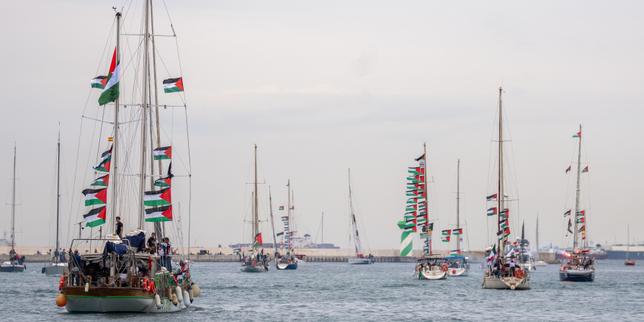
The latest attempt to breach the maritime blockade of the Gaza Strip has ended not in the waters of the Levant, but in a series of legal and logistical skirmishes across European ports. For weeks, a coalition of international activists under the banner of the Freedom Flotilla has attempted to launch a multi-vessel convoy carrying hundreds of tons of humanitarian aid. However, the mission has stalled. Israeli diplomatic pressure combined with administrative hurdles in countries like Greece and Turkey has effectively neutralized the fleet before it could reach open water. This isn't just a story about a boat being stopped; it is a clinical demonstration of how modern blockades are enforced through paperwork and port authorities long before a naval vessel ever fires a warning shot.
The strategy of the Freedom Flotilla remains unchanged since its inception over a decade ago. By putting civilian lives and humanitarian cargo in the direct path of the Israeli Navy, the organizers hope to create a political crisis that makes the blockade untenable. Israel, conversely, views these missions as a direct threat to its security framework, arguing that any breach of the maritime perimeter could facilitate the smuggling of weapons or dual-use materials to Hamas. For a deeper dive into similar topics, we suggest: this related article.
The Invisible Wall at the Dockside
Most people imagine a blockade as a line of warships patrolling a coastline. While those ships certainly exist, the most effective part of the current enforcement mechanism happens in the back offices of maritime registries. In the recent standoff near Greece, several vessels found their flags revoked or their safety certificates suddenly called into question.
International maritime law is a dense thicket of regulations that can be weaponized with surgical precision. When a country like Israel identifies a vessel intended for a protest mission, it doesn't just monitor the radar. It engages in a high-stakes diplomatic campaign to pressure the country where the ship is flagged. If a small nation like Guinea-Bissau or Palau feels the heat, they may simply de-register the vessel. Without a flag, a ship is a pariah. It cannot legally leave port, and if it does, it can be treated as a pirate vessel, subject to boarding by any navy in international waters. For further information on this development, comprehensive coverage can also be found on Reuters.
This administrative strangulation is far cleaner for the Israeli government than a high-seas boarding. A violent confrontation on the water creates a global PR nightmare. A boat stuck at a pier because of a missing safety inspection barely makes the evening news.
The Evolution of the Activist Fleet
The activists behind the "Handala" and other ships in the current flotilla have learned from past failures, yet they face an increasingly sophisticated opposition. In 2010, the Mavi Marmara incident resulted in a deadly confrontation that strained Israel’s relations with Turkey for years. Since then, the Israeli Defense Forces (IDF) have refined their interception tactics to focus on non-lethal deterrents and preventative diplomacy.
The organizers of the current mission claim they are carrying basic necessities—food, medical supplies, and construction materials. They argue that the land crossings are insufficient and subject to the whims of military censors. From their perspective, the sea represents the only sovereign path to Palestinian autonomy. Yet, the logistical reality is that these small civilian craft are ill-equipped to challenge a modern Mediterranean navy.
Beyond the physical ships, there is a war of narratives. Israel maintains a strict list of permitted goods, citing the need to prevent the construction of tunnels and the manufacturing of rockets. The flotilla organizers counter that the restrictions amount to collective punishment of the two million people living in Gaza. The gray area lies in the definition of "humanitarian." If a bag of cement can build a hospital or a bunker, who decides its fate?
The Greek Connection and Regional Realities
Greece has become an unlikely frontline in this conflict. In previous years, the Greek government has been the primary actor in physically preventing flotilla ships from leaving their waters. This shift in Greek policy reflects a broader geopolitical realignment. Over the last decade, Greece, Cyprus, and Israel have formed a tight energy and security alliance, centered around the management of natural gas deposits in the Eastern Mediterranean.
For Athens, the calculus is simple. Allowing a protest fleet to launch from its shores risks damaging a vital strategic partnership. By enforcing strict "administrative checks" on the activists' boats, Greece can claim it is merely following the letter of maritime law while effectively serving the interests of its regional ally. The activists find themselves caught in a geopolitical pincer movement where their right to protest is secondary to the stability of energy markets and defense pacts.
The Cost of the Stalemate
While the boats sit idle, the situation on the ground in Gaza continues to deteriorate. The land crossings at Rafah and Kerem Shalom are frequently congested or closed, and the air-drop campaigns initiated by various Western nations are widely seen as inefficient and symbolic at best. The sea remains the most logical route for large-scale aid, which is why the struggle over the flotilla is so intense.
The activists are not just fighting for a delivery route; they are fighting for the principle of "freedom of navigation." They argue that the maritime blockade is illegal under international law because it targets a civilian population. Israel argues the blockade is a legal necessity under the laws of armed conflict. This legal dispute has been debated in the United Nations and the International Criminal Court for years with no definitive resolution.
The Financial Strain on Protest Movements
Maintaining a fleet of ships is an incredibly expensive endeavor. Every day a ship sits in port, it accrues docking fees, insurance costs, and maintenance expenses. For a movement funded largely by private donations and NGOs, these delays are a form of financial attrition. The longer the legal battles drag on in Greek or Turkish courts, the more the movement’s resources are drained.
- Vessel Maintenance: Engines and hulls deteriorate faster when idle in saltwater.
- Crew Logistics: Dozens of volunteers must be fed and housed while the mission is stalled.
- Legal Fees: Challenging a revoked flag or a port detention requires specialized maritime lawyers.
The goal of the authorities is often to simply wait them out. If the ships never leave the pier, the "crisis" never moves to the water, and the activists eventually run out of money or public attention.
A New Era of Non-Kinetic Warfare
We are witnessing a transition in how sovereign states handle dissent on the high seas. The era of dramatic naval boardings may be giving way to an era of "lawfare," where the primary weapons are inspections, insurance mandates, and diplomatic cables. This method is cheaper, safer for the enforcing state, and much harder for the public to rally against.
The activists currently stuck in the Mediterranean are facing a wall that isn't made of steel, but of ink and stamps. They are learning that in the 21st century, the most effective way to stop a ship is to make it legally invisible. The ships may eventually find a way to sail, but by the time they do, the political moment they hoped to capture may have already drifted away.
The struggle for the Gaza coastline is no longer just about who controls the water. It is about who controls the bureaucracy of the sea. As long as the administrative blockade remains as tight as the naval one, the chances of a civilian fleet reaching Gaza remain slim. The dockworkers and port officials in the Mediterranean have become the gatekeepers of a conflict that shows no signs of receding.
Governments have realized that you don't need to sink a ship if you can simply ensure it never has the right to float.