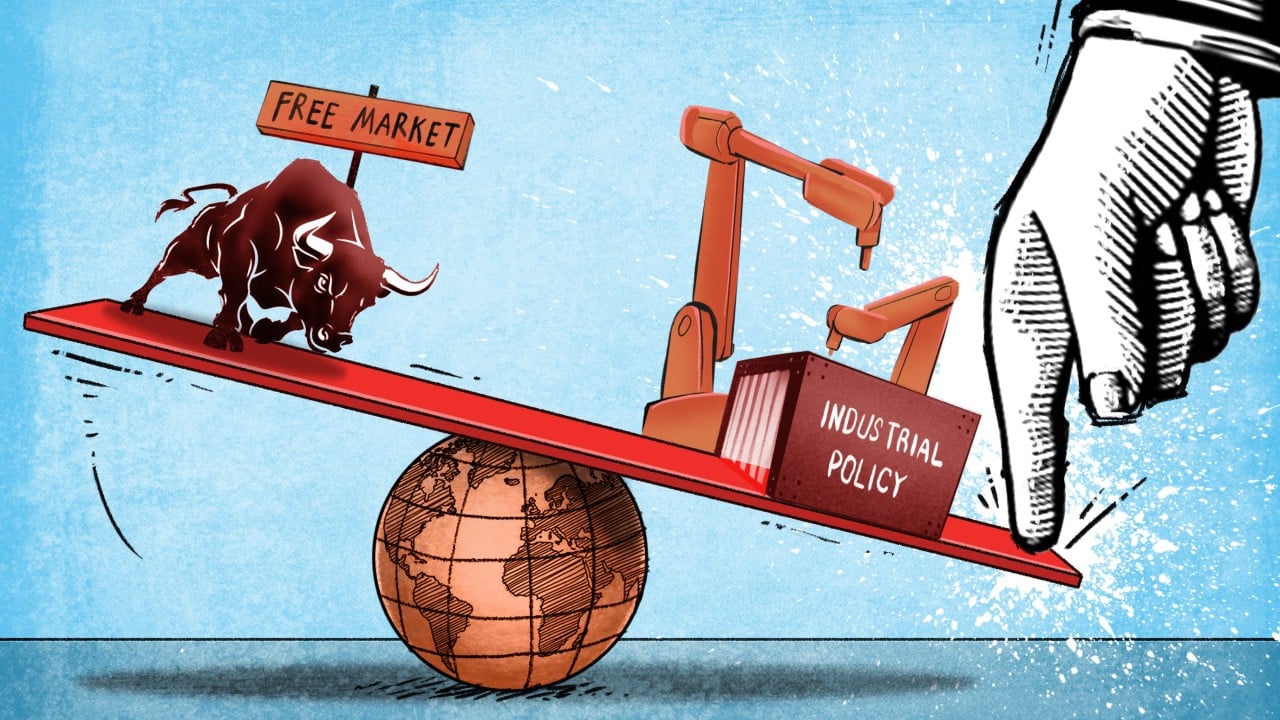
China didn't just grow its economy. It re-engineered the entire global trade system to suit its own needs. While Western politicians spent the last two decades arguing about carbon taxes and quarterly earnings, Beijing was busy building a monopoly on the future. They didn't do it by following the free-market playbook you'll find in an MBA textbook. They did it by breaking every rule in that book.
If you think this is just about cheap labor or "stealing" intellectual property, you're missing the bigger picture. The real story is about a massive, state-directed pivot toward high-tech dominance. China stopped being the world's factory for plastic toys and became the world's laboratory for electric vehicles, green energy, and advanced semiconductors. This wasn't an accident. It was a calculated, well-funded, and ruthless industrial policy that caught the rest of the world sleeping.
The End of the Lazy Globalization Era
For years, the consensus in Washington and Brussels was that as China got richer, it would become more like us. We thought they'd embrace democratic values and play by the World Trade Organization rules. That was a fantasy. Instead, China used its wealth to double down on a model of "State Capitalism" that funnels billions into specific industries they want to own.
The pivot happened right after the 2008 financial crisis. While the West was reeling from the housing market collapse, Beijing realized that relying on exports to the US was a vulnerability. They shifted. They started pumping money into domestic "national champions" like Huawei, BYD, and CATL. They didn't just want to participate in the global supply chain. They wanted to be the supply chain.
Why the New Industrial Policy Actually Works
Traditional economic theory says governments shouldn't pick winners. It says the market is more efficient at allocating resources. In a perfect world, that’s true. But we don't live in a perfect world. We live in one where the Chinese government provides zero-interest loans, free land, and massive subsidies to companies that align with their 10-year plans.
Take the electric vehicle (EV) market. Ten years ago, BYD was a laughingstock to many Western auto executives. Today, they're rivaling Tesla for the top spot globally. This didn't happen because they had a better "startup culture." It happened because the Chinese state ensured they had exclusive access to lithium processing and battery tech. They built the charging infrastructure before the cars were even on the road. They created the demand by fiat.
The Resource Trap Nobody Saw Coming
You can't build a green economy without minerals. This is where China’s strategy gets really clever—and scary for everyone else. They realized early on that owning the mine is better than owning the factory.
- Lithium and Cobalt: China controls the vast majority of the world's processing capacity for these "white gold" minerals. Even if a mine is in Australia or the Congo, the ore often goes to China for refinement.
- Rare Earth Elements: They hold a near-monopoly here. These minerals are essential for everything from iPhone speakers to F-35 fighter jet engines.
- Solar Dominance: By subsidizing their solar panel industry so heavily that European and American competitors went bankrupt, they now control over 80% of the global solar supply chain.
When you control the ingredients, you control the price of the final meal. The West is now frantically trying to "de-risk" or "de-couple," but you can't build a battery plant in Georgia or Germany overnight if the chemicals you need only come from Ningbo or Shenzhen.
Why the West Failed to Compete
We got complacent. US and European companies were happy to outsource production because it made their balance sheets look great in the short term. It boosted stock prices and executive bonuses. But it also hollowed out the middle class and transferred decades of manufacturing "know-how" across the Pacific.
Innovation isn't just a guy in a hoodie writing code in Silicon Valley. It's the guy on the factory floor figuring out how to make a widget 5% faster. When you move the factory, you eventually lose the innovation too. China understood this. They moved up the value chain from assembling iPhones to designing the sophisticated components inside them.
The Myth of the Level Playing Field
If you're a business owner in Ohio or Lyon, you're competing against a company that has the entire weight of the Chinese state behind it. That's not a fair fight. It's like a high school football team going up against a professional NFL squad that also happens to own the referees.
The WTO has proven mostly toothless in stopping these practices. By the time a case is litigated, the Chinese company has already reached such a massive scale that the ruling doesn't matter. They've already won the market share.
What Happens When the Pivot Hits Your Industry
This isn't just about cars and phones anymore. The next frontier is biotech and artificial intelligence. Beijing is pouring money into "Little Giants"—thousands of smaller, specialized firms that dominate niche parts of the tech stack.
They’re also using "Civil-Military Fusion." This means any breakthrough in the private sector is immediately shared with the military. In the US, Google employees might protest working with the Pentagon. In China, that's not an option. This structural advantage allows them to move faster and with more singular purpose than any Western democracy.
The Strategy for Survival
Complaining about it won't change the reality on the ground. The "Pivot" is here, and it has already remade the world. If you want to remain competitive, you have to stop thinking like it’s 1995.
- Map your dependencies. If your product requires a component that only comes from one region in China, you don't have a business; you have a ticking time bomb. You need to find alternative suppliers in India, Vietnam, or Mexico immediately.
- Focus on "Process Innovation." Stop just trying to invent new things. Start figuring out how to manufacture them more efficiently. The West lost its lead because it forgot how to make things.
- Lobby for Industrial Policy. Free markets are great, but when every other major player (China, the EU, even the US now with the CHIPS Act) is subsidizing their tech, you can't afford to be the only one playing by the old rules.
- Invest in talent, not just software. We need more hardware engineers and chemists. The digital economy is built on a physical foundation of chips and cables. If you don't own the physical, the digital doesn't matter.
China’s industrial policy succeeded because it was patient. They didn't care about the next quarter; they cared about the next quarter-century. The only way to counter that is to start thinking with the same level of long-term aggression. The era of easy growth is over. Now, it's a fight for the fundamental building blocks of the modern world.