Westminster's political class thinks it just pulled off a masterstroke.
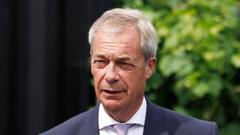
When Nigel Farage resigned his seat in Clacton to trigger a "people versus the establishment" by-election over his £5 million crypto donation controversy, the establishment responded with what they believed was the ultimate humiliation. Labour, the Conservatives, the Liberal Democrats, and the Greens all agreed to stand down. They left Farage in an empty ring, forced to campaign against Count Binface and a handful of satirical fringe candidates.
The media consensus was instant. Commentators declared the move a "farce," a self-inflicted wound, and a tactical blunder that leaves the Reform UK leader arguing with a novelty bin while a parliamentary standards inquiry hangs over his head.
They are completely wrong.
By refusing to field candidates in Clacton, the mainstream parties haven't isolated Farage. They have handed him the exact narrative weapon he needed to survive the biggest financial investigation of his career.
The Lazy Consensus Behind the Boycott
The official justification from Sir Keir Starmer and Kemi Badenoch sounds noble on paper. Why waste public resources and £200,000 of taxpayer money on a "political tantrum"? Why validate a sitting MP who steps down simply to dodge a Parliamentary Commissioner for Standards inquiry into undeclared gifts?
The establishment line is simple: Ignore him, deny him airtime, and let him look silly.
Having spent decades observing political communications during high-stakes scandals, I can tell you that this approach ignores elementary rules of voter psychology. Political boycotts almost never look like moral superiority to the average voter. They look like cowardice.
When major political parties abandon a constituency, they do not starve the incumbent of attention. They validate his core thesis. For years, Farage has told his electorate that the political establishment is a cartel that conspires to protect itself and suppress outsider voices. By coming together in a backroom agreement to boycott an election, the legacy parties didn't punish Farage. They literally formed a cartel to alter the democratic process.
The Cold Calculus of Resignation
To understand why Farage pulled this stunt, you have to look at the math behind the parliamentary standards process, not the headlines.
The investigation into the £5 million gift from crypto billionaire Christopher Harborne—alongside unreported benefits from George Cottrell—was heading toward a single outcome: a potential Commons suspension. Under the Recall of MPs Act 2015, any suspension of 10 days or longer triggers a recall petition. If 10% of Clacton voters sign it, a mandatory by-election occurs anyway.
In that scenario, Farage would have been forced onto the defensive. He would have had to campaign as a discredited politician fighting off a recall petition triggered by a bipartisan ethics committee.
By resigning first, Farage flipped the script:
- He reset the timeline. He chose the date and control of the news cycle before the Standards Commissioner could deliver a formal sanction.
- He framed the issue as constitutional overreach. He turned a dry, damning accounting dispute into an ideological question: Who rules Clacton? The voters or a committee in Westminster?
- He created a shield against future sanctions. If he wins this by-election with 80% or 90% of the vote against Count Binface, any subsequent effort by Parliament to suspend him will be framed as overriding the fresh, direct mandate of the voters.
This is not a political meltdown. It is preemptive defense.
Why the "Binface Trap" Is a Media Illusion
The media is currently obsessing over the optics of Farage sharing a stage with Count Binface. Opponents argue that winning an election against a novelty candidate delivers zero credibility.
That view misses how populist media ecosystems operate.
Pop-culture politics relies on high engagement, simplified narratives, and constant coverage. In a standard election fight against a serious Labour or Conservative candidate, Farage would be forced to answer granular questions on national radio about suspicious activity reports filed to the National Crime Agency, bank transfers, and property disclosures.
Instead, every interview now centers on the procedural absurdity of the major parties running away.
"Look at them," Farage can say to every camera crew in Essex. "The Labour Party and the Tories are so terrified of the voters of Clacton that they won't even put up a candidate. They'd rather let a man with a bin on his head speak for them than face you."
It converts a defense of personal wealth declarations into an attack on party cowardice. Every joke about Count Binface shifts attention away from the £5 million Harborne transaction.
The Real Risk Reform UK Is Taking
This strategy is far from risk-free. Farage has backed himself into a corner where victory is meaningless and anything short of total dominance is fatal.
When you run against novelty candidates, your only real opponent is turnout.
If Clacton voters decide the election is a foregone conclusion and stay home, a low turnout—say, sub-25%—erodes the legitimacy Farage desperately needs. A victory built on a tiny fraction of the electorate fails to provide the democratic armor required to withstand the resumption of the Parliamentary Standards Committee probe once he is re-sworn in.
Furthermore, parliamentary rules dictate that resigning does not wipe the investigative slate clean. The moment Farage takes his seat again, the investigation into his financial declarations resumes.
If the Standards Commissioner eventually recommends a suspension that triggers a second, mandatory recall petition down the line, Clacton residents may suffer from severe voter fatigue. Asking a constituency to go to the polls twice in six months over one man's personal accounting troubles tests the loyalty of even the most dedicated populists.
Dismantling the Popular Myths
To understand where this election is actually heading, we need to strip away the partisan spin dominating the news cycle.
Myth 1: "A by-election victory clears Farage of financial wrongdoing."
Reality: An election victory is a political mandate, not a legal acquittal. Re-election has zero legal bearing on parliamentary standards inquiries, National Crime Agency reviews, or tax compliance. Winning in Clacton changes the public narrative, but it does not alter a single page of evidence before the Standards Commissioner.
Myth 2: "The major parties are saving the taxpayer money by boycotting."
Reality: The cost of running an election in Clacton is fixed once the writ is issued. Returning officers, polling stations, and postal ballot processing must be funded regardless of whether two candidates run or ten. By boycotting, the establishment parties did not save the public money; they simply surrendered their right to offer an alternative platform on that ballot.
Myth 3: "This move isolates Reform UK from mainstream politics."
Reality: Farage thrives on isolation. Reform UK built its entire brand on being the sole alternative to an interchangeable political class. When Labour and the Conservatives issue joint justifications using near-identical language, they reinforce the exact "Uniparty" narrative that drives voters toward alternative movements across Europe and North America.
What the Establishment Should Have Done Instead
If Westminster truly wanted to neutralize Farage, boycott was the worst possible choice.
The effective strategy would have required tactical courage. Labour and the Conservatives should have backed a single, independent local candidate—a respected community figure, doctor, or business owner from Clacton—and run a campaign focused entirely on local representation.
They could have asked the voters one simple question: Do you want an MP who represents Clacton in Parliament, or an MP who uses Clacton as a stage to fight his personal legal battles?
By running a serious local campaign, they would have forced Farage to defend his record of constituency attendance, his time spent abroad, and the specifics of his financial declarations. They would have made the election about Clacton.
Instead, by walking off the field, they made the election entirely about Nigel Farage.
The Unintended Consequences for British Electoral Politics
This boycott sets a precedent that will haunt future Parliaments.
When political parties decide to sit out democratic contests because they dislike the circumstances under which they were called, they undermine the universal necessity of electoral competition. It tells voters in places like Clacton that their ballots are only worth fighting for when conditions are convenient for headquarters in London.
Whether Farage wins by tens of thousands of votes or faces an embarrassingly empty polling station, the outcome of this contest was decided the moment the major parties walked away.
They thought they were starving a media fire. In reality, they handed the arsonist a microphone, stepped out of the room, and let him claim he was the only candidate willing to stand his ground.