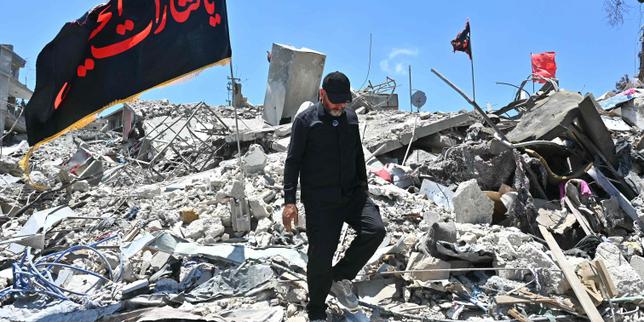
The scent of a home after it ceases to be a home is something the nostrils never truly unlearn. It is a suffocating mixture of pulverized concrete, charred synthetic fabric, and the sharp, metallic tang of old copper pipes exposed to the sun. For Mohamad Taqi, that smell became the boundary line between the life he knew and the void he now inhabits.
On a March afternoon in southern Lebanon, Mohamad was sitting on his front porch. The air carried the slight chill of early spring, the kind that makes a warm cup of tea feel like a quiet luxury. Inside the house, life was moving in its usual, predictable rhythms. His mother, 78-year-old Zeinab, was there. His four daughters—Zeinab, Zahraa, Malika, and Yasmina—were scattered across the rooms, their voices drifting out to the porch in bursts of laughter and standard household chatter. They were fourteen, twelve, nine, and six years old.
Then, the sky tore open.
There was no siren. No text message warning. No whistle of an incoming projectile to offer a three-second window for a frantic prayer. Just a sudden, catastrophic pressure that flattened the world into gray dust and deafening silence.
When Mohamad finally managed to stand up through the fog of debris, the house was gone. Not damaged. Not crumbling. Gone. In its place lay a crater surrounded by scattered fragments of concrete that looked like gravel. He began digging with his bare hands, clawing through the gray powder until he found six-year-old Yasmina. Her breathing was shallow, a faint rhythm against the silence of the afternoon. She was rushed to a hospital, but the mountain of rubble held the rest of his world. Malika was already gone. His other daughters, his parents, his brother—eight family members in total—vanished into the ledger of a single afternoon strike in Nabatieh.
We often consume conflict through statistics. We read about numbers on a screen, body counts tallied by ministries, and legal declarations issued from offices in London or The Hague. But international law exists because of afternoons like the one Mohamad survived.
A newly released investigation by Amnesty International has cast a harsh, unyielding light on a series of three specific Israeli airstrikes that tore through southern Lebanon between March 6 and March 13. The findings paint a devastating picture. Across these three attacks—striking residential neighborhoods in Tyre, Saida, and Nabatieh—24 civilians were killed.
Twelve of them were children.
The defense ministries of the world use sterile vocabulary to describe these events. They speak of "mitigating harm," "operational activity," and "examination of allegations." When Amnesty pushed for specifics regarding what military targets could possibly justify flattening these homes, the responses remained frustratingly vague. Some strikes were attributed to "Hezbollah military objectives," while others were simply "referred for examination."
But human rights investigators who walked the craters, interviewed fifteen survivors, and sifted through the wreckage found a different reality. There were no weapons caches in the basements. There were no rocket launchers hidden in the gardens. There were only families trying to outlast a war that had already claimed thousands of lives across the region.
Consider the legal framework that governs modern warfare. It sounds complex, filled with Latin phrases and dense treaties, but its core principle is simple enough for a child to understand: you must separate the fighters from the families. International humanitarian law dictates that forces must distinguish between military targets and civilian objects at all times. If there is doubt, protection must be the default.
To launch an attack without that distinction—or to fail to take every feasible precaution to protect the innocent—is not just a tragic miscalculation. It is a violation of international law. Amnesty is now calling for these specific March strikes to be formally investigated as war crimes.
The real problem lies elsewhere, buried under a layers of geopolitical inertia. A call for an investigation is only as powerful as the willingness of nations to enforce it. For years, the civilian populations of southern Lebanon have lived under a sky that feels less like an atmosphere and more like a ceiling waiting to fall. Even as high-level diplomatic frameworks and ceasefires are negotiated in distant capitals, the reality on the ground remains fractured. The bombs still fall intermittently, turning family trees into historical footnotes in the span of a single second.
The push for accountability requires more than just local outcries; it demands that nations holding leverage step forward. Human rights advocates are urging the international community to enact a comprehensive arms embargo and to utilize universal jurisdiction to ensure that those who command these strikes are held responsible.
Without that accountability, the laws written on parchment in Geneva remain entirely abstract to the people sleeping in Tyre or Saida. They do not protect the pregnant woman who died in the March strikes, nor do they bring back the children whose laughter was silenced before the spring could fully arrive.
Mohamad Taqi spent three days after the blast gathering what remained of his family from the dirt. He remarks to anyone who will listen that his entire life was destroyed without a whisper of warning. His words linger long after the news cycle moves on to another briefing or a new political statement.
The true cost of these strikes is not measured in the currency of geopolitical strategy or territorial security. It is measured in the silence of a house where four sisters used to play, and in the dirt under the fingernails of a father who had to dig them out.