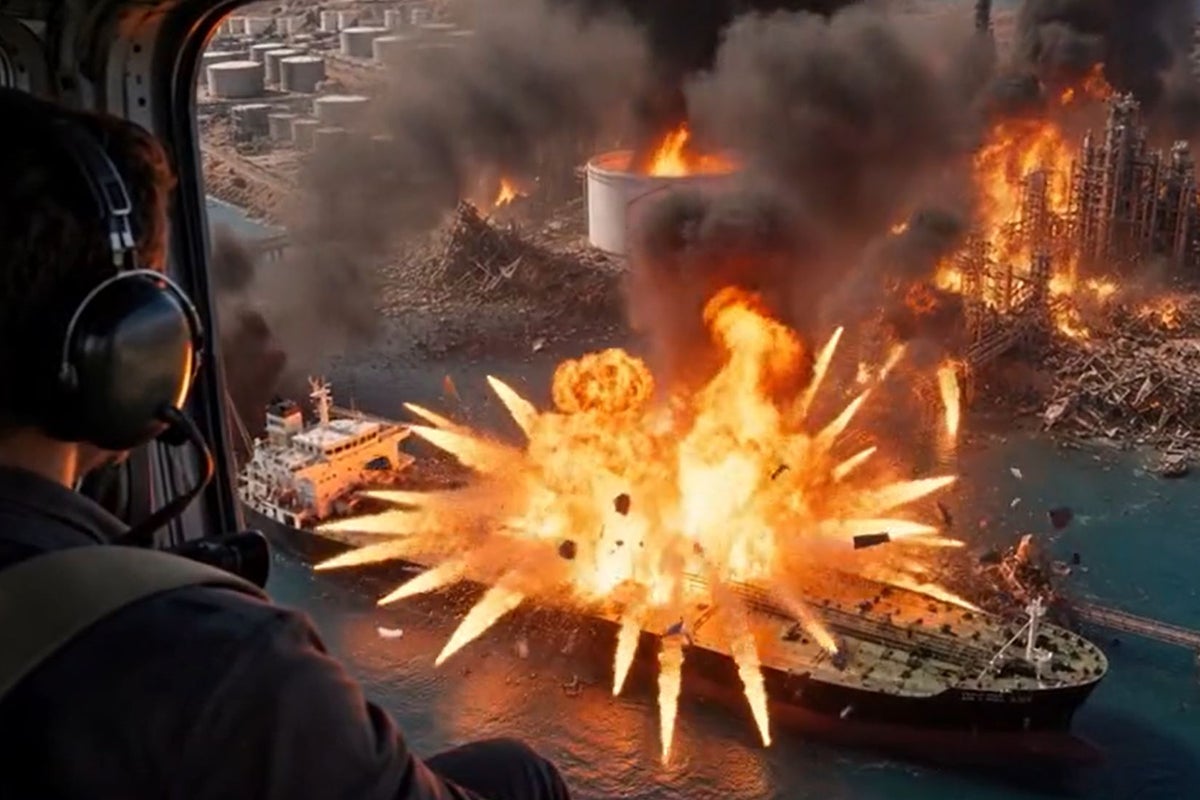
The media machine is having a collective meltdown over a digital clip. The headlines shriek that Donald Trump posted a synthetic video depicting Iran's Kharg Island vanishing under fiery explosions, complete with captions celebrating its simulated demise. Pundits are rushing to label it a blunder, a fake, or the cognitive misfire of a leader playing with dangerous digital toys.
They are missing the plot entirely.
Focusing on the artificial nature of the footage is a beginner's mistake. It treats statecraft like a movie review. This is not about pixels or deepfakes; it is about asymmetric psychological warfare executed in broad daylight. While mainstream analysts waste column inches pointing out that the clip was generated by software, they completely ignore the structural reality of what Kharg Island represents to Tehran and why projecting its destruction matters more than actually doing it.
The Economics of Phantom Destruction
Let us look at the asset. Kharg Island is not just a piece of land; it is the economic jugular of the Iranian state, handling the vast majority of its crude oil exports. Real kinetic strikes on that infrastructure carry catastrophic escalation risks, massive oil price spikes, and secondary global economic shockwaves that no administration wants to manage lightly.
So what do you do when you want to deter an adversary actively plotting to mine the Strait of Hormuz? You do not necessarily spend billions in ordnance right away. You weaponize expectation.
Imagine a scenario where a poker player slides their chips forward, not with a real hand, but with a terrifyingly convincing bluff that forces the table to fold. That is what is happening here. By broadcasting the synthetic obliteration of Iran's primary economic lifeline right after real kinetic strikes on Larak Island, the administration accomplished three distinct objectives without deploying a single extra warhead:
- Cost-Free Deterrence: It signals to the Islamic Revolutionary Guard Corps that their crown jewel is locked in the crosshairs, creating internal panic and strategic paralysis.
- Market Signaling: It forces energy traders and foreign buyers to price in the existential vulnerability of Iranian oil supply lines instantly.
- The Narrative Monopoly: It shifts the battlefield from narrow shipping lanes to the cognitive space, dominating the news cycle and eclipsing whatever retaliatory moves Tehran attempts.
The Lazy Consensus Exposed
The mainstream critique relies on a lazy assumption: that leaders must only communicate via formal diplomatic cables or verified Department of Defense press releases. That playbook belongs in the last century.
When critics scoff that "the video is fake," they reveal a profound misunderstanding of modern deterrence. Deterrence has never been purely about reality; it is about perception and the adversary's fear of what comes next. Tehran does not care whether the clip was rendered in a software suite or filmed from an F-35 cockpit. They care that the sitting President of the United States is openly publishing a blueprint for their complete economic annihilation to millions of people, unprompted, right after American forces hit their missile launchers.
That is not a technical error. That is psychological dominance.
Treasury Secretary Scott Bessent is concurrently rolling out aggressive secondary banking sanctions designed to starve the regime of capital. The digital video functions as the loud, blunt hammer paired with the quiet, surgical scalpel of financial strangulation. It sets a ceiling on Tehran's appetite for risk. If you are an Iranian shipping commander watching your leadership weigh a response in the Persian Gulf, a simulated island explosion playing on your phone screen is a far more visceral deterrent than a dry memo from the State Department.
Stop analyzing statecraft through the lens of media literacy classes. The goal was never to fool a forensics lab; the goal was to send a message written in fire, real or rendered.
Wake up and look at the scoreboard.