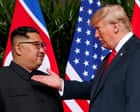
Donald Trump recently claimed he’s in talks with North Korean leader Kim Jong-un. He says Kim responded to his request for a conversation. Then, the silence from Pyongyang was deafening. Finally, Kim Yo-jong, the supreme leader’s sister and a top official, broke that silence. She didn't just walk back the claim; she essentially left it hanging in the wind.
She said she is "completely unaware" of any such communication.
This isn't just a simple disagreement over a phone call. It’s a high-stakes performance. To understand why this matters right now, you have to look at the motivation behind Trump's recent decision to slash the scale of annual joint military drills with South Korea. He’s looking for a win. He wants a headline. But North Korea isn't handing out freebies anymore.
The Reality Behind the Rhetoric
Why would Trump announce these secret talks? It’s classic diplomacy theater. He’s trying to manage two very different audiences. First, he’s speaking to his base, signaling that his personal rapport with Kim is still a viable tool for de-escalation. Second, he’s sending a message to Seoul. By scaling back the Ulchi Freedom Shield exercises, he’s punishing South Korea for its refusal to join the recent U.S.-led operation against Iran.
It’s a blunt instrument of policy. He thinks by weakening the alliance, he buys leverage with Pyongyang.
Kim Yo-jong’s response tells us exactly what North Korea thinks of this strategy. She didn't use the usual fire-and-brimstone language they've been known for in the past. She was measured. She acknowledged that her brother and Trump have "great" relations and that Kim still harbors "positive memories" of their time together.
This isn't an accident. Pyongyang knows exactly what they are doing. They are keeping the door cracked just enough to stay relevant but refusing to walk through it without concrete, massive concessions. They don't care that the drills are shorter or smaller. To them, the presence of these exercises is an affront to their sovereignty. A five-day drill instead of an eleven-day one? It doesn't change the nature of the training in their eyes.
Why North Korea Holds the Cards
We have to face the facts. The 2018-2019 era of summitry is over. Back then, North Korea was desperate for sanctions relief. Today, the world has shifted. Kim Jong-un has built a powerful, if isolated, network of support. His alliance with Russia has changed the math entirely.
When you look at the evidence, the motivation for North Korea to rush back to the table with a mercurial U.S. president is low. They have weapons, they have fuel from Moscow, and they have the tacit support of Beijing. Why trade that for the uncertainty of a photo-op in a country that changes its strategy every time the White House changes occupants?
Kim Yo-jong’s specific denial of troop deployments to Ukraine also signals that Pyongyang is managing its reputation carefully. They aren't just a reclusive hermit kingdom anymore. They are a strategic player in a global conflict.
The Disconnect in Washington
The confusion in the Oval Office is palpable. Reporters asked Trump directly if he had heard back from Kim. His answer was a definitive, "Yeah, he has." Then, he refused to offer any proof or detail.
This creates a dangerous gap between perception and reality. If a president insists a conversation is happening and the other side denies it, one of three things is true. Either there’s a backchannel no one knows about, the communication is so vague it doesn't qualify as a "talk" to the North Koreans, or the president is simply creating a narrative to shift the news cycle.
If you are trying to parse what comes next, stop looking for "secret talks." Start looking at the military posture.
Practical Steps to Watch
Don't buy into the headlines about a "breakthrough." If you want to understand the trajectory of U.S.-North Korea relations over the next few months, keep your eye on these three indicators:
- Military Exercises. Look beyond the duration. If the U.S. continues to pare down the exercises to punish Seoul, watch how Pyongyang reacts. If they stay quiet, it means they are enjoying the friction between the U.S. and its allies. If they start testing missiles again, the "friendly" phase is officially dead.
- Third-Party Alignment. Keep track of North Korea's activity with Russia and China. If trade or military cooperation increases, you can bet that Kim feels less pressure to engage with Washington.
- The APEC Summit. Trump has floated the idea of a meeting later this year, potentially during his trip to the Asia-Pacific Economic Cooperation summit. If that meeting is actually scheduled, it will be the only proof that matters. Until then, everything else is just noise.
The diplomatic landscape in 2026 is far more complex than the summit-chasing of the past. The stakes are higher, the alliances are more fragile, and North Korea is no longer acting like a supplicant. If you're betting on a quick resolution, you’re looking at the wrong map. This is a long, slow game of attrition where the only thing that actually counts is what happens on the ground, not what gets posted on a social media feed.