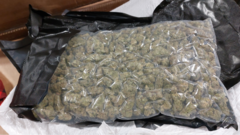
Governments love a good crackdown. It looks great on a press release. It satisfies the tough-on-crime voters. It gives border officials a chance to pose next to confiscated luggage full of shrink-wrapped weed.
But the mainstream media's fixation on tougher penalties for drug mules smuggling cannabis out of Thailand completely misses how global supply chains operate.
The standard narrative goes like this: Thailand legalized cannabis in 2022, creating a massive surplus. Smugglers recruit low-level couriers to fly bags of "Thai stick" or high-grade exotic flower into countries with strict prohibition, like the UK or parts of East Asia. To stop this, authorities claim they just need to lock these mules up for longer, beef up airport security, and make the penalties so draconian that no one will dare risk the trip.
It is a comforting lie. It assumes that drug smuggling is a problem of individual morality and deterrence.
It is not. It is a problem of arbitrage.
As an industry insider who has watched international supply chains adjust to legalization, prohibition, and everything in between, I can tell you that trying to stop the flow of Thai cannabis by punishing couriers is like trying to stop the tide with a broom. The math does not work, the economics do not work, and the policy is dead on arrival.
The Flawed Premise of Deterrence Economics
Law enforcement agencies operate on a flawed economic model. They believe that if you increase the risk (longer prison sentences), you decrease the supply of couriers.
In reality, you only increase the risk premium.
Basic economics dictates that when the risk of a venture increases, the payout must rise to compensate. International syndicates do not look at a new law and decide to close shop. They adjust their spreadsheets. If a courier used to cost $5,000 to fly from Bangkok to London, increased enforcement simply pushes that fee to $10,000 or $15,000.
There is an endless supply of desperate, economically vulnerable people worldwide who will take that gamble, regardless of whether the sentence is five years or fifteen. You are not shrinking the pool of mules; you are just filtering for more desperate people.
The Arbitrage Engine
To understand why this crack-down strategy fails, look at the price disconnect. This is pure arbitrage.
In Bangkok, the market is severely oversupplied. Dispensaries sit on every corner. Wholesale prices for mid-to-high-grade flower have plummeted over the last few years as production outpaced domestic demand. You can buy a kilogram of decent flower in Thailand for a fraction of what it commands on the illicit market in a prohibitionist country.
When a product costs $1,000 to acquire in Market A and can be sold for $15,000 in Market B, the economic gravity is too strong to contain. The profit margin easily absorbs the loss of a few intercepted couriers, the cost of higher payouts, and the price of sophisticated concealment methods.
When customs officials boast about a "major bust" at the airport, they are celebrating a tax. Syndicates view intercepted shipments as a standard cost of doing business. If nine out of ten couriers make it through, the operation remains wildly profitable.
The True Cost of the War on Mules
Focusing enforcement on the airport terminal creates a massive blind spot. While border agents spend hours parsing through suitcases and interrogating nervous 22-year-olds, the real volume bypasses them entirely.
If you want to move serious weight, you do not use commercial airlines. You use maritime shipping. You use international postal networks. You hide the product inside legitimate commercial cargo where the sheer volume of trade makes 100% inspection impossible.
By hyper-focusing on the visible, media-friendly narrative of the airport drug mule, governments waste limited law enforcement resources on the lowest tier of the supply chain. The couriers are entirely replaceable. They know nothing about the structure of the organization. They do not know who grew the product, who packaged it, or who is distributing it on the other side.
Arresting them changes absolutely nothing about the infrastructure of the illicit trade. It fills prison cells with low-level offenders while the actual distributors continue operating with impunity.
The Inevitable Evolution of the Market
What happens if a government actually succeeds in making air smuggling too difficult? The trade adapts.
We saw this during the height of the war on drugs in South America, and we see it now. If the raw flower becomes too risky to move, syndicates shift to concentrates, oils, and vapes. These products are smaller, less aromatic, and significantly easier to conceal in large quantities. A single suitcase of high-potency THC distillate can contain the economic value of dozens of suitcases of raw flower.
By raising the stakes on flower smuggling, authorities inadvertently incentivize traffickers to move toward more potent, processed, and unregulated synthetic variants. It is the classic iron law of prohibition: the harder the enforcement, the more potent the illicit substance becomes.
Stop Targeting the Symptom
The public frequently asks: "How do we stop the influx of illegal cannabis from Thailand?"
The question itself is broken. You cannot stop it through border control.
The only way to eliminate the illicit pipeline is to eliminate the price differential that funds it. That means either Thai authorities must radically restructure their domestic market to curb overproduction—a move that faces massive resistance from a multi-billion dollar domestic agricultural lobby—or destination countries must reconsider their own prohibition models.
Until one of those two things happens, the arbitrage engine will keep humming along.
So keep building longer prison cells. Keep writing aggressive headlines about tougher penalties. Keep holding press conferences behind tables piled high with vacuum-sealed bags. The syndicates are not watching. They are busy booking the next flight.