The sun over Stamford Hill didn’t signal a tragedy. It was a standard Friday, the kind where the air carries the scent of baking challah and the rhythmic hum of a neighborhood preparing for the Sabbath. In this corner of North London, the passage of time is marked by ritual. It is marked by the sight of men in traditional long coats and dark hats walking with purpose. Peace is the baseline.
Then the screaming started.
Violence is always a rupture, but here, it felt like a tear in the very fabric of a sanctuary. Within moments, the ordinary afternoon collapsed. Two Jewish men, aged 50 and 30, were targeted in what should have been a safe corridor of their own community. The weapon was a knife. The motive, according to the investigators who would later swarm the cordons, was rooted in the darkest corners of ideology.
The blood on the pavement was real. The fear that radiated outward through the streets of Hackney was even more tangible.
The Anatomy of a Second
When we read a headline about a "terror incident," we often process it as a data point. A statistic. A fleeting moment of concern before we scroll to the next update. But for those standing on the street, the world didn't move in headlines. It moved in heartbeats.
Consider the perspective of a shopkeeper watching from a window. One moment, the street is a familiar map of neighbors. The next, it is a crime scene. The speed of a stabbing is hypnotic in its horror; there is no time for a philosophical debate on the rise of antisemitism or the complexities of urban security. There is only the primal instinct to run, to hide, or to help.
The victims weren't just "Jewish men." They were fathers, sons, colleagues. They were individuals who had woken up that morning concerned with the mundane—perhaps a work deadline, a family dinner, or the encroaching quiet of the weekend. That normalcy was stripped away by a blade.
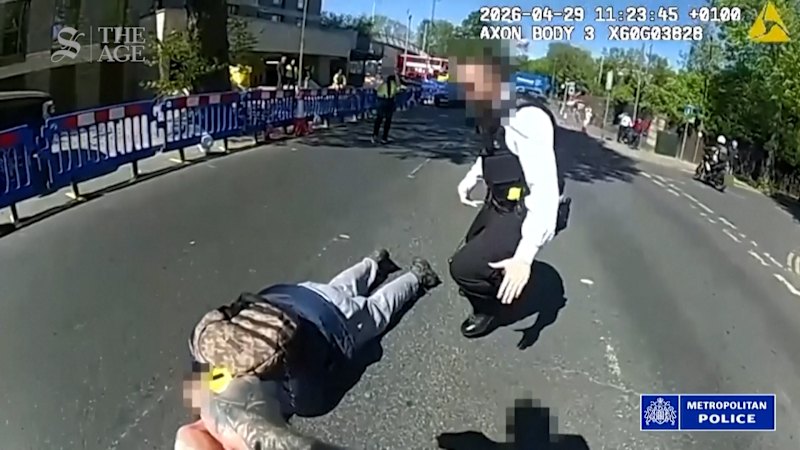
Emergency services arrived with the frantic precision that defines London’s first responders. The victims were rushed to the hospital. The wounds were deep, but the psychological scarring of the neighborhood ran deeper. This wasn't just an assault on two bodies; it was an assault on the collective sense of safety that allows a community to exist.
The Invisible Stakes
We talk about "radicalization" as if it is a weather pattern—something that happens over us, out of our control. We treat it as an abstract noun. It isn't. Radicalization is a deliberate poisoning of the well.
The suspect, a man in his late 20s, was apprehended relatively quickly. The police eventually declared it a terrorist incident. That label changes everything. It elevates a crime from a local tragedy to a national wound. It means the intent wasn't just to harm two people, but to send a message of terror to thousands.
Why Stamford Hill? The answer is as obvious as it is painful. It is a visible center of Jewish life. To strike there is to strike at the heart of an identity.
The invisible stakes are the quiet conversations that happen the next day. It’s the mother who hesitates for a split second before letting her son walk to the synagogue alone. It’s the elderly man who looks over his shoulder twice while crossing the road. This is the "tax" that terrorism leeches from a free society. It steals our ease. It replaces our trust with a low-level, vibrating anxiety.
The Response to the Rupture
London is a city that prides itself on resilience, but resilience is an exhausting requirement.
In the aftermath of the stabbings, the Metropolitan Police flooded the area. Extra patrols. Increased visibility. Meeting with communal leaders. These are the tools of the state, and they are necessary. They provide a physical shield. But they cannot mend the underlying fracture.
There is a specific kind of silence that follows a terror attack. It’s a heavy, expectant silence. People wait to see how the world will react. Will it be met with a shrug? Will it be lost in the noise of a twenty-four-hour news cycle? Or will it be recognized for what it is: a brutal reminder that the demons of hatred are never truly dormant?
The suspect remains in custody. The legal machinery will grind forward. There will be hearings, evidence logs, and eventually, a trial. But the courtroom cannot address the "why." It can only address the "who" and the "what." The "why" is a much larger, much more uncomfortable conversation about how a person living in a modern, multicultural city decides that his neighbors deserve to die for their faith.
The Fragility of the Sabbath
The Jewish Sabbath, Shabbat, is meant to be a cathedral in time—a day of rest, reflection, and separation from the chaos of the world.
When the sun set on that particular Friday, the ritual went on. The candles were lit. The prayers were said. But the windows were locked a little tighter. The songs were sung with a bit more gravity.
Hatred succeeds when it forces us to change who we are. If the community in Stamford Hill stopped wearing their traditional dress, or stopped walking those streets, the attacker would have won his long-term goal. The defiance, then, is found in the continuation of the ordinary.
The two men who were attacked are recovering. Their physical wounds will heal, though the body never truly forgets the cold touch of steel. The neighborhood will continue to bake its bread and walk its streets.
But the memory of that afternoon remains. It sits there, a jagged reminder that the peace we take for granted is held together by a very thin thread. We live in a world where a walk to the store can turn into a battleground, not because of a lack of police, but because of a surplus of hate.
The real story isn't the arrest. It isn't the police cordon. It is the persistent, stubborn light of a community that refuses to be flickered out by a shadow with a knife.
The street is quiet now. The sirens have faded. The challah is being served. But under the table, the hands are still shaking.