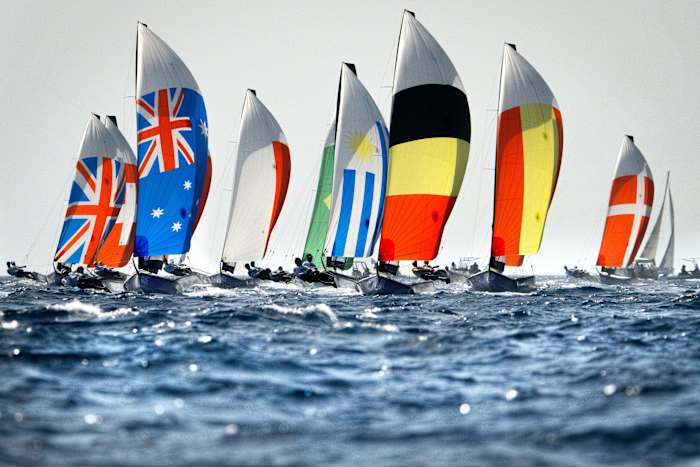
World Sailing wants a medal for counting its carbon. The governing body recently made waves by announcing a "first-of-its-kind" Life Cycle Assessment (LCA) to measure the environmental impact of Olympic-class equipment. They are rolling out tools like MarineShift360 to scrutinize everything from the PVC foam in an ILCA dinghy to the carbon fiber weave of a Nacra 17. By 2032, independent LCA data will be a mandatory prerequisite for Olympic selection.
It sounds progressive. It reads like a blueprint for environmental stewardship.
It is a complete distraction.
By obsessing over the materials used to build elite boats, the federation is falling into a classic corporate trap: fixing the minor, visible problem while ignoring the massive systemic monster in the room. They are hunting down kilograms of fiberglass while ignoring the metric tons of aviation fuel burned to get those boats to the starting line.
Focusing on hull materials to save the oceans is like using a paper straw to drink a milkshake while sitting in an idling diesel truck.
The Math of Environmental Greenwashing
Let's dissect the actual footprint of elite sport. I have spent years analyzing performance supply chains, and the data always reveals the same inconvenient truth: manufacturing is a fraction of the problem.
The International Laser Class Association is actively testing whether they can swap out high-density PVC foam for recycled PET plastic. Imagine a scenario where every single Olympic boat converts to 100% bio-sourced or recycled composites. What happens to the global carbon ledger? Virtually nothing.
The absolute volume of Olympic-class sailing equipment manufactured globally each year is minuscule. We are not talking about mass-market automotive production or consumer electronics. We are talking about a few thousand highly specialized, ultra-performance hulls worldwide. The total embodied energy of the entire global Olympic fleet is a rounding error compared to a single weekend of commercial aviation operations.
Yet, World Sailing's strategy places the burden of proof on the boat builders.
"We are putting data behind every decision," the consultants claim.
But they are collecting the wrong data from the wrong people. By centering the conversation on whether a mast or a sail can be recycled at the end of its four-year cycle, the sport completely abdicates responsibility for its actual, ongoing carbon engine: hyper-mobility.
The Real Culprit is the Calendar, Not the Composite
An elite sailor does not just buy a boat and sit on a local lake. Olympic campaigning is a logistical nightmare masquerading as a sporting journey. To be competitive, an athlete needs multiple hulls, masts, and foils scattered across global training hubs.
Consider the average itinerary of a top-tier campaign over a four-year cycle:
- Continuous Transport: Equipment is constantly packed into shipping containers and sent across oceans to various World Cup events, European Championships, and localized test events.
- Aviation Footprint: Athletes, coaches, support staff, physiotherapists, and judges fly hundreds of thousands of miles annually.
- Chase Boats: Every single elite sailing coach spends hours every day idling a high-horsepower, petrol-burning rigid inflatable boat (RIB) right next to the "clean, green" wind-powered sailboat.
Stuart Parkinson, executive director of Scientists for Global Responsibility, notes a reality that sports federations consistently ignore: the overwhelming majority of emissions from international sports events stem from travel, particularly air travel.
If World Sailing actually cared about immediate, drastic reductions in its environmental footprint, it wouldn't start by auditing the resin mix of a fiberglass hull in 2032. It would cancel half the international calendar tomorrow.
Instead of flying hundreds of teams to disparate corners of the globe for fractional ranking points, they would mandate regionalized qualifying circuits. But doing that threatens sponsorship revenue, broadcast rights, and municipal host fees. It is far easier to tell a niche manufacturer in Europe to buy an expensive software license to track their scrap carbon fiber than it is to dismantle a lucrative, carbon-heavy global tour.
Why the Tech Cascade Flow is Flawed
The defense of these equipment-focused LCAs always relies on the trickle-down argument. Academic advocates suggest that forcing Olympic suppliers to invent circular materials will create a ripple effect, forcing the broader recreational boating sector to clean up its act.
This ignores how industrial manufacturing actually scales.
The marine industry does not build production cruising yachts or commercial vessels using the hyper-expensive, specialized techniques used for Olympic skiffs and foiling boards. A breakthrough in recycling an Olympic-grade carbon foil does not magically translate into cheaper, cleaner manufacturing for a 40-foot family production boat. The material properties, safety margins, and economic realities are entirely different.
Furthermore, forcing niche builders to adopt expensive, independently verified LCAs will inevitably consolidate the market. Small, artisan builders who cannot afford the compliance overhead will drop out. You do not get a greener sport this way; you just get a more corporate, exclusive sport where only a handful of well-funded monopolies can afford to supply the equipment.
The Unintended Downside of Standardization
There is another dark side to this administrative push for green standards. When you codify strict environmental metrics into equipment rules, you lock in the existing technological status quo.
Right now, an athlete like Dave Hughes notes that sailors buy equipment in multiples to find the absolute best mast or sail to gain a competitive edge, leading to waste. World Sailing's proposed solution is tighter manufacturing standards to eliminate variation.
But variation is exactly where disruptive innovation happens. If you eliminate tolerance variations and force every builder to adhere to a rigid, pre-approved LCA template, you kill the incentive to experiment with genuinely radical, alternative designs. You create a bureaucratic monoculture where equipment is standardized to the point of stagnation, all under the guise of saving carbon.
Disrupting the Status Quo
If we want to stop playing defense with PR campaigns disguised as science, we need to alter the structural rules of the game. Here is how you actually reduce the impact of elite sailing without the corporate theater:
1. Charter-Only Major Regattas
Stop allowing teams to ship their own bespoke setups across the globe. For major international events, the organizing body should provide a single pool of identical, locally manufactured, reusable charter boats. Athletes show up with their personal apparel and a set of sails. This immediately deletes the ocean-freight footprint of hundreds of separate shipping containers.
2. Cap the Support Fleet
Ban the ocean-going, gas-guzzling coach boats. Mandate shared, electric-propulsion tracking vessels for safety marshals and coaches alike. The sight of thirty 200-horsepower outboards chasing five wind-powered dinghies around a course should be an obsolete relic of the past.
3. Decentralize the Campaign
Reward teams that train locally. Alter the Olympic qualification system to heavily penalize athletes who rack up excessive air miles. Introduce a "logistical passport" that tracks a campaign's total travel distance, capping it to force teams to base operations out of single geographic hubs for longer periods.
Sailing has a beautiful, intrinsic connection to the elements. Relying on the wind is a masterclass in clean kinetic energy. But let’s drop the delusion that a bureaucratic audit of a boat’s hull construction is going to protect the oceans. Until the sport confronts its addiction to global aviation and relentless logistical movement, every single LCA report it publishes is just premium paper over a massive carbon crack. Stop measuring the boat. Start measuring the passport.