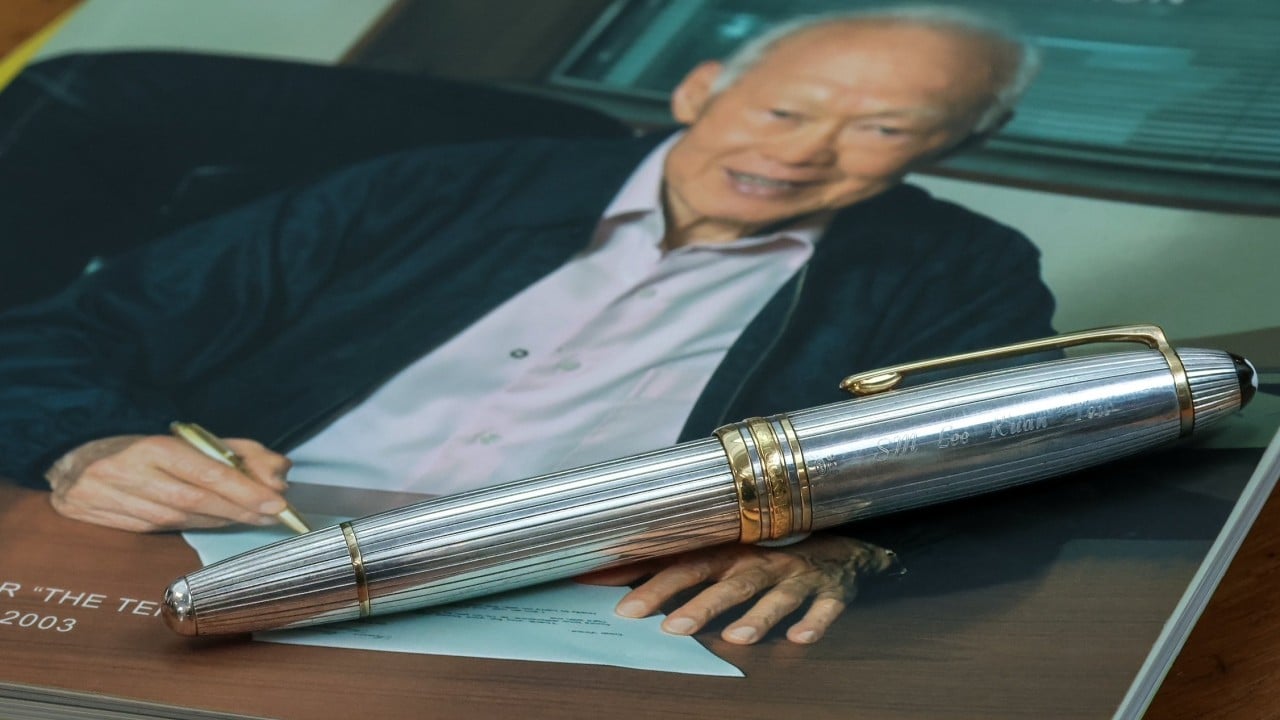
A single fountain pen just fetched a staggering US$360,000 at a Singapore auction. Not because it was encrusted with rare diamonds. Not because it was forged from solid gold. It commanded that price because it belonged to Lee Kuan Yew.
The item in question is a sterling silver Montblanc Meisterstück No. 146. It drew a fierce 111 bids, eventually selling for nearly ten times its highest estimated valuation. That kind of bidding frenzy tells us something fascinating about modern political memorabilia, the economy of legacy, and how deeply Singapore's founding prime minister remains tied to the national psyche. You might also find this similar article interesting: Five Years Under the Shadow of the Taliban Regime.
The Power of Ordinary Objects with Extraordinary Provenance
Most luxury collectibles rely on brand prestige or material rarity. A standard silver Montblanc Meisterstück holds decent secondary market value, but it is hardly a half-million-dollar asset. Add the ghost of a historical titan to the equation, and the math changes completely.
Lee Kuan Yew wasn't known for flashiness. He governed with a stark, pragmatic, no-nonsense efficiency that shaped modern Singapore from a swampy port into a global financial powerhouse. He wasn't a collector of luxury trinkets. He used tools that worked. When a utilitarian object like a fountain pen links directly to his daily statecraft, it transforms from a writing instrument into a cultural artifact. As extensively documented in recent articles by Al Jazeera, the effects are worth noting.
People crave tangible connections to history. Statues and museums feel distant and sterile. A pen that likely signed policy documents, redrawn maps, and trade agreements? That feels alive.
Why the Bidding Went Astronomical
Auctions for political items often surprise observers, but a tenfold markup defies normal market logic. Why did this happen?
Scarcity is the obvious driver. Personal items belonging to Lee Kuan Yew rarely circulate on the open market. His family has largely guarded his estate, making public offerings exceptionally rare events. When collectors realize an opportunity will likely never repeat itself, money stops being a rational constraint.
National sentiment plays an equally massive role. Singapore's identity is inextricably bound to Lee's personal legacy. For wealthy collectors and patriotic investors within the region, owning his personal effects functions as a badge of honor and a physical anchor to the nation's founding era.
Think about what a pen represents to a leader like him. It represents authority. Decisions made in ink that could alter shipping lanes, economic zones, and housing policies for millions of citizens. Bidders weren't buying silver. They were buying the instrument of a legacy.
The Market for Modern Political Relics
We are seeing a massive shift in how historical value is measured. Ancient antiquities used to dominate high-end auction houses. Today, items from the late 20th century command insane premiums.
The digital age makes physical permanence scarce. Everything is logged in the cloud, typed on keyboards, or sent via encrypted messaging apps. A heavy, hand-held silver pen feels heavy with intention. It represents an era when governance happened on paper, signed by hand, with permanent consequences.
When you look at the winning bid of US$360,000, you aren't just looking at the price of a luxury pen. You are looking at a market valuation of modern history. As time moves further away from Singapore's foundational decades, items touched by its primary architect will only grow heavier in myth and market value.
If you plan on collecting historical artifacts, pay attention to provenance over raw materials. The object itself matters far less than whose hand held it, and what history was written when they did.