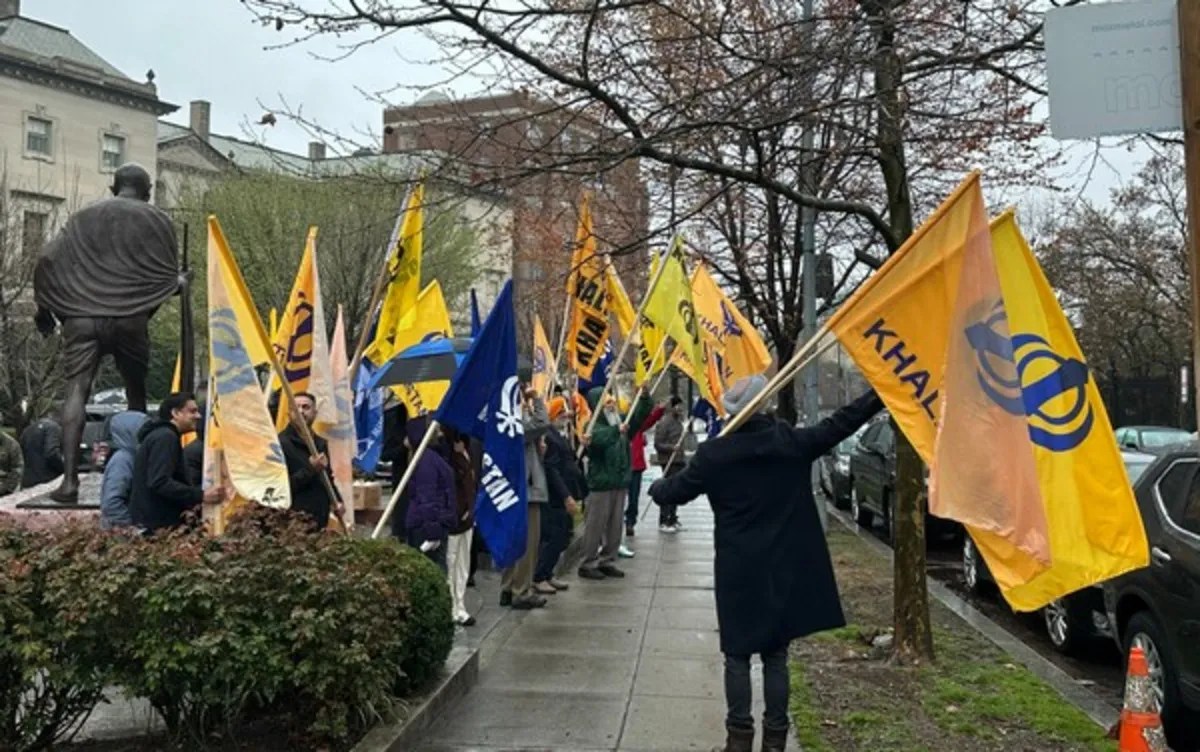
A quiet street in Surrey, British Columbia, doesn't look like a geopolitical fault line. It looks like any other slice of North American suburbia—manicured lawns, SUVs in driveways, and the faint smell of pine needles in the air. But under this veneer of domestic peace, a storm has been brewing for decades, one that has finally forced the Canadian Security Intelligence Service (CSIS) to step out of the shadows and voice a warning that should have been heard years ago.
The warning is blunt. Khalistani extremism is not just a "foreign issue" or a distant echo of Punjab’s history. It is a domestic threat to the national security of Canada.
To understand why this matters, we have to look past the political rallies and the colorful flags. We have to look at the people caught in the middle. Consider a hypothetical shopkeeper in Brampton, let's call him Arjun. Arjun moved to Canada for the same reason everyone does: a better life. He pays his taxes, coaches his daughter’s soccer team, and keeps his head down. But lately, the air in his community has grown heavy. He sees posters that glorify violence. He hears whispers at the local community center about who is "loyal" and who is a "traitor."
When radicalism takes root in a diaspora, it doesn’t just target the "enemy" thousands of miles away. It targets the Arjuns of the world first. It poisons the local well.
The Intelligence Pivot
For a long time, the official stance in Ottawa was one of cautious observation. There was a sense that as long as the friction stayed within the community, it wasn't a "Canadian" problem. That illusion has shattered. The latest intelligence assessments indicate that the activities of Khalistani extremists have crossed a line from protected political speech into something far more jagged and dangerous.
The threat is multi-dimensional. It involves the radicalization of youth who have never even set foot in India, the funneling of unregulated funds, and the use of digital platforms to coordinate intimidation. This isn't just about a few angry men in a basement. This is a sophisticated network that leverages the very freedoms Canada provides—freedom of speech, freedom of assembly—to undermine the safety of those same citizens.
CSIS doesn't use the word "threat" lightly. When an intelligence agency identifies a group as a danger to national security, it means they have seen the blueprints. They have tracked the money. They have monitored the recruitment.
A Digital Battlefield
The modern extremist doesn't need a mountain hideout. They need a smartphone and a high-speed connection.
The battle for the soul of the Sikh diaspora is being fought on Telegram, WhatsApp, and encrypted forums. Here, the narrative is carefully curated. Historical grievances are weaponized. Complex geopolitical realities are flattened into "us versus them" memes. For a teenager sitting in a bedroom in Mississauga, feeling disconnected from their heritage and looking for a sense of belonging, these digital echo chambers are a siren song.
They offer a clear identity and a clear enemy.
But the real-world consequences are anything but virtual. We are seeing a rise in targeted harassment of those who speak out against the separatist narrative. Journalists have been threatened. Scholars have been silenced. When a community becomes too afraid to debate its own future, the extremists have already won a significant victory.
The invisible stakes are the loss of democratic pluralism within the Indo-Canadian community itself. If you can only hold one opinion without fearing for your safety, you aren't living in a free society. You are living in a fiefdom.
The Geopolitical Ripple Effect
Canada has often prided itself on being a "cultural mosaic," a place where people can bring their cultures and histories with them. It is a beautiful ideal. But what happens when someone brings a blood feud?
The tension between New Delhi and Ottawa is no longer a diplomatic spat over trade or visas. It is a fundamental disagreement over where the line between activism and terrorism is drawn. India has long complained that Canada has become a "safe haven" for those seeking to destabilize the Punjab region. Canada, meanwhile, has struggled to balance its commitment to civil liberties with the need to crack down on violent rhetoric.
But the CSIS report suggests that the "safe haven" argument is gaining weight within the Canadian government's own walls. The intelligence suggests that foreign interference is a two-way street. While Canada worries about foreign governments reaching into its borders, it must also worry about groups within its borders reaching out to cause chaos elsewhere.
It is a messy, tangled web.
The Weight of History
We cannot ignore the ghost of 1985. The bombing of Air India Flight 182 remains the deadliest terrorist attack in Canadian history. 329 people vanished into the Atlantic Ocean. Most of them were Canadians.
For many, that tragedy is a distant chapter in a history book. For the families of the victims, it is a wound that never closed. The rise of Khalistani extremism today feels like a cold wind blowing from the past. It serves as a reminder that when radicalism is allowed to fester under the guise of political grievance, the end result is often measured in lives lost.
The current intelligence warning is an attempt to prevent history from repeating itself. It is a signal that the "wait and see" approach has failed.
Beyond the Headlines
If you talk to the average person in the community, they are tired. They are tired of being defined by the loudest, most radical voices in the room. They are tired of the suspicion that falls on their entire faith because of the actions of a few.
The tragedy of this situation is that the vast majority of Sikhs in Canada are seeking the same things everyone else is: peace, prosperity, and a future for their children. They are the ones who suffer the most when their community centers are co-opted or when their neighborhoods become synonymous with extremism in the national press.
The invisible cost is the erosion of trust. Trust between neighbors, trust between the community and the police, and trust between Canada and the world.
The path forward isn't found in more rhetoric or more flags. It’s found in the difficult, unglamorous work of deradicalization. It’s found in protecting the Arjuns of the world so they can speak their minds without looking over their shoulders. It’s found in acknowledging that national security isn't just about borders and bombs—it's about the safety of a shopkeeper on a quiet street in Surrey.
The warnings have been issued. The data is on the table. The shadows are lengthening, and the time for looking the other way has ended.
In the silence between the headlines, the real work begins. We are left to wonder if we can hear the cracks in the foundation before the house begins to lean.