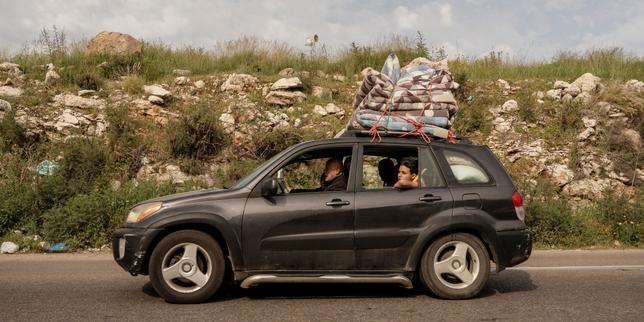
The media loves a tragedy it can quantify with suitcases and rubble. Every report trickling out of the Lebanese-Israeli border follows the same exhausted script: the "impossible" return of the displaced, the heartbreak of the olive groves, and the indefinite limbo of the south. They treat the displacement of 100,000 people from Southern Lebanon as a static humanitarian crisis. They are wrong.
This isn't a temporary disruption of a functioning society. It is the final collapse of an obsolete economic model that was dead long before the first shell fell in October 2023. To talk about "the return" is to indulge in a fantasy. The south, as it existed—a clientelist agrarian pocket propped up by remittances and political subsidies—is gone. And frankly, trying to rebuild it in its old image is the worst thing Lebanon could do.
The Return Is Not Impossible It Is Irrelevant
Mainstream pundits argue that the "impossibility" of return stems from security guarantees or the lack of a diplomatic roadmap. That is a surface-level reading. The real reason people won't go back isn't just the fear of a ceiling falling on their heads; it’s that there is no longer a floor beneath their feet.
Before the current escalation, the south was already hemorrhaging its youth to Beirut and West Africa. The economy was built on "prestige agriculture"—growing tobacco that the state bought at inflated prices just to keep the peace. It was a welfare state disguised as farming. When you remove the political stability, the subsidy chain snaps.
I’ve spent years analyzing regional development in failed states. You don't "fix" a border zone by putting the same people back in the same crumbling houses to grow the same unprofitable crops. That’s not a homecoming; it’s a hostage situation. The "impossible return" is actually a market correction. The labor force has moved. The capital has evaporated. To force a return is to demand that a population undergo systemic poverty for the sake of a map.
The Security Fallacy
Everyone asks: "When will it be safe?"
Wrong question. Safety is a relative term in the Levant. The real question is: "What is the cost of the buffer?"
The "lazy consensus" suggests that a UN resolution or a new line on a map creates the conditions for life. It doesn't. Real security in a border zone comes from economic density, not patrols. Look at the northern side of that same border. Despite the sirens, there is industrial infrastructure, high-tech agriculture, and a reason for people to stay.
On the Lebanese side, the "resistance economy" has produced nothing but dependency. By keeping the south as a permanent "front," the political class ensured it could never become a "hub." The displacement isn't a bug in the system; for the ruling elite, it’s a feature. It clears the board. It allows for a total reset of property rights and demographic leverage. If you think the "impossibility" of return is a failure of the state, you don't understand how the Lebanese state profits from its own dysfunction.
Why We Should Stop Trying to Fix the South
We need to stop romanticizing the village. The "tragedy" of the displaced is often framed through the lens of lost heritage. Heritage doesn't pay the bills.
In my time working with infrastructure finance, I’ve seen the same mistake made from the Balkans to Benghazi: pouring "stabilization funds" into reconstruction projects that ignore the shift in global trade. Southern Lebanon shouldn't be rebuilt as a collection of villages. It needs to be reimagined as a special economic zone or it should be left to the wild.
The Counter-Intuitive Reality of Destruction
Destruction creates a vacuum. Usually, we try to fill that vacuum with the past. That is a loser’s game.
- The Infrastructure Gap: The old electricity grid in the south was a joke—a series of illegal hookups and diesel generators. Why rebuild it?
- The Agricultural Dead-End: Tobacco is a dying industry. Forcing displaced farmers back to the fields is sentencing them to permanent debt.
- The Urban Pivot: The displaced are currently integrating into the informal economies of the north and Beirut. While the living conditions are often horrific, they are closer to the "real" economy than they ever were in a border village.
The honest, brutal truth? The displacement has done more to modernize the Lebanese labor distribution in six months than the Ministry of Labor has done in sixty years. It has forced a rural population into urbanized environments where, out of pure necessity, they are diversifying their skill sets.
The Geopolitical Sunk Cost
The international community is obsessed with "Resolution 1701." They treat it like a holy text. But 1701 is a document designed for a world that no longer exists. It assumes two sovereign states acting in good faith.
Imagine a scenario where we stop pretending the border is a line and start treating it as a shared economic wound. If Lebanon wants the south back, it cannot be as a military outpost. It has to be as a competitive asset.
The "expert" class will tell you that we need "de-escalation." I’m telling you we need "de-politicization." The south is currently a geopolitical pawn. As long as its value is measured in "deterrence" rather than "GDP," no one with a brain or a bank account is going to move back there.
The False Hope of Reconstruction Funds
Billions will eventually be pledged. The "Friends of Lebanon" will hold a conference in Paris or Doha. There will be glossy brochures featuring 3D renders of rebuilt stone houses and solar panels.
Don't believe the hype.
I have seen these funds disappear into the pockets of the same contractors who built the substandard roads that washed away in the first rain. "Reconstruction" in Lebanon is just another word for "laundering." If the money is tied to the return of the displaced to their original locations, the money is wasted.
The displaced are being used as moral shields to secure funding that will never reach them. The "impossibility" of their return is a lucrative talking point for a government that has defaulted on every promise it ever made to its citizens.
The Hard Truth About "Home"
We have a sentimental attachment to the idea of "home" that ignores the reality of "survival."
Ask a 22-year-old from Dhayra or Meiss el-Jabal what they want. They don't want a rebuilt house in a zone that gets bombed every decade. They want a passport, a remote job, and a life that isn't dictated by the proximity of a missile silo.
The tragedy isn't that they can't go back. The tragedy is that we are trying to force them to want to.
We are witnessing the death of the Lebanese periphery. This isn't a localized crisis; it's a preview of what happens when a 19th-century concept of "land" meets 21st-century warfare and a collapsed banking system. The south is being hollowed out, and the "impossibility" of return is simply the sound of the door locking behind a generation that has realized the frontier is no place to raise a family.
Stop Asking When They Can Go Back
Start asking where they are going next.
The displaced are already voting with their feet. They are renting in the mountains, they are crowding into the suburbs of Beirut, and they are looking for the exit. The "impossible return" is a narrative for the evening news. The "permanent relocation" is the reality on the ground.
If you want to help Lebanon, stop funding "return" initiatives. Start funding urban integration. Start building the schools and hospitals where the people actually are, not where you wish they were.
The south is a graveyard of bad ideas and failed diplomacy. Let it be. Focus on the living, not the land. The dirt isn't going anywhere, but the people already have.
Move on. They have.