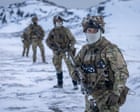
The movement of biological payloads across the North Atlantic is rarely a matter of routine medical supply; in the context of Arctic geopolitics, it is a high-fidelity signal of kinetic readiness. Recent reports detailing the Danish transport of blood products to Greenland under the premise of preparing for a potential United States "attack" or "takeover" represent a critical case study in defensive posturing. To analyze this event, one must move beyond the sensationalism of a theoretical conflict between allies and instead quantify the structural requirements of maintaining a "Warm Base" in the high north.
The strategic logic behind this deployment rests on three functional pillars: the expiration of the Thule-era status quo, the physical constraints of the Arctic medical cold chain, and the signaling utility of non-lethal logistics.
The Triad of Arctic Medical Readiness
Maintaining a combat-ready posture in Greenland is a unique challenge defined by geographical isolation and extreme environmental variables. The Danish military’s decision to preposition blood supplies addresses a specific set of logistical bottlenecks that would render any sudden defense of the island impossible if managed from Copenhagen in real-time.
- Temporal Latency: The flight time from Denmark to Pituffik Space Base (formerly Thule Air Base) or Nuuk exceeds four hours under optimal conditions. In a crisis, the "Golden Hour" of trauma care—the period during which medical intervention has the highest probability of preventing death—is mathematically incompatible with transatlantic supply lines.
- Biological Volatility: Unlike ammunition or fuel, whole blood and plasma have a rigid shelf life. Red blood cells typically expire within 42 days when refrigerated at 1°C to 6°C. The act of flying these supplies to Greenland indicates a shift from "Just-in-Time" logistics to "Just-in-Case" prepositioning, signaling that the Danish Defense Command viewed the threat window as immediate and active.
- Environmental Degradation: Arctic operations require specialized storage infrastructure. Moving blood bags isn't merely a transport task; it requires a validated cold chain that can withstand external temperatures of -40°C while maintaining internal stability. This deployment serves as a stress test for Greenland’s permanent medical infrastructure.
The Cold Chain as a Proxy for Sovereignty
When Denmark reinforces Greenland's medical capacity, it is asserting administrative control over a territory that has become the focus of intensified Great Power competition. The hypothesis that these supplies were a response to a potential U.S. "attack" requires a nuanced definition of "attack." In a modern geopolitical framework, an attack is not necessarily a kinetic bombardment but can manifest as a "de facto" takeover through the unilateral expansion of military footprints or the declaration of a state of emergency that bypasses Danish authority.
The Danish response functions as a Sovereignty Assertion Mechanism. By ensuring that the medical infrastructure on the ground is Danish-supplied and Danish-managed, Copenhagen mitigates the "Capability Gap" that the United States often uses to justify its presence in the region. If a territory lacks the basic logistical requirements to handle a mass casualty event or a localized conflict, a larger power—in this case, the U.S. through its assets at Pituffik—naturally fills that vacuum. Prepositioning blood products is a tactical move to ensure that, in the event of any escalation, the foundational emergency response remains under Danish jurisdiction.
The Cost Function of Arctic Defense
Every liter of blood moved to the Arctic carries a disproportionate "Logistical Tail." The cost is not found in the unit price of the blood itself, but in the maintenance of the environment required to keep it viable.
- Energy Overhead: In Greenland, keeping something at 4°C often requires heating, not cooling, relative to the external environment. This requires a constant, redundant power supply.
- Personnel Specialization: Managing a blood bank in a remote outpost requires Lab Technicians and Medical Officers who are trained in Arctic survival and remote clinical practice.
- Opportunity Cost: Deploying these assets to the North Atlantic diverts specialized medical resources from the domestic Danish healthcare system or from NATO commitments in Eastern Europe.
The willingness to absorb these costs suggests that the perceived risk of losing administrative grip on Greenland outweighed the standard operational expenses of the Danish Defense.
Examining the U.S. Integration Paradox
The United States and Denmark are NATO allies, yet the Arctic creates a friction point known as the "Integration Paradox." While both nations share a goal of Russian and Chinese containment in the polar region, their methods of achieving "Domain Awareness" often overlap or conflict.
The U.S. military’s interest in Greenland is primarily driven by its position in the GIUK (Greenland-Iceland-UK) gap and its role in missile defense. However, the U.S. has a historical tendency to expand its operational footprint during periods of perceived instability. The Danish "blood bag" maneuver was likely a preemptive stabilization effort. By proving that the Danish military could independently sustain medical readiness, they removed a primary justification for the U.S. to take "emergency command" of Greenland’s southern civilian corridors or northern strategic hubs.
The Mechanism of Deterrence via Logistics
Standard deterrence theory focuses on the "cost of entry" for an aggressor. In the Arctic, deterrence is shifted toward "resilience of the defender."
$$R = (S_{v} \times T_{a}) / L_{g}$$
In this simplified model, Readiness (R) is a function of Supply Volume (S_v) multiplied by Technical Accessibility (T_a), divided by Logistical Gap (L_g). By flying blood bags to Greenland, Denmark effectively reduced $L_{g}$ while increasing $S_{v}$. This change in the equation alters the calculus for any external power—allied or otherwise—considering a unilateral change to the status quo.
The presence of medical supplies indicates a transition from a "Passive Observation" state to a "Managed Defense" state. It communicates that the garrison is not just a skeleton crew for maintenance, but a functional unit capable of absorbing and reacting to physical trauma.
Technical Limitations of the Reporting
The reports regarding this deployment often fail to specify the volume and type of biologicals moved. This is a critical oversight. If the shipment consisted primarily of O-Negative whole blood, the intent was immediate trauma response for unidentified casualties. If it included Freeze-Dried Plasma (FDP), the intent was long-term sustainability, as FDP has a much longer shelf life and is easier to store in rugged environments.
Furthermore, the "attack" narrative must be scrutinized against the backdrop of the 2019-2021 diplomatic friction regarding the potential sale of Greenland. While the idea of a physical U.S. invasion remains a low-probability "Black Swan" event, the risk of a "Political Encroachment" was, at the time, at a multi-decade high. The blood bags were a physical manifestation of a political "No Trespassing" sign.
Operational Conclusion for Arctic Strategy
The Danish movement of medical supplies to Greenland should be categorized as a High-Utility, Low-Kinetic Signal. It achieved three strategic objectives without firing a shot:
- It validated the Danish Air Force’s ability to maintain a cold chain over 2,000 miles.
- It provided a "sovereignty audit" of the facilities at Pituffik and Nuuk.
- It signaled to the Pentagon that Copenhagen recognizes the difference between a cooperative alliance and a subservient one.
Future Arctic defense strategies will increasingly rely on these "civilian-adjacent" military maneuvers. As the ice melts and the Northern Sea Route becomes a viable commercial reality, the ability to provide emergency medical and search-and-rescue (SAR) infrastructure will become the primary metric by which Arctic sovereignty is measured.
The strategic play for any sub-Arctic nation with northern territories is to prioritize the "Warm Base" model. This involves the permanent installation of high-spec medical and fuel storage that can be activated within a six-hour window. Failure to maintain this independent logistical capacity effectively invites larger powers to provide "protection," which is the first step toward permanent loss of territorial autonomy. Focus must remain on hardening the modularity of these supplies, specifically moving toward synthetic blood products and automated cold-chain monitoring to reduce the personnel footprint while maintaining a credible defensive posture.