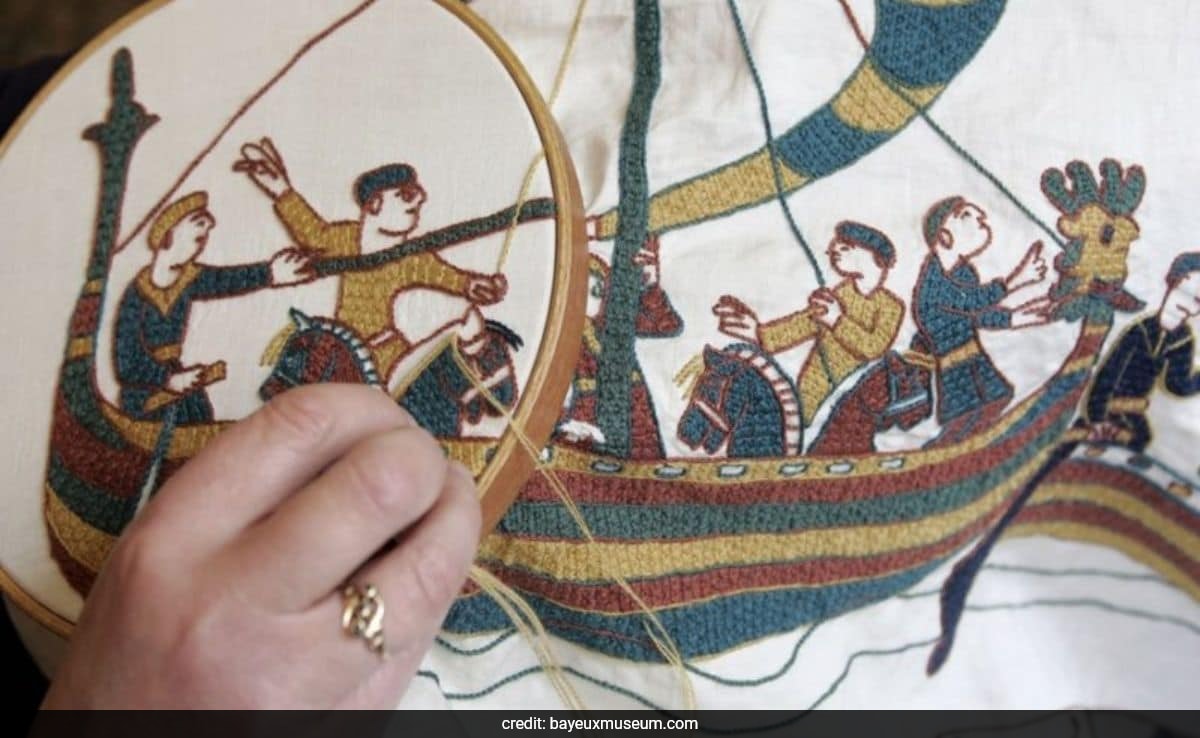
The story of King Harold Godwinson’s 200-mile dash from Stamford Bridge to the South Coast is one of the most enduring legends of English history. We are taught that the last Anglo-Saxon king performed a superhuman feat of endurance, marching an exhausted army across the spine of England in mere days to meet William the Conqueror at Hastings. It is a stirring narrative of doomed heroism. It is also, according to fresh geographic analysis and logistical reality, a physical impossibility that has obscured the true reason for the Saxon collapse.
Recent research into medieval road networks and troop movement suggests the "lightning march" is a Victorian embellishment that ignores the sheer friction of 11th-century travel. Harold did not lead a cohesive, 10,000-man force on a non-stop sprint. Instead, the English defense shattered because of a staggered, fragmented arrival that left the King with a makeshift militia rather than the hardened veterans who had just broken the Vikings in the North.
The Friction of the Fosse Way
To understand why the 200-mile sprint is a fantasy, one must look at the mud. Modern historians often project modern movement speeds onto a landscape that was essentially a series of bogs connected by crumbling Roman ruins.
In October 1066, the English weather was turning. The Roman roads, while still the primary arteries of the kingdom, were not the paved highways of popular imagination. They were rutted, waterlogged tracks. A lone messenger on a fresh horse might cover fifty miles in a day. An army of thousands, burdened with iron mail, shields, and the logistical tail of a medieval baggage train, cannot.
Historical consensus has often placed Harold’s arrival at the Hoar Apple Tree—the traditional muster point—just days after he learned of the Norman landing. This requires an average pace of nearly 30 miles per day. For context, the highly disciplined Roman legions aimed for 15 miles a day under optimal conditions. Expecting a medieval infantry force, fresh from the bloodiest battle of the age at Stamford Bridge, to double that pace for a week straight is a refusal to acknowledge human biology.
The reality was likely a rolling collapse. Harold traveled fast with his mounted housecarls, leaving the bulk of his regional levies to follow at a grueling, slower pace. This wasn't a unified march; it was a desperate, disconnected scramble.
The Cost of the Northern Victory
We often forget that before Hastings, there was Stamford Bridge. On September 25, 1066, Harold’s forces decimated the army of Harald Hardrada. It was a total victory, but it came at a staggering cost. The English army wasn't just tired; it was depleted.
The elite core of the army, the housecarls, took the brunt of the fighting in the North. These were the men who possessed the specialized gear and training required to stand against Norman cavalry. When the news reached Harold that William had landed at Pevensey, he faced a choice that would define the fate of England. He could wait in London, allow his forces to regroup, and gather the full might of the southern shires. Or he could move immediately.
He chose the latter. But he moved without his full strength. The "200-mile march" wasn't a feat of military brilliance; it was a logistical disaster born of panic. By the time Harold stood on Senlac Hill, many of his best soldiers were still somewhere in the Midlands, nursing wounds or struggling through the mud of the Old North Road.
The Myth of the Unified Shield Wall
If the march was slower and more fragmented than the textbooks claim, the composition of the army at Hastings changes entirely. This isn't just a matter of pedantry. It explains why the shield wall, usually the impregnable signature of Saxon warfare, broke under pressure.
A shield wall is only as strong as the man standing next to you. It requires deep familiarity and collective discipline. The force Harold fielded at Hastings was a "pickup team" of local Sussex levies and the exhausted remnants of his personal guard. The veterans who had marched from the North were operating on a massive caloric deficit.
Caloric Exhaustion and Combat Effectiveness
- Average daily caloric need for a marching soldier: 4,500–5,000 kcal.
- Estimated forage availability in late autumn England: Minimal.
- The Result: Profound muscle fatigue and slowed reaction times.
When the Norman archers began their final volleys and the cavalry made their feigned retreats, the English soldiers lacked the physical reserves to maintain their formation. The myth of the 200-mile march suggests they arrived ready to fight. Logic suggests they arrived in a state of advanced physiological shock.
Re-evaluating the Norman "Luck"
William the Conqueror is often portrayed as lucky—lucky the wind changed, lucky Harold was in the North, lucky the English broke cover. But if we accept that Harold’s march was a disorganized slog rather than a heroic sprint, William’s victory looks less like luck and more like the inevitable result of superior logistics.
William had established a secure beachhead. He had spent weeks foraging and consolidating. Harold, by contrast, arrived with a skeleton crew and a hope that his presence alone would galvanize the local peasantry. The research into the timing of the march suggests Harold may have spent more time in London than previously thought, desperately trying to drum up reinforcements that never materialized.
The gap between the "official" timeline and the logistical reality suggests a king who was losing control of his kingdom's infrastructure. The communications 1,000 years ago were brittle. Orders were lost. Men deserted. The 200 miles between York and the south coast acted as a filter, stripping away Harold's power mile by grueling mile.
The Shadow of the Roman Road
Why has the myth persisted? It serves a nationalist narrative of the "English underdog." We want to believe in the King who flew across the country to save his people. It makes for a better story than a king who sat in London for five days, arguing with his brothers about whether they had enough horses, while his army trickled south in broken groups.
But the data is stubborn. You cannot move ten thousand men through the 11th-century English interior at thirty miles a day. Not with the shoes they wore, not with the food they had, and certainly not on the roads that existed.
The Battle of Hastings wasn't lost on the hills of Sussex. It was lost in the mud of the East Midlands, during a march that was far slower, far more painful, and far less coordinated than we have been led to believe. The collapse of the Anglo-Saxon state was a failure of distance and time.
Check the topographic maps of the 1066 route yourself and try to find a path for 5,000 infantrymen that doesn't involve a week-long quagmire.