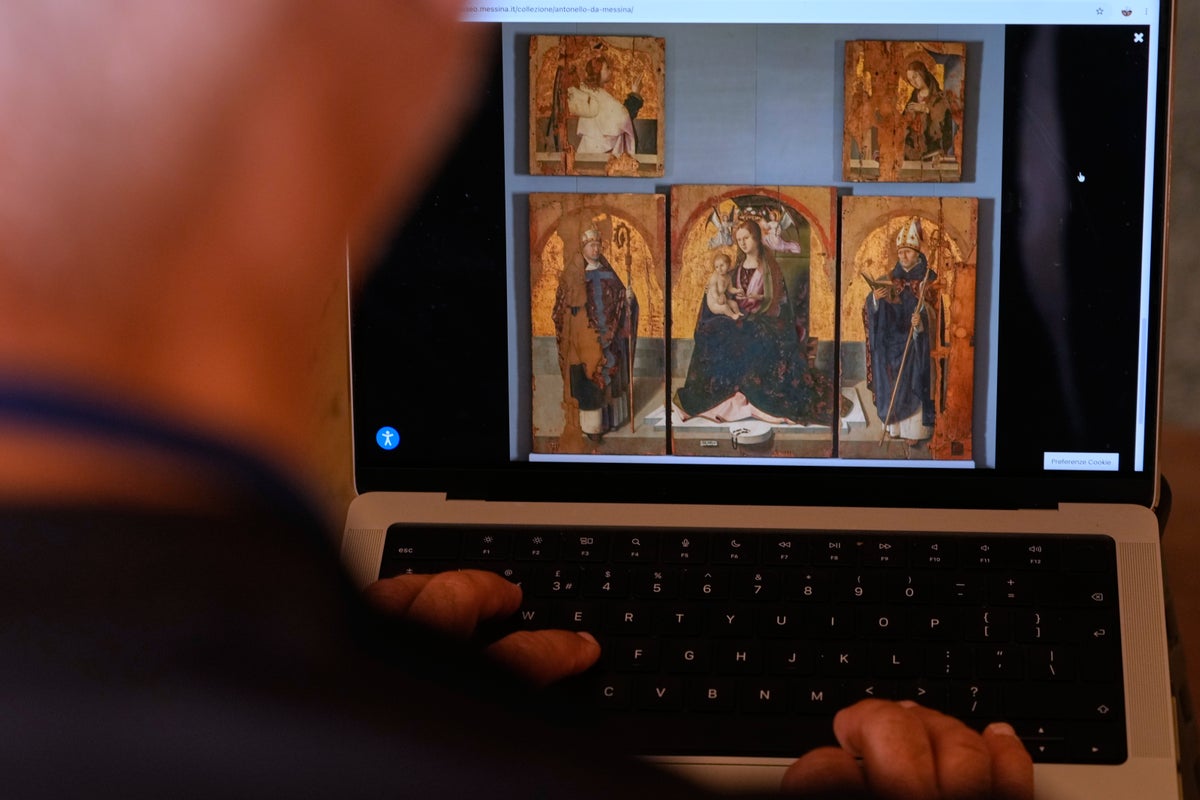
On a Saturday night wrapped in the drowsy humidity of the Italian Ferragosto holiday, a precision operation unfolded inside the Regional Museum of Messina (MuMe) in Sicily. Thieves bypassed sophisticated electronic alarms, breached an armored display case, and vanished into the Mediterranean night with four irreplaceable wood panels painted by 15th-century master Antonello da Messina. Among the stolen items were three surviving sections of the legendary San Gregorio Polyptych dating back to 1473, alongside a double-sided panel depicting the Virgin Mary and the dead Christ.
The timing was no accident. Ferragosto paralyzes Italian civic infrastructure as millions flee urban centers for coastal retreats, leaving cultural institutions thinly staffed and local police forces stretched thin across massive traditional celebrations like Messina’s public street processions. Museum director Marisa Mercurio called the catastrophe a devastating blow to the historical memory of the city. Yet beyond the shockwaves rippling through the international art community, this brazen theft exposes the severe vulnerabilities plaguing regional European museums that house billionaire-tier heritage items with municipal-tier security budgets.
The Market Mechanics Behind the Messina Raid
Art-crime investigators immediately faced a baffling paradox. Masterpieces of this caliber cannot be openly auctioned, displayed in private collections, or easily fenced on the open market. They are too famous, too heavily cataloged, and instantly recognizable to custom authorities and cultural heritage squads.
Ordinary thieves quickly discover that stealing a Renaissance treasure is vastly easier than converting it into cash. When high-end cultural property vanishes, it rarely travels down a traditional criminal pipeline. Instead, seasoned syndicates utilize these items as high-value collateral within subterranean criminal economies, trading stolen epochs for narcotics, weapons, or financial leverage among transnational syndicates.
Furthermore, the physical nature of the haul reveals calculated targeting. The thieves originally attempted to pull six panels from the frame of the San Gregorio Polyptych but discarded two on a low exterior wall during their escape. This sloppy abandonment hints at a hurried exit or unexpected friction during the extraction, suggesting the crew was operating under tight operational constraints or panicked as automated security protocols blinked to life.
The Rising Value Problem
This Sicilian disaster follows a troubling pattern across the Italian peninsula. Just days prior to the MuMe break-in, authorities in northern Italy announced the recovery of masterworks by Paul Cézanne, Pierre-Auguste Renoir, and Henri Matisse stolen earlier in the year from a private foundation near Parma.
Public and government interest in Antonello da Messina has surged dramatically. Earlier in the year, the Italian Ministry of Culture shelled out $14.9 million at a New York auction house to repatriate the master's devotional painting Ecce Homo. That high-profile acquisition thrust early Renaissance Sicilian art back into global financial headlines, inadvertently broadcasting a neon sign to predatory international rings about the escalating market worth of regional Italian holdings.
When national governments aggressively inflate the valuation of specific artists through multi-million-dollar state buyouts, they simultaneously drive up the black-market insurance value of unprotected local artifacts. Small regional museums like MuMe hold assets worth tens of millions of euros, yet they remain vulnerable targets compared to heavily fortified state galleries in Rome or Florence.
The Structural Fragility of Regional Heritage
Italy guards the densest concentration of cultural heritage on the planet, creating an impossible defense matrix. The state cannot afford military-grade protection for every provincial monastery, municipal archive, and regional pinacoteca. Security systems rely heavily on automated sensors, perimeter alarms, and contracted private guards who are frequently isolated during national holidays.
When a community's identity is anchored in wood panels that survived five centuries of warfare, political turmoil, and the catastrophic 1908 Messina earthquake, losing them to opportunistic thieves feels like an existential fracture. The Italian Carabinieri's specialized art recovery squad faces an uphill battle tracking down the Messina panels before they degrade in damp hiding spots or vanish across porous Mediterranean smuggling routes. The recovery of the Parma French masters proves that specialized police work can claw stolen beauty back from the shadows, but recovering fragile 15th-century tempera and oil-on-wood panels after a criminal syndicate has bounced them through underground channels is an entirely different gamble.
The investigation crawls forward behind locked museum doors while investigators dust the empty frames for microscopic trace evidence. The panels remain missing in the dark.


