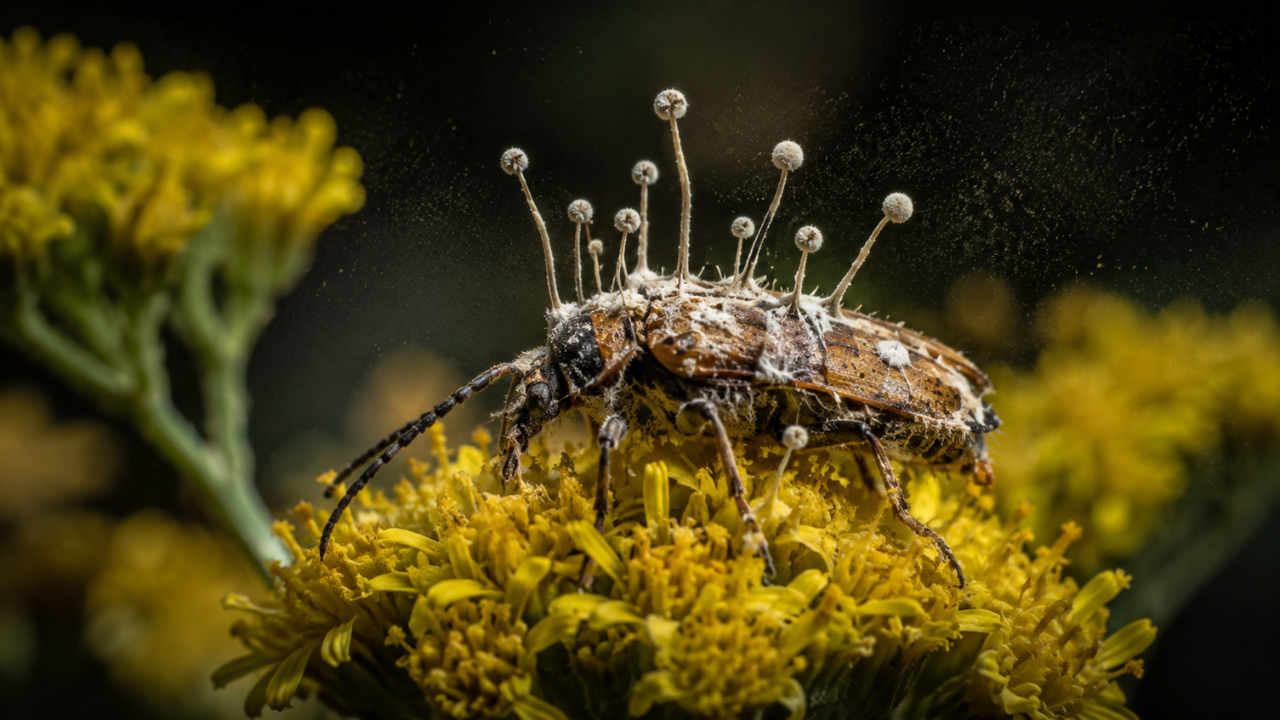
In the fading light of autumn, goldenrod blossoms across North America double as high-stakes ecological trading floors where goldenrod soldier beetles gather to feed on pollen and secure mates. Beneath the surface of this seasonal congregation, an entomopathogenic fungus named Eryniopsis lampyridarum hijacks the biology of Chauliognathus pensylvanicus, turning healthy insects into behavioral anomalies. This parasite does not simply kill its host; it orchestrates a precise, multi-stage manipulation that begins with forced terminal climbing and culminates in post-mortem mechanical puppetry.
Understanding how Eryniopsis lampyridarum manages to subvert host free will requires looking past standard pathogen behavior. When a soldier beetle contracts the fungal spores, the microscopic invader breaches the tough chitinous exoskeleton, multiplying within the hemolymph. Weeks later, as the infection reaches maturity, the dying host experiences a compulsion to scale a nearby plant, anchoring its mandibles into the petal or bract of an Asteraceae flower with a vice-like grip. This terminal clamping ensures that the beetle stays suspended in place rather than dropping uselessly into the leaf litter below.
The Mechanics of Post-Mortem Articulation
Death does not end the influence of the fungus; rather, it marks the beginning of the most physically striking phase of the infection cycle. Between 15 and 22 hours after the host expires—typically during the quiet hours between midnight and 7 AM—internal hyphal growth exerts immense pressure on the interior cavities of the carcass. This proliferation forces the hardened forewings, or elytra, to pry open while simultaneously expanding the delicate hind wings.
The result is a grotesque display: a dead beetle frozen in a posture resembling flight or courtship. Field researchers note that this mechanical unfolding exposes the distended, spore-laden abdomen to passing traffic. Far from being a random byproduct of decay, this structural shift transforms the corpse into an active transmission hub.
Healthy beetles arriving at the same flowers to forage or initiate courtship brush against the stiffened, spore-covered remains of their peers. Each physical contact dislodges sticky conidia, transferring the microscopic threat to a new host and perpetuating the cycle.
Dual Survival Strategies Within the Fungal Life Cycle
The evolutionary brilliance of Eryniopsis lampyridarum relies on nutritional and environmental hedging. Not every infected soldier beetle ends up clamped to a floral summit. Field data demonstrates a distinct divergence in how the pathogen handles different hosts based on microclimatic conditions and internal spore development.
While flower-clamping hosts produce ephemeral conidia designed for immediate, high-probability horizontal transmission among active adult beetles, other infected specimens succumb closer to the ground. These ground-bound individuals develop thick-walled resting spores instead.
- Conidia Production: Short-lived spores generated on elevated flower-clamping corpses, optimized for rapid transmission during the peak autumn adult window.
- Resting Spores: Environmentally resilient spores housed within carcasses that fall to the soil, capable of surviving harsh winter conditions to infect subsequent generations months later.
This dual approach ensures that even if environmental factors or low adult densities disrupt immediate transmission on the floral canopy, the soil-dwelling reservoir guarantees persistence through the following year.
Unresolved Mysteries in Entomophthoralean Parasitism
Despite decades of sporadic study by field entomologists, the exact biochemical pathways driving the pre-death mandible clamp remain poorly understood. Scientists can document the physical pressure required to pry open the post-mortem elytra and map the exact hourly windows of spore maturation, yet the precise neurological or muscular hijacking signals emitted by the fungus stay shrouded behind the complexity of insect physiology.
Field surveys across Arkansas and wider North America indicate that epizootics can infect upward of 20 percent of a local soldier beetle population during peak autumn weeks. This prevalence highlights a persistent evolutionary pressure shaping insect behavior in plain sight. Every autumn bloom hosts these silent dramas, where the line between living pollinator and botanical anchor blurs under the microscopic pressure of fungal expansion.