The global automotive industry is witnessing a calculated, cold-blooded asset grab that is rewriting the rules of industrial dominance. While Western legacy automakers scramble to justify thinning margins and shuttering plants, Chinese EV giants are moving in to occupy the shells they leave behind. This isn't just a "carpool" or a temporary lease agreement. It is a fundamental transfer of manufacturing power. By moving into idled factories in Europe, Southeast Asia, and South America, companies like BYD, Chery, and Great Wall Motor are bypassing the decades-long struggle of building a brand from scratch. They are inheriting the infrastructure of their rivals to destroy them.
This strategy effectively neuters the primary weapon Western governments have used to protect their home turf: tariffs. When a car is built in a former Ford plant in Brazil or a former Nissan facility in Spain, it ceases to be a "foreign import" in the eyes of many local tax codes. It becomes a product of local investment. The Chinese "Big Tech" of the car world is not just exporting vehicles; they are exporting an entire industrial ecosystem, transplanting it into the rusted-out husks of the old guard.
The Scavenger Model of Industrial Growth
For a century, building a car company required a massive, risky bet on greenfield sites. You bought land, cleared it, built the steel frames, and prayed the market stayed stable for the thirty years it took to recoup the investment. The new wave of Chinese expansion has discarded this playbook entirely. They are operating as industrial scavengers, picking over the remains of the internal combustion engine (ICE) era.
When Mercedes-Benz or Volkswagen idles a plant because their transition to electric vehicles (EVs) is stumbling, they leave behind more than just a building. They leave a trained workforce, established logistics routes, and a local government desperate to keep employment numbers up. Chinese firms walk into these situations with bags of state-backed cash and a simplified manufacturing process that requires fewer workers and less space. They can turn a dead factory into a high-output EV hub in a fraction of the time it would take to build a new one.
Take the case of Brazil. When Ford exited the country in 2021, it left a massive vacuum in Camaçari. BYD didn't just see a factory; they saw a shortcut. By taking over that site, they gained immediate access to Mercosur trade benefits, allowing them to ship cars across South America with minimal friction. They aren't just selling cars to Brazilians; they are using Brazil as a fortified base to attack the entire hemisphere.
The Myth of the Level Playing Field
Policymakers in Washington and Brussels often talk about "fair competition." This is a fantasy. The companies moving into these idled plants operate under a completely different economic reality than the firms they are replacing. While a publicly traded Western automaker must answer to shareholders demanding quarterly dividends and stock buybacks, Chinese firms are often extension pieces of national industrial policy.
Their goal isn't necessarily immediate profit in the traditional sense. Their goal is market share and the control of the global supply chain for lithium-iron-phosphate (LFP) batteries. By occupying a factory in the EU, a Chinese firm like Chery can claim "Made in Europe" status. This complicates the political narrative. How does a populist politician campaign against a Chinese company that just saved 3,000 jobs in their district? They can't. The "foreign threat" becomes the "local savior."
This creates a paradox for Western labor unions. Historically, unions have been the loudest voices calling for protectionist trade barriers. But when a Chinese company offers to reopen a shuttered plant and rehire union members, those same organizations find themselves in the awkward position of lobbying for the very competitors that are undermining the domestic industry. It is a brilliant, silent coup.
The Logistics of Displacement
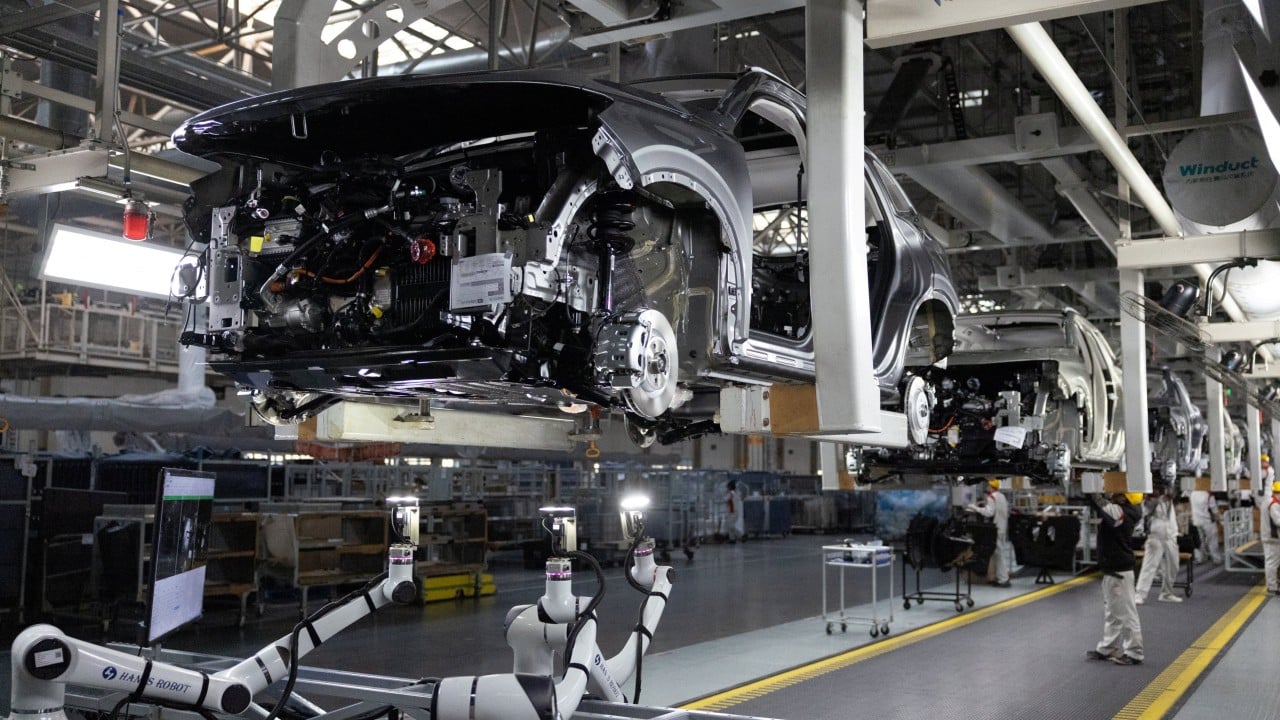
It is a mistake to think these firms are simply moving into old buildings and doing the same things their predecessors did. The internal architecture of these plants is being gutted and replaced with something far more efficient. The traditional assembly line—a mile-long beast designed for the 2,000+ parts of a gasoline engine—is being swapped for high-speed, modular EV cells.
Why the Old Guard Can't Compete
- Software Verticalization: Western firms rely on a fragmented web of Tier 1 suppliers like Bosch or Continental. Chinese firms moving into these plants often make their own chips, their own batteries, and their own software.
- Speed to Market: A traditional redesign takes five to seven years. The scavenger firms are hitting three-year cycles.
- Infrastructure Reuse: They don't just use the factory floor; they use the existing rail spurs and port access points that were optimized over sixty years by the previous tenants.
This isn't a transition. It is an eviction. The legacy companies are paying the "exit tax" of decommissioning while the newcomers are getting "entry bonuses" in the form of tax breaks and ready-made utilities.
The South East Asian Testing Ground
Thailand has long been known as the "Detroit of the East," a hub for Japanese giants like Toyota and Honda. For decades, this was an impenetrable fortress of Japanese industrial might. That fortress is currently under siege. Chinese automakers have recognized that the Japanese were slow to pivot to full battery electric vehicles (BEVs), sticking instead to hybrids.
By moving into idled or underutilized capacity in Thailand, Chinese firms are not just competing on price; they are changing the technological standard of the region. They are flooding the market with affordable, high-tech EVs that make the local Japanese offerings look like relics. This has a secondary effect: it breaks the supply chain dominance of the Japanese Keiretsu. When a factory flips from Toyota-aligned to BYD-aligned, every local parts supplier has to either adapt to the Chinese spec or go out of business.
The Hidden Cost of the Takeover
There is no such thing as a free lunch in geopolitics. While these factory takeovers save jobs in the short term, they represent a massive hollowing out of indigenous engineering capability. When a domestic firm owns a factory, the R&D, the intellectual property, and the high-level decision-making stay within the country. When a "scavenger" firm takes over, the factory becomes a mere assembly point. The "brain" of the operation remains in Shenzhen or Shanghai.
We are seeing the birth of a new kind of industrial colonialism. In this model, the "colonized" nations provide the labor and the physical space, while the "colonizer" provides the high-value technology and reaps the long-term data rewards. Every one of these new EVs is a rolling data center, collecting information on driving habits, infrastructure, and consumer behavior—data that flows back to the home office.
Breaking the Tariff Wall
The most significant strategic advantage of this factory-hopping is the destruction of the "China Price" stigma. If a car is built in Thailand and sold in Australia, it benefits from the ASEAN-Australia-New Zealand Free Trade Area. If it’s built in Hungary, it moves freely across the EU. The "Chinese" nature of the product is laundered through the geography of the factory.
This makes traditional trade wars nearly impossible to win. If the US or EU raises tariffs based on the "Country of Origin," they have to decide if they want to penalize a product made by their own citizens in their own towns. It is a hostage situation where the hostages are the workers.
The Strategy of Forced Obsolescence
The final piece of this puzzle is the speed at which these new tenants are moving. They are not looking to run these plants for fifty years. They are looking to dominate the next decade of the EV transition, establish a massive installed base, and then use their scale to dictate the next set of global standards.
Legacy automakers are trapped in a cycle of "de-risking" and "downsizing." Every time they close a plant to save money, they provide a low-cost entry point for the very competitor that is putting them out of business. It is a self-cannibalizing cycle. To stop it, Western firms would need to invest with the same disregard for short-term profit that their Chinese counterparts show—a feat that is virtually impossible under the current pressures of the New York and Frankfurt stock exchanges.
The map of global manufacturing is being redrawn, not with new lines, but by tracing over the old ones in a different ink. The factories are the same, the workers are the same, but the power has shifted. By the time the old guard realizes they haven't just lost a lease but have lost their sovereignty, the transition will be complete.
Ask yourself if your local economy is prepared for the moment the "foreign" car becomes the only "local" option available.