The Pacific Northwest ocean does not welcome you. It swallows you whole. One moment, you are standing on the deck of a boat, the damp salt air biting your nostrils, and the next, you drop backward through a skin of gray water into total suspension.
Carl Sorensen knew this routine by heart. With nearly twelve hundred dives logged beneath the gray swells of Vancouver Island, his underground world usually belonged to the familiar. He was hunting for the soft, intelligent gaze of a giant Pacific octopus near Parksville, looking for familiar shapes in the dim gloom.
Water absorbs color first. Red vanishes at fifteen feet. Orange follows. By one hundred feet, the world is rendered in shades of slate, iron, and bruised blue. It is an alien theater where humans are clumsy intruders, tethered to plastic tanks and mechanical breaths.
Then came the shadow.
Out of the blackness, illuminated only by the frantic sweep of a handheld flashlight, a shape materialized. It was not an octopus. It was massive, ancient, and moving with an unhurried, royal menace directly toward him.
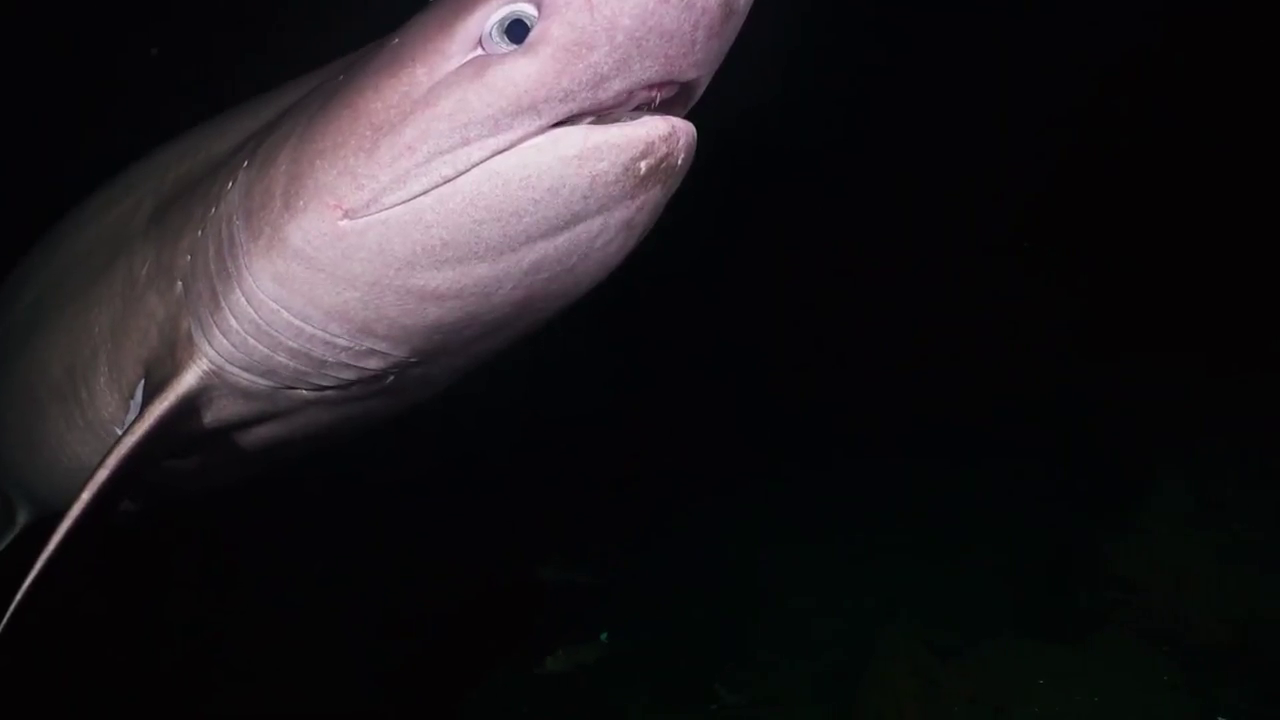
A bluntnose sixgill shark. Ten to twelve feet of primordial muscle, cruising through the chill water with its mouth slightly agape.
Panic is a physical weight. It sits on your chest and squeezes. Sorensen did what any human would do when a prehistoric predator looms out of the dark just five feet away: he screamed inside his regulator. A ragged bubble of terror escaped his lips, lost instantly to the current.
Most people know these sharks only as ghosts of the abyss. Hexanchus griseus belongs to a lineage older than the trees, older than dinosaurs, stretching back over two hundred million years. They are deep-water dwellers, haunting the crushing, pitch-black pressures down to eight thousand feet or more. To see one while recreational diving at a mere one hundred feet is like stumbling upon a deep-sea submersible in your backyard swimming pool. It breaks the rules of geography. It violates the logic of the wild.
In that fraction of a second, instinct warred with muscle memory.
The terror receded, replaced by the cold, sharp click of professional survival. His thumb found the record button.
Consider what happens next: the animal shifts from a monster of myth to a creature of flesh, blood, and quiet curiosity. The sixgill closed the distance, brushing gently against his camera gear. There was no frantic thrashing, no cinematic frenzy. Just an ancient evaluation. Are you food? Can I eat you?
The conclusion was swift. Satisfied that the bubble-blowing metal creature was inedible, the shark drifted past, its wide, pale eye taking in the strange intruder before fading back into the deep blue ceiling of the inlet.
For three minutes, time stopped. Three minutes of hyperventilating inside a drysuit, heart hammering against ribs like a trapped bird, breath hissing through the regulator like a steam valve. When the shark finally dissolved into the murk, the silence returned, heavier than before.
Marine biologists note that these summer visits to shallower coastal shelves are likely tied to the ancient rhythms of mating and pupping. Females drift upward into the continental shelf, trusting the colder northern waters to shelter their young. But knowing the biology does little to calm the adrenaline spike.
Sorensen swam upward toward the safety of the surface, his eyes constantly darting over his shoulder. The ocean looked empty. It always looks empty until it isn't.
Back on the boat, peeling off the rubber seals of his gear, the shakes set in. The human mind struggles to process encounters with things that operate outside our daily dominion. We spend our lives building walls against the wild, convincing ourselves that the planet has been tamed, mapped, and cataloged.
Yet beneath the cold Vancouver waves, the real world keeps turning, dark and indifferent, populated by living fossils that care nothing for human schedules.
He didn't find his octopus that day. He found something much rarer. He found a reminder of how small we are, and how much mystery is still left hiding just beneath the surface.