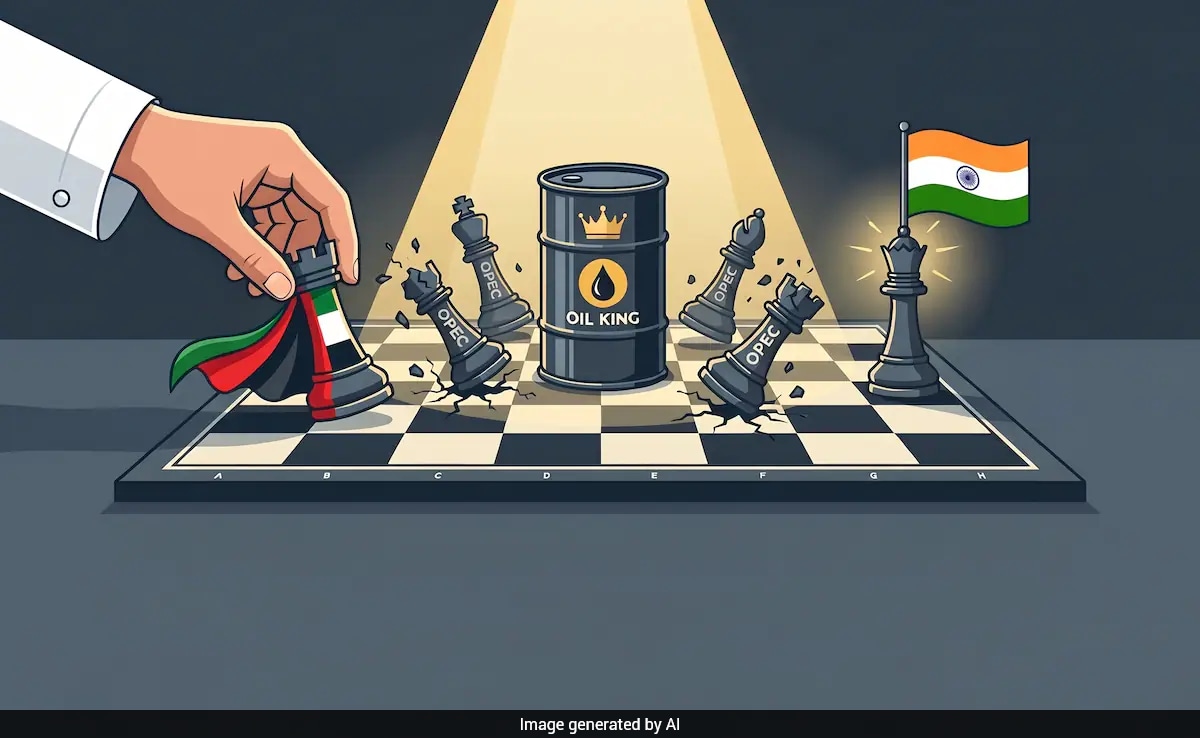
The United Arab Emirates (UAE) potential exit from the Organization of the Petroleum Exporting Countries (OPEC) represents a fundamental shift from price-targeting cartels to volume-driven market participation. For India, the world’s third-largest oil consumer, this decoupling is not a mere change in supplier relations but a structural re-rating of its energy security architecture. While speculative headlines focus on immediate price drops, a rigorous analysis reveals that the impact on Indian fuel bills is governed by the interaction between the UAE's spare capacity, the Brent-Dubai spread, and the domestic taxation framework of the Indian government.
The Divergent Incentives of the Abu Dhabi National Oil Company
To understand why the UAE would consider an exit, one must examine the capital expenditure (CAPEX) trap. The Abu Dhabi National Oil Company (ADNOC) has committed over $150 billion to increase its production capacity to 5 million barrels per day (mbpd) by 2027. Under current OPEC+ quotas, a significant portion of this newly built capacity sits idle to support global price floors. This creates a diminishing Return on Invested Capital (ROIC).
The UAE’s economic strategy, "Operation 300bn," requires massive liquidity to fund non-oil industrialization. Sitting on shut-in capacity while competitors like Guyana and the United States capture market share is no longer a viable fiscal path. By exiting OPEC, the UAE shifts its objective function from Price Maximation ($P$) to Revenue Maximization ($P \times Q$). For India, this transition is the primary lever for potential cost reduction.
The UAE-India Energy Corridor: A Structural Advantage
India imports approximately 85% of its crude oil requirements. The UAE is historically one of India’s top three suppliers, but the relationship has evolved beyond a simple buyer-seller dynamic. The Comprehensive Economic Partnership Agreement (CEPA) and the UAE’s investment in India’s Strategic Petroleum Reserves (SPR) create a "locked-in" demand-supply loop.
The mechanical benefit for India in a post-OPEC UAE scenario stems from three distinct pillars:
- Elimination of the Sovereign Risk Premium: OPEC’s coordinated production cuts often create artificial scarcity, leading to "backwardation" in the futures market (where current prices are higher than future prices). A rogue, volume-focused UAE would likely trade at a discount to Brent to secure long-term contracts with Indian refiners, effectively dampening the premium.
- The Brent-Dubai Differential: Most Middle Eastern crude is indexed to the Dubai/Oman benchmarks. Traditionally, when OPEC cuts production, the price of "sour" Middle Eastern crude rises relative to "sweet" Atlantic Brent. UAE’s exit would flood the market with medium-sour grades, compressing the Dubai-Brent spread and lowering the landed cost of crude for Indian state-run refiners like IOCL and BPCL.
- Freight and Logistics Optimization: The proximity of the Port of Fujairah to India’s western coast (Mundra, Jamnagar) provides a permanent logistical hedge. Short transit times reduce the "carrying cost" of oil, which is critical when global interest rates remain elevated.
The Refinery Complexity Factor
India’s refining sector is among the most sophisticated globally, capable of processing "bottom-of-the-barrel" heavy crudes. This complexity allows Indian refiners to switch between grades based on the "Gross Refining Margin" (GRM).
If the UAE exits OPEC and ramps up production, they will likely export more Murban crude—a light, sweet grade. While Murban is easier to refine, its entry into the market without quota restrictions would force other regional producers (Saudi Arabia, Kuwait) to adjust their Official Selling Prices (OSPs) to remain competitive in the Asian market. This creates a "buyer’s auction" for Indian procurement managers.
The internal math for an Indian refinery looks like this:
$$GRM = (Value\ of\ Refined\ Products) - (Cost\ of\ Crude + Operating\ Costs + Freight)$$
A UAE exit lowers the $Cost\ of\ Crude$ and $Freight$ components simultaneously, theoretically allowing for a reduction in retail petrol and diesel prices if the gains are passed through.
The Fiscal Friction: Why Domestic Prices May Not Fall Proportionally
A common misconception is that a 10% drop in international crude prices translates to a 10% drop at the Indian pump. This ignores the Elasticity of Revenue required by the Indian Union and State governments.
Central and State taxes account for a significant portion of the retail price of fuel. In periods of falling crude prices, the Indian government has historically raised "Special Additional Excise Duties" to capture the windfall, using the savings to fund infrastructure or manage the fiscal deficit rather than lowering consumer costs. Therefore, the UAE's exit is more likely to provide Fiscal Room for the government than an immediate Cost Break for the commuter.
The relationship can be modeled as a zero-sum game between consumer surplus and government revenue. Unless the Indian government reaches a fiscal breakeven point elsewhere, the "OPEC-exit dividend" will likely be absorbed by the treasury to hedge against future volatility.
Strategic Vulnerabilities and Counterparty Risks
The exit of a major member like the UAE could trigger the total disintegration of OPEC. While this sounds beneficial for a consumer like India, extreme price volatility is a double-edged sword.
- Investment Stagnation: If prices crash below $50 per barrel due to a price war between the UAE and Saudi Arabia, global investment in new oil fields will halt. This creates a "supply cliff" 3-5 years down the line, leading to a massive price spike that would devastate the Indian economy.
- Currency Correlation: India’s Rupee (INR) often weakens when the dollar strengthens. Since oil is priced in USD, a global oil price war often leads to capital flight from emerging markets to "safe haven" US assets. The depreciation of the INR could negate any savings gained from lower nominal oil prices.
- The Russian Variable: India currently imports a significant volume of discounted Russian Urals. If the UAE exits OPEC and lowers prices, it will compete directly with Russian crude. India would then have to navigate a complex geopolitical balance, weighing the benefits of cheap Emirati oil against its strategic energy ties with Moscow.
The Displacement of the Petro-Dollar
The UAE’s potential exit is also a maneuver toward currency flexibility. The UAE has already experimented with settling oil trades in Indian Rupees (INR) for certain transactions. Within the OPEC framework, there is immense pressure to stick to the US Dollar. Outside of it, the UAE has the autonomy to engage in bilateral "Oil-for-Goods" or "Oil-for-Investment" swaps with India.
This "De-dollarization" of the energy trade reduces the cost of transaction for Indian banks and mitigates the impact of Federal Reserve interest rate hikes on India’s import bill.
Re-Engineering the India-UAE Strategy
The strategy for Indian policymakers in the event of a UAE exit must shift from spot-market opportunism to long-term structural integration.
- Equity Oil Acquisition: Instead of just buying crude, Indian entities (ONGC Videsh) must seek to acquire stakes in ADNOC’s upstream assets. If the UAE is no longer bound by quotas, these equity stakes will yield higher volumes of "cost-price" oil for India.
- Storage Arbitrage: India must accelerate Phase II of its Strategic Petroleum Reserve program. If a UAE exit triggers a temporary price war, India should be prepared to "buy the dip" and store 90 days of consumption, creating a buffer against the inevitable price correction.
- Refinery Re-Configuration: Refiners must optimize their catalysts and units to maximize the yield from UAE-specific grades like Murban and Upper Zakum.
The end of the UAE’s tenure in OPEC would not be a "game-changer" in the sense of a permanent low-cost utopia. Instead, it would be a return to market fundamentals where supply, demand, and logistics—rather than a committee in Vienna—dictate the terms of trade. For India, the opportunity lies in using this period of volatility to lock in long-term, non-dollar-denominated supply contracts that decouple its economic growth from the whims of a fracturing cartel.