The completion of the Gordie Howe International Bridge is not merely a matter of civil engineering but a high-stakes recalibration of the North American supply chain. While public discourse focuses on the "promising" nature of ongoing diplomatic talks, the underlying reality is a complex negotiation of risk allocation, cost overruns, and the operational transition from a construction project to a revenue-generating sovereign asset. The delay in finalizing the "deal"—specifically the revised timeline and financial liability frameworks—represents a friction point in a corridor that facilitates over 25% of all surface trade between the United States and Canada.
The Triad of Delivery Risks
The execution of the Gordie Howe International Bridge (GHIB) rests on a Public-Private Partnership (P3) model. This structure was designed to shift risk away from the public sector, yet the scale of the project has triggered three distinct categories of systemic stress that the current "promising" talks must resolve.
1. The Capital Expenditure Inflation Spiral
The initial fixed-price contract, while intended to protect taxpayers, did not account for the post-2020 disruption in global commodity markets. Steel, labor, and specialized maritime logistics have experienced non-linear price increases. When a project of this magnitude hits a cost-ceiling in a high-interest-rate environment, the "promising" talks referenced by U.S. and Canadian officials are likely focused on who absorbs the delta between the 2018 budget and the 2026 reality.
The mechanism at play is the Force Majeure vs. Compensation Event debate. Bridging North America (the private consortium) and the Windsor-Detroit Bridge Authority (WDBA) must reconcile whether delays are "excusable" (extending the timeline without penalty) or "compensable" (requiring the government to inject more capital).
2. Regulatory and Environmental Asymmetry
The bridge connects two distinct legal and environmental jurisdictions. While the physical towers are mirrored, the regulatory hurdles are not. The U.S. side involves complex eminent domain settlements and Michigan-specific environmental mitigation, while the Canadian side navigates federal impact assessments. The current diplomatic "optimism" serves as a lubricant for these friction points, ensuring that the Michigan Department of Transportation (MDOT) and Transport Canada remain aligned on the "Port of Entry" requirements—the most labor-intensive and technologically sensitive components of the project.
3. The Revenue Certainty Gap
The bridge’s viability depends on toll revenue. However, the legacy Ambassador Bridge remains a direct competitor. The "deal" being finalized isn't just about finishing the concrete; it is about the operational protocols that will determine how traffic is diverted. If the Gordie Howe Bridge implements a fully automated, frictionless tolling system that outpaces the Ambassador Bridge’s aging infrastructure, it captures the high-margin "Just-in-Time" (JIT) logistics market.
Technical Architecture and Logistics Throughput
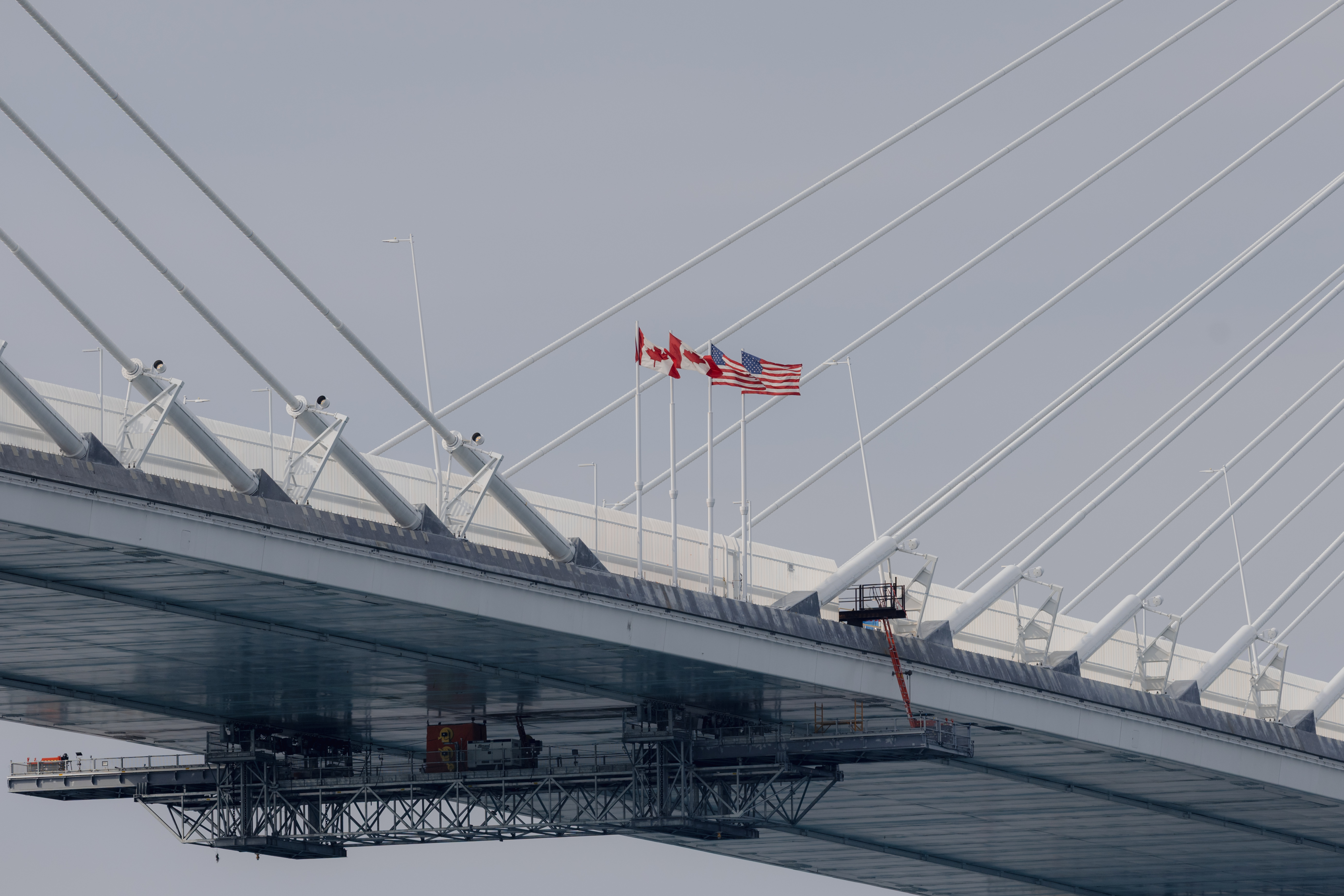
The bridge is a cable-stayed design, featuring a clear span of 853 meters, making it the longest in North America. This design choice was not aesthetic; it was an operational requirement to keep the Detroit River—a primary maritime artery—entirely unobstructed.
The Physics of Economic Throughput
Economic efficiency in border crossings is defined by the formula:
$$T = \frac{C}{(P + S)}$$
Where:
- $T$ is Throughput.
- $C$ is the Capacity of the bridge lanes.
- $P$ is the Processing time per vehicle.
- $S$ is the Staging/Buffer time required.
The Gordie Howe Bridge addresses the $P$ and $S$ variables through the most expansive Ports of Entry (POE) in North America. By dedicating 167 acres in Detroit and 133 acres in Windsor to customs and processing, the project aims to reduce $S$ to near zero. The "promising talks" between the U.S. Ambassador and Canadian counterparts involve the staffing of these ports. A bridge without adequate CBP (Customs and Border Protection) and CBSA (Canada Border Services Agency) personnel is simply a very expensive parking lot.
Strategic Implications for the North American Auto Belt
The Windsor-Detroit corridor is the nervous system of the integrated automotive industry. Components often cross the border seven times before a vehicle is fully assembled. This creates a hyper-dependency on "Zero-Latency" logistics.
The Fragility of the Ambassador Bridge Monopoly
For decades, the privately-owned Ambassador Bridge has functioned as a single point of failure. The 2022 blockade demonstrated that even a minor disruption can halt assembly lines in Kentucky and Ontario within 48 hours. The Gordie Howe Bridge introduces Systemic Redundancy.
The second bridge does not just add capacity; it adds resilience. This allows manufacturers to move away from "Just-in-Case" inventory—which is capital intensive—back toward "Just-in-Time" models, knowing that a closure on one crossing can be mitigated by the other. This redundancy is the primary driver behind the U.S. government’s willingness to stay at the negotiating table despite mounting costs.
The EV Battery Supply Chain Pivot
With the shift toward Electric Vehicles (EVs), Southwestern Ontario and Michigan are becoming hubs for battery manufacturing. This new supply chain requires the transport of hazardous materials and high-value chemical components that are often restricted on older bridges. The Gordie Howe Bridge is being built with the specific hazardous material (HAZMAT) certifications and safety redundancies required to facilitate the EV transition, a feature the Ambassador Bridge lacks.
Mapping the Finalization Bottlenecks
Why is the deal "not yet finalized"? The delay is likely rooted in the Handover and Maintenance (O&M) Phase.
In a P3 project, the private partner is responsible for maintenance for a set period (usually 30 years). Given the current climate of extreme weather and its impact on suspension cables and road surfaces, the "Handover Standards" are a point of intense litigation. The private consortium wants a lower threshold for "normal wear and tear," while the WDBA requires a "as-new" condition at the 30-year mark.
Furthermore, the integration of IT systems for the NEXUS and FAST programs (Frequent Traveler and Free and Secure Trade) requires a unified software architecture between two countries with different data privacy laws. The "promising talks" are likely focused on the Data Sovereignty Framework of the bridge's electronic tolling and security surveillance systems.
Operational Reality vs. Diplomatic Rhetoric
When an ambassador uses the term "promising," it is a signal to the bond markets and stakeholders that the project has reached the "Sunk Cost" stage. There is no longer a scenario where the bridge is not completed. The leverage has shifted from the government to the builders.
The builders know the government cannot afford a skeleton in the middle of the Detroit River. The government knows the builders need to trigger the "Availability Payments"—the regular fees paid to the private partner once the bridge is open. This creates a Nash Equilibrium where both parties are forced to settle on a revised completion date (now projected for late 2025 or early 2026) and a compensation package for the COVID-era disruptions.
The Economic Cost of the Final 10%
The final 10% of any mega-project represents 50% of the complexity. For GHIB, this includes:
- Testing and Commissioning: Ensuring the structural health monitoring sensors (fiber optics embedded in the concrete) are communicating with the central control hub.
- Toll Integration: Syncing the Michigan and Ontario transponder systems.
- Customs Training: Mobilizing and housing the hundreds of new border agents required to man the 36 inspection lanes.
The Strategic Path Forward
The "finalized deal" will inevitably include a multi-million dollar "Completion Incentive" for the private consortium. To mitigate the risk of further delays, the WDBA must pivot from a "Compliance and Oversight" posture to an "Operational Integration" posture.
- Decouple the POE from the Span: If the bridge span is ready before the full POE technology suite is localized, the project should move to a "Soft Launch" phase, utilizing mobile customs units to begin moving commercial traffic immediately.
- Aggressive HAZMAT Re-routing: The state of Michigan and the province of Ontario must coordinate a policy shift that mandates certain classes of industrial and chemical cargo use the Gordie Howe Bridge exclusively. This ensures the bridge hits its revenue targets early and removes high-risk loads from the more congested Ambassador corridor.
- Automated Trade Corridor Development: The land surrounding the Detroit and Windsor POEs should be designated as an "Automated Trade Zone," allowing for the testing of autonomous trucking platoons that can cross the bridge without driver intervention, leveraging the bridge’s built-in 5G and V2X (Vehicle-to-Everything) infrastructure.
The Gordie Howe International Bridge is no longer a construction project; it is the physical manifestation of North American industrial policy. The success of the "promising talks" will be measured not by the ribbon-cutting ceremony, but by the reduction in cross-border transaction costs and the stabilization of the regional automotive manufacturing base. The deal is nearing its end because the cost of failure is now significantly higher than the cost of the overruns.