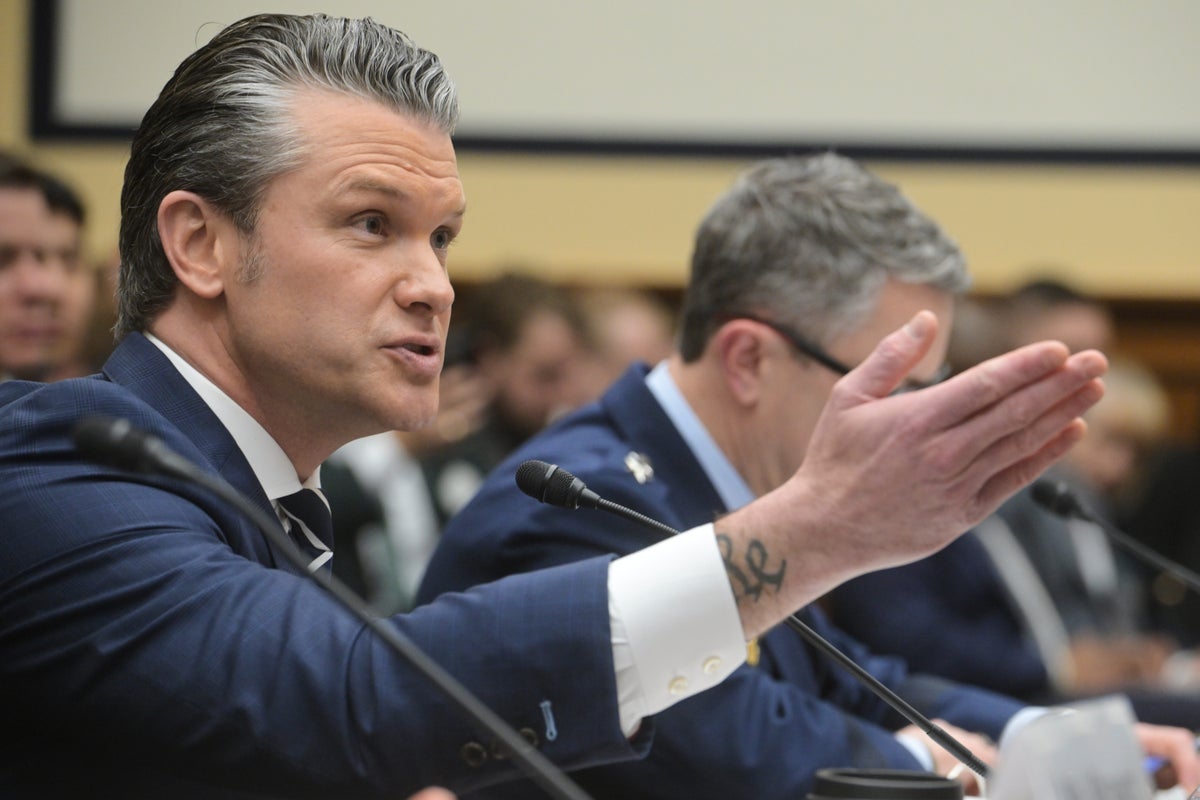
The air in Room 216 of the Hart Senate Office Building carries a specific, metallic scent. It is the smell of old floor wax, expensive wool, and the electric hum of a dozen television cameras waiting for a slip-up. When Pete Hegseth and General Caine took their seats behind the witness table, the silence wasn't just a lack of noise. It was a physical weight.
In the hallways of power, we often treat military leadership like a math problem. We talk about troop levels, procurement cycles, and readiness percentages as if they are entries in a ledger. But as the committee chairman leaned into the microphone, the ledger felt irrelevant. This wasn't a hearing about numbers. It was a collision between two very different visions of what a nation is willing to ask of its children.
Hegseth sat with the rigid posture of a man who spent his formative years in the dust of Samarra and Kabul. To his side, General Caine represented the institutional memory of the Pentagon—a man whose uniform was a roadmap of every American conflict since the Cold War. They were there to answer for the future of the American warfighter, but the subtext was much louder than the testimony.
The Weight of the Uniform
Consider a young corporal standing post in a place most Americans couldn't find on a map. For that soldier, the debates in Washington aren't academic. They are the difference between a mission with a clear objective and a decade spent wandering through the fog of "nation-building" without a compass.
Hegseth’s testimony focused on a singular, uncomfortable truth: the military has a purpose that is distinct from civilian society. He spoke of "lethality" not as a buzzword, but as a moral obligation. When a government sends a human being into harm's way, that human being must be the most dangerous person in the room. Anything less is a betrayal.
The tension in the room spiked when the questioning turned to social engineering within the ranks. To the senators on the left, the military is a laboratory for progress—a place where the best of American values can be modeled. To Hegseth, that is a dangerous distraction. He argued that the only "value" that matters at 3:00 AM in a firefight is whether the person to your left can drag you to safety under fire.
It is easy to scoff at this perspective from the comfort of a climate-controlled office. But the reality of combat is visceral. It is loud. It is terrifying. It is primitive. Hegseth’s argument is that we have forgotten how to prepare for the primitive because we are too focused on the polished.
The Institutional Guardian
General Caine provided the counterweight. If Hegseth is the firebrand seeking to tear down the wallpaper, Caine is the architect who knows which walls are load-bearing.
His testimony was a masterclass in the complexity of modern warfare. He spoke of a world where the battlefield is no longer just a patch of dirt, but a digital web of satellites, fiber-optic cables, and autonomous drones. He defended the need for a broad, inclusive military because, in his view, the next war won't be won by brute strength alone. It will be won by the kid who can out-code an adversary while sitting in a trailer in Nevada.
The General’s voice remained steady, even when the questioning turned sharp. He represented the "Steady State"—the idea that the military must remain an island of stability even when the political winds are at gale force. For Caine, the human element isn't just about the warrior; it's about the entire ecosystem that supports them.
But even his composure couldn't mask the underlying anxiety shared by everyone in the room. The recruiting crisis isn't a secret. It’s a ghost haunting the Pentagon. Young Americans are looking at the military and, for the first time in generations, they are asking: "Why?"
The Invisible Stakes
Imagine a dinner table in a small town in Ohio. A grandmother is showing her grandson his grandfather’s Silver Star. For decades, that medal was a symbol of a clear, unquestioned duty. Today, that same grandson watches the news and sees a military leadership that seems more interested in winning Twitter arguments than winning wars.
That disconnect is the "invisible stake" of the Senate hearing.
When Hegseth and Caine clash over policy, they are really fighting over that kid in Ohio. Hegseth wants to tell him: "Join us, and we will make you a master of your craft. We will give you a purpose that is hard, clear, and uncompromising." Caine wants to tell him: "Join us, and you will be part of a sophisticated global force that protects the very fabric of the modern world."
Neither answer seems to be working.
The hearing touched on the skyrocketing costs of hardware—the F-35s and the new carrier groups that cost more than the GDP of some nations. But the most expensive thing in that room was the trust of the American public. You can't buy that with a supplemental budget. You can't fix it with a new slogan.
A House Divided
The most striking moment came during a back-and-forth about the "warrior culture." Hegseth argued that we have spent two decades apologizing for our strength. He pointed to the way we prosecute our own soldiers and the way we second-guess the split-second decisions of twenty-year-olds.
One senator challenged him, asking if he was advocating for a military that is above the law.
Hegseth’s response was quiet. He didn't yell. He simply noted that if you train a man to be a predator for years, you cannot be surprised when he doesn't act like a social worker the moment things go south.
This is the central friction of the modern American era. We want a military that is powerful enough to keep the world's bullies at bay, but we want it to be "nice" enough not to offend our sensibilities. We want the protection of the sword without having to look at the blood on the blade.
General Caine tried to bridge this gap. He spoke of "disciplined initiative." He argued that the American soldier is unique precisely because they do carry a moral code into the darkness. He warned that if we abandon that code in the name of "lethality," we become the very thing we are fighting against.
The Human Cost of Indecision
The hearing lasted for hours. By the end, the witnesses looked drained. The cameras began to pack up, and the senators scurried off to their next fundraisers or televised interviews.
But the questions remained hanging in the air like smoke.
We are at a crossroads. One path leads toward a military that is an extension of our social debates—diverse, inclusive, and reflective of a changing America. The other path leads back to a Spartan ideal—a separate class of citizens dedicated solely to the mastery of violence.
The danger isn't in choosing one or the other. The danger is in refusing to choose at all.
When we send a ship into the South China Sea or a platoon into a valley in the Middle East, we are sending more than just hardware. We are sending a message about who we are. If the leadership in Washington can't agree on what that message is, the person carrying the rifle is the one who pays the price.
History is littered with the ruins of nations that thought they could have it both ways. They thought they could maintain a global empire while treating their defenders as an afterthought or a political football.
As the lights dimmed in the Hart building, the two men stood up. They shook hands—a brief, professional contact between the civilian reformer and the career soldier. They walked out of the room and back into a world that is growing more dangerous by the hour.
Somewhere, a young person is watching. They are looking for a reason to believe that the sacrifice is worth it. They are looking for a sign that the people in charge understand the weight of the gavel and the sharp edge of the sword.
They are still waiting.