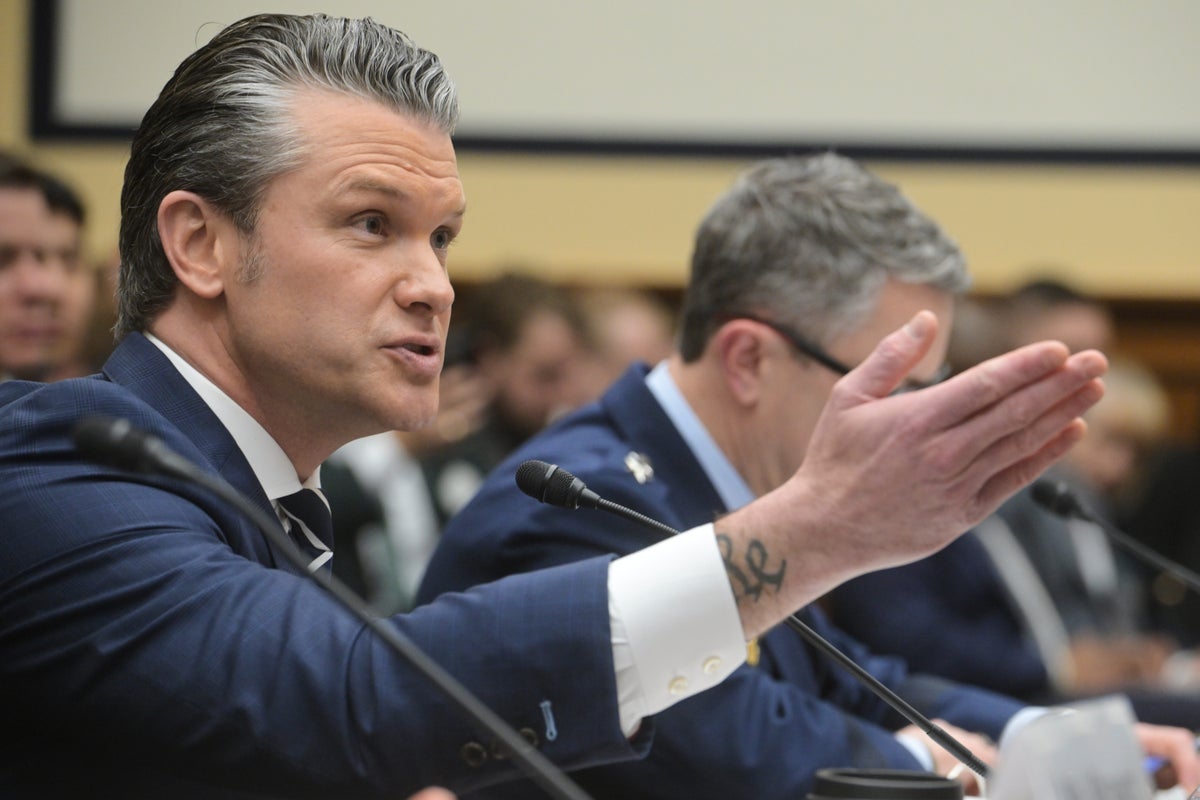
The confirmation hearings for Pete Hegseth regarding his oversight of the Department of Defense have transitioned from a standard political vetting process into a high-stakes audit of executive war-making authority. While media narratives focus on the friction of the "grilling" itself, the underlying tension is a fundamental disagreement over the Unitary Executive Theory versus Congressional Oversight in the context of preemptive or retaliatory strikes. The central inquiry is not merely about past actions but about the prospective risk profile of a Secretary of Defense who maintains a divergent view on international rules of engagement.
The Triad of Confirmation Resistance
Opposition to the Hegseth nomination operates across three distinct analytical layers. Each layer represents a different systemic concern that congressional Democrats are leveraging to challenge his suitability for the role. For another view, see: this related article.
- Legal and Normative Compliance: This involves the candidate's historical stance on the Geneva Conventions and the laws of armed conflict. The risk identified here is "normative erosion," where a leader’s rhetoric signals to the rank-and-file that established international legal frameworks are optional rather than mandatory.
- Strategic Risk Assessment: The primary friction point in the current hearings involves the Iran-U.S. escalation cycle. Senators are examining whether the candidate’s decision-making matrix prioritizes short-term tactical shows of force over long-term regional stability. The concern is a "miscalculation loop," where aggressive posturing triggers a defensive reaction from an adversary, leading to unplanned kinetic conflict.
- Institutional Continuity: The Department of Defense (DoD) is a massive bureaucracy reliant on predictable policy cycles. A leader who views the existing institutional guardrails as impediments rather than safeguards creates internal friction. This is analyzed through the lens of civil-military relations—specifically, how a non-traditional appointee manages a professionalized officer corps accustomed to a specific doctrine.
Mechanics of the Escalation Bias
A significant portion of the questioning targets Hegseth’s specific commentary regarding military action against Iran. In strategic studies, this is categorized as Escalation Bias. When a decision-maker views every adversarial move through a lens of total ideological opposition, the available response set narrows.
The logic being scrutinized follows a linear path: Similar insight on this trend has been published by Associated Press.
- Threat Perception: Identifying Iranian regional influence as an existential rather than a manageable threat.
- Response Selection: Preferring high-impact kinetic options (e.g., strikes on cultural or leadership targets) over diplomatic or economic containment.
- Risk Tolerance: Accepting a high probability of regional war as a necessary byproduct of "restoring deterrence."
Congressional interrogators are attempting to quantify this risk. They are seeking a commitment to the War Powers Resolution, which requires the President to consult Congress before committing forces into hostilities. Hegseth’s reluctance to provide granular constraints on executive power suggests a strategy of "Strategic Ambiguity," which, while effective in some deterrence models, creates significant internal political instability during a confirmation process.
The Cognitive Dissonance of Cultural Warfare in Defense Logic
A unique variable in this confirmation is the intersection of military readiness and cultural ideology. Hegseth has frequently argued that the DoD has been compromised by "woke" policies that degrade combat lethality. From a consultant’s perspective, this is an argument about Resource Allocation and Organizational Focus.
However, the counter-argument presented by the committee is that these "cultural" policies are actually Retention and Recruitment Mechanics. The U.S. military is currently facing its most severe recruiting crisis in decades. The data suggests that narrowing the recruitment pool or creating a hostile environment for specific demographics results in a "Talent Bottleneck."
The logic gap here is significant:
- Hegseth’s Thesis: Ideological neutrality (or a return to traditionalist standards) increases unit cohesion and lethality.
- Committee’s Antithesis: Modern warfare requires a high-tech, diverse workforce; exclusionary rhetoric reduces the total available human capital, thereby weakening the force.
This creates a deadlock where both sides use the term "readiness" to describe diametrically opposed personnel strategies.
Accountability Cycles and the Commander’s Intent
The second day of questioning has pivoted toward the "Command Climate" Hegseth would likely establish. In military doctrine, Commander’s Intent is the clear and concise expression of the purpose of the operation and the desired end state. It provides the "why" so that subordinates can exercise disciplined initiative.
The friction in the hearing arises from Hegseth’s previous support for service members accused or convicted of war crimes. To a data-driven analyst, this is a problem of Incentive Structures.
- If the highest levels of leadership signal that violations of the Uniform Code of Military Justice (UCMJ) will be pardoned or overlooked, the internal policing mechanism of the military fails.
- This leads to "Moral Hazard," where soldiers feel empowered to take actions that violate the laws of war, knowing they have political cover.
- The result is a degradation of international legitimacy and an increase in the difficulty of maintaining foreign alliances.
The "grilling" is a mechanism to force a recalibration of this incentive structure before the candidate takes office. Senators are looking for a shift from "Advocate" to "Administrator."
The Economic and Geopolitical Cost of Unilateralism
The debate over the Iran war is not just about missiles; it is about the Global Commons. The Strait of Hormuz carries roughly 20% of the world's petroleum liquids. Any policy that increases the likelihood of a kinetic conflict in this corridor carries a massive "Conflict Premium" for the global economy.
Strategic analysts calculate the cost of a secretary’s ideology by looking at the Volatility Index (VIX) and oil futures. A Secretary of Defense perceived as "pro-war" or "hawkish" without a clear de-escalation strategy induces market instability. The committee’s focus on Iran is an attempt to price this risk. If Hegseth cannot define the boundaries of a "proportionate response," he creates a vacuum of predictability that allies and markets find untenable.
Structural Limitations of the Grilling Process
While the questioning is rigorous, it suffers from the Information Asymmetry inherent in classified defense matters. Hegseth can—and does—revert to "broad policy objectives" when pinned down on specific tactical scenarios. This creates a circular debate where:
- Democrats ask for a specific "No-Go" criteria for Iran.
- Hegseth provides a "National Interest" justification.
- The lack of specificity is labeled as a lack of fitness by the opposition.
- The lack of specificity is labeled as "necessary discretion" by supporters.
This stalemate confirms that the hearing is less about discovering new facts and more about a Vetting of Temperament. The goal is to see if the candidate breaks under the pressure of prolonged scrutiny, which serves as a proxy for his ability to handle a high-stress crisis in the Situation Room.
Predictive Analysis of the Confirmation Path
The probability of confirmation remains tied to party-line discipline rather than the technical merits of the testimony. However, the "damage" being done in these hearings isn't necessarily to the confirmation itself, but to the Initial 100-Day Efficacy.
A Secretary of Defense entering the Pentagon after a bruising, high-friction confirmation faces:
- Low Institutional Buy-In: The "Frozen Middle" of the DoD bureaucracy will be less likely to implement radical reforms if they believe the Secretary lacks a strong mandate.
- Heightened Congressional Surveillance: Every memo and movement will be scrutinized by the committees that just spent days questioning his judgment.
- Allied Hesitation: Foreign defense ministers will be cautious in sharing intelligence or committing to joint exercises until they see how the Secretary's rhetoric translates into actual policy.
The strategic play for Hegseth in the remaining hours of testimony is to pivot toward Technical Competence. He must move away from the "punditry" that defined his previous career and adopt the language of Systems Integration and Budgetary Oversight. The committee is currently attacking his "Why" (his ideology); he can only survive by proving his "How" (his ability to manage the $840+ billion DoD budget and the 2.8 million personnel under his charge).
The failure to define a clear, non-escalatory path regarding Iran will leave a permanent "Risk Premium" on his tenure. To mitigate this, the nominee must provide a concrete definition of "Victory" that does not require a total regional realignment—a task that remains unfulfilled. The outcome hinges on whether he can convince two or three skeptical centrist votes that his desire for "disruption" stops short of "destabilization."