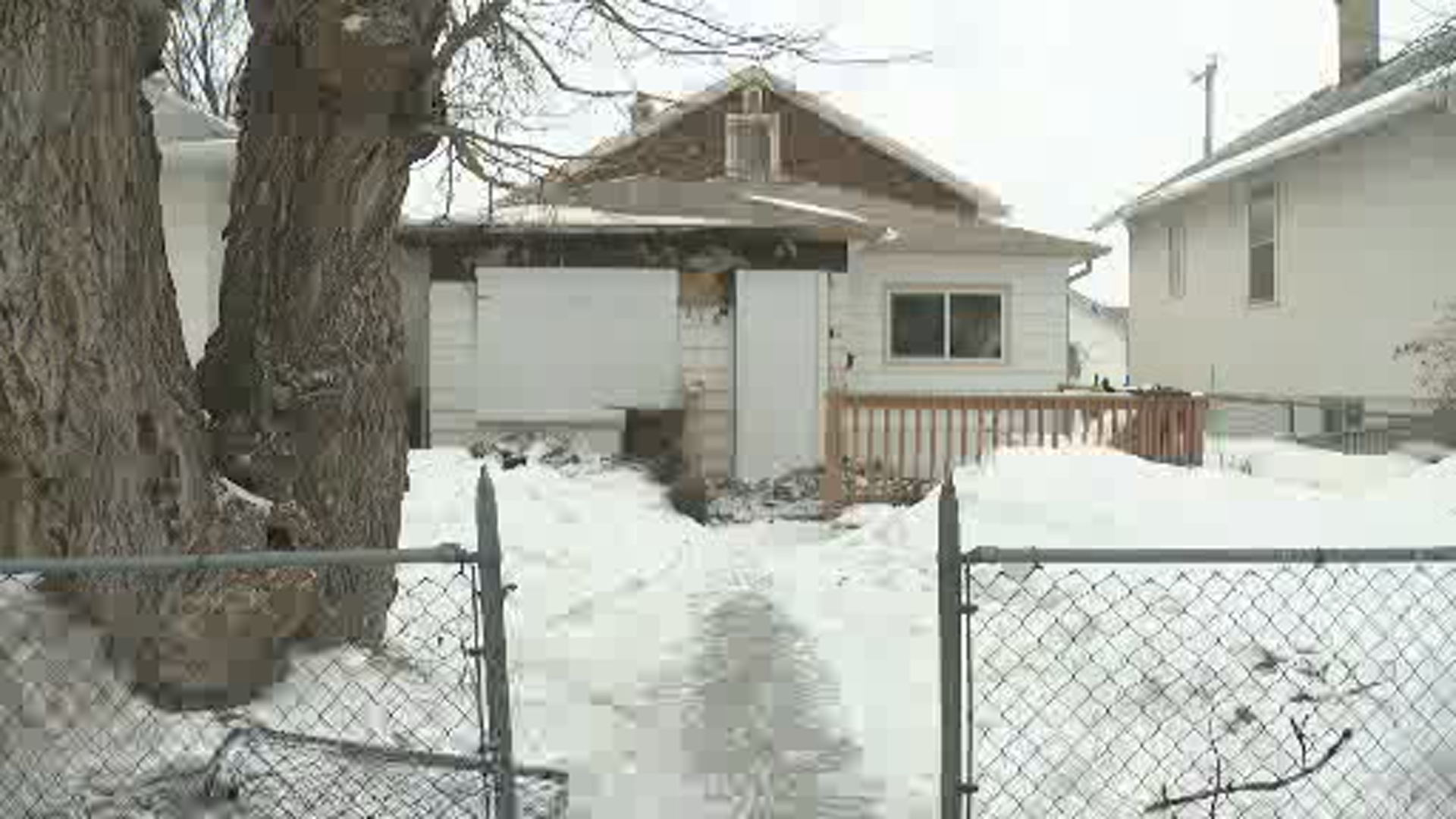
The report out of Trent Avenue is a tragedy, but the way we talk about it is a farce. A person died. The neighbors watched the smoke. The fire department arrived. The news cycle moved on to the next siren. We treat these events like "accidents"—unpredictable lightning strikes of bad luck.
They aren’t.
Every time a residential fire makes the evening news, we get the same tired advice: check your smoke detector batteries, have an escape plan, don't leave candles burning. It is the safety equivalent of telling a drowning person to try harder to float. If we actually wanted to stop the body count on streets like Trent Avenue, we would stop obsessing over batteries and start talking about the structural and economic negligence that makes modern homes literal tinderboxes.
The Synthetic Death Trap
The "lazy consensus" is that house fires are getting deadlier because people are careless. Wrong. Fires are getting deadlier because your living room is made of solid gasoline.
Thirty years ago, you had roughly 14 to 17 minutes to escape a house fire. Today, you have about three. This isn't a theory; it is a measurable result of the shift from natural materials to synthetics. I have spent years looking at the aftermath of these scenes. When a wooden chair burns, it’s a slow, predictable process. When your polyurethane foam sofa catches, it undergoes a process called "flashover" almost instantly.
We are building environments where the time between "ignition" and "unsurvivable" is shorter than the average response time of the fastest fire department in the country. To report on a fatal fire without mentioning the chemical composition of the modern home is like reporting on a car crash without mentioning the brakes failed.
The Smoke Detector Myth
We worship the smoke detector as a silver bullet. It’s a plastic disk that costs ten dollars and gives us a false sense of security.
Here is the brutal truth: a standard ionization smoke alarm—the kind in 90% of homes—is garbage at detecting the smoldering fires that kill people in their sleep. They are great at screaming when you burn toast, which leads to people ripping the batteries out in frustration. By the time an ionization sensor picks up the thick, toxic smoke of a smoldering synthetic mattress, the air in the room is already lethal.
If you aren't using photoelectric sensors, you aren't protected. But you don't hear that in the Trent Avenue post-mortem. You just hear the same drone about "checking the batteries." We are blaming the victims for not maintaining a flawed technology that was never designed to handle the speed of a modern chemical fire.
The Poverty of Protection
Look at where fatal fires happen. They don't happen in LEED-certified, newly minted smart homes in the suburbs. They happen in older, subdivided housing stock where the electrical systems were designed for a 1950s toaster, not a 2026 array of high-draw appliances and lithium-ion chargers.
Fire safety is a luxury good.
- Residential Sprinklers: The only thing that actually stops a fire in its tracks. They are absent from almost all older residential stock because of lobbying from developers who claim the cost is "prohibitive."
- Arc-Fault Circuit Interrupters (AFCIs): These can detect the specific type of electrical arcing that starts fires before a standard breaker even trips. Most older homes on streets like Trent Avenue don't have them.
- Space Heaters: We wag our fingers at people for using them, ignoring the fact that many tenants use them because their landlords haven't updated the central heating in forty years.
We treat fire safety as a matter of personal "vigilance" because that's cheaper than holding the construction and real estate industries accountable for the death traps they lease out.
Stop Planning Your Escape and Start Hardening Your Zone
The standard advice is to "have an escape plan." Fine. But if you’re on the second floor and the hallway is at $600^\circ\text{C}$, your plan is just a wishlist.
Real survival isn't about a map on the fridge. It’s about "hardening" the environment.
- Close the Damn Door: The "Close Before You Doze" campaign is the only piece of mainstream advice worth its salt. A closed bedroom door can keep a room at $100^\circ\text{F}$ while the hallway is $1000^\circ\text{F}$. It is the difference between life and a headline.
- Lithium-Ion Literacy: We are ignoring the elephant in the room. E-bike batteries and cheap knock-off phone chargers are the new leading causes of "spontaneous" fires. If you are charging a high-capacity lithium battery in your only path of egress, you are committing passive suicide.
- The Sprinkler Mandate: We need to stop asking nicely. Every multi-family dwelling, regardless of age, should be retrofitted with heavy-duty suppression systems. The "cost" argument is a lie told by people who value a 2% margin over a human life.
The Wrong Question
The public asks: "How did the fire start?"
The insider asks: "Why did the building allow it to spread?"
Focusing on the "spark" is a distraction. Sparks happen. Cooking accidents happen. Electrical shorts happen. A civilized society builds structures that can contain a mistake. We have moved in the opposite direction, favoring open-concept floor plans that allow fire to travel like a high-speed train and using "lightweight" construction materials that collapse in minutes.
We are trading structural integrity for aesthetic vibes and cheap square footage. The fire on Trent Avenue wasn't a freak accident. It was the logical conclusion of our current building philosophy.
If you want to honor the dead, stop buying 9-volt batteries and start demanding fire-rated materials and mandatory sprinkler retrofits. Everything else is just theater.
Go to your front door. Look at your sofa. Realize it is essentially a pile of solid gasoline. If that doesn't change your perspective on "safety," nothing will.