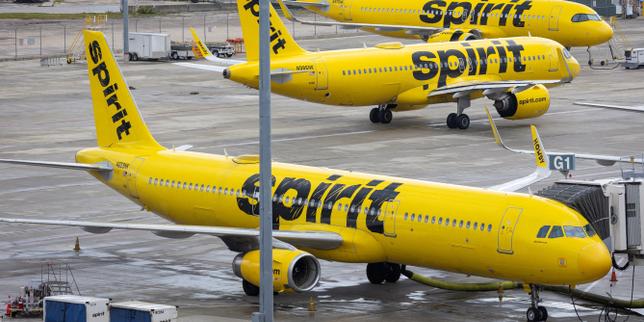
The yellow planes are grounded. Spirit Airlines has officially shuttered its operations, filing for a total liquidation that marks the largest collapse in the American aviation sector in decades. For millions of travelers who relied on "Bare Fare" pricing to visit family or take a rare vacation, the news is a blunt force trauma to the wallet. For the industry, it is the predictable culmination of a decade spent chasing growth at the expense of a functional balance sheet.
Spirit’s demise wasn't triggered by a single bad season or a fluke of the market. It was a slow-motion collision between a debt-heavy business model and a post-pandemic reality that no longer had room for a carrier that sold seats like a commodity but treated its customers like an after-thought. When the engines finally stopped, the company was suffocating under billions in debt, a failed merger attempt, and an operational cost structure that had become indistinguishable from the legacy carriers it once sought to disrupt.
The Mirage of the Bare Fare
The foundational promise of Spirit Airlines was simple. They unbundled everything. You paid for a seat, and if you wanted water, a carry-on bag, or the luxury of choosing where you sat, you paid again. This worked when fuel was cheap and the "Big Three"—Delta, United, and American—were slow to react.
The math has changed. Labor costs have surged following a series of aggressive pilot and flight attendant contract renegotiations across the industry. Fuel remains volatile. Most importantly, the legacy carriers stopped ignoring the bottom of the market. By introducing "Basic Economy," the major airlines effectively weaponized Spirit's own strategy against it. They offered the same low price but with the backing of massive loyalty programs, better reliability, and more robust hub networks. Spirit found itself squeezed into a corner where it could no longer offer a price low enough to justify the indignity of its service model.
Why the JetBlue Merger Was a Suicide Note
In 2022, Spirit became the center of a bidding war between Frontier and JetBlue. Management chose JetBlue’s cash offer, a move that now looks like a desperate grab for a life raft that was never going to be launched. The Department of Justice blocked the merger on antitrust grounds, arguing that removing Spirit would eliminate a "disruptive" force that kept prices low for consumers.
The irony is thick. By blocking the merger to "save" competition, the regulators effectively signed Spirit’s death warrant. The airline had stopped being a disruptor years ago; it was a zombie. Without the capital infusion and the operational integration JetBlue promised, Spirit was left to face its mounting debt alone. It had no Plan B. The company spent two years in a state of corporate stasis, waiting for a legal miracle while its cash reserves evaporated and its Pratt & Whitney engines faced massive, fleet-grounding recall issues.
The Engine Crisis That Broke the Back
You cannot run an airline if your planes cannot fly. Spirit was disproportionately hit by issues with the Pratt & Whitney Geared Turbofan (GTF) engines. At the time of the shutdown, dozens of Spirit’s Airbus A320neo aircraft were parked on the tarmac, waiting for inspections and parts that were months away.
This wasn't just a technical glitch. It was a catastrophic drain on revenue. Spirit was forced to pay for planes that weren't generating a cent, all while leasing older, less efficient aircraft to fill the gaps. For a high-utilization carrier that depends on keeping planes in the air twenty hours a day, this was the final mechanical failure that the balance sheet couldn't survive.
The Myth of Consumer Benefit
Critics of the liquidation argue that the loss of Spirit will lead to an immediate spike in airfares. This is a half-truth. While the literal "ten-dollar fare" might vanish, the market has already moved on. The ultra-low-cost carrier (ULCC) model in America is currently being rewritten.
Southwest is moving toward assigned seating. Frontier is bundling perks back into its fares. The industry has realized that the "race to the bottom" has a floor, and Spirit hit it hard. Passengers became weary of the hidden fees and the constant threat of cancellations. The cost of a Spirit ticket was never just the price on the screen; it was the risk of being stranded without a backup flight in a network that had zero slack.
The Creditor Reaping
When an airline fails this spectacularly, the focus usually lands on the passengers holding useless tickets. But the real story is in the bankruptcy courts. Spirit’s creditors, holding roughly $3.3 billion in debt, finally stopped believing in the turnaround story.
The liquidation process will be a fire sale. Spirit’s slots at congested airports like Orlando, Las Vegas, and Fort Lauderdale are the crown jewels. Their relatively young fleet of Airbus jets will be picked over by competitors looking to expand without waiting for Boeing’s backlogged production lines.
A Warning to the Remaining Players
Frontier and Allegiant are now the last ones standing in the true ULCC space, and they are looking over their shoulders. Spirit’s collapse proves that you cannot survive on volume alone if your margins are razor-thin and your brand equity is negative.
To stay alive, the remaining budget carriers are being forced to "premiumize." They are adding legroom, improving reliability, and trying to convince the American traveler that "cheap" doesn't have to mean "broken." Spirit refused to evolve until it was too late. They doubled down on a 2010 strategy in a 2026 world.
How to Navigate the Fallout
If you are one of the thousands of travelers with a cancelled Spirit itinerary, do not wait for the airline to reach out. Their customer service infrastructure is essentially non-existent at this stage.
- Credit Card Chargebacks: This is your most effective weapon. If you paid for a service that was not rendered due to insolvency, your bank is required to investigate and, in most cases, refund the transaction.
- Alternative Carriers: Delta and United have already begun adding capacity on key Spirit routes, but don't expect them to match the defunct carrier's prices. The "Spirit Discount" is gone.
- The DOT Mandate: Under recent Department of Transportation rulings, airlines are required to provide prompt cash refunds for cancelled flights. However, in a liquidation, the queue for those refunds is long and the pot of gold is nearly empty.
The era of the "yellow bus in the sky" is over. It serves as a grim reminder that in the airline business, growth is a vanity metric, but cash flow is reality. The market didn't kill Spirit Airlines; a stubborn refusal to acknowledge that the consumer had grown up did.