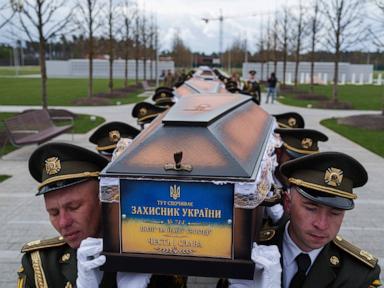
Mass graves and nameless headstones make for powerful, heartbreaking journalism. We have all read the standard dispatch: a somber cemetery on the outskirts of Dnipro or Kyiv, rows of fresh graves marked only by numbers, and a narrative centering entirely on the tragedy of bureaucratic delay. The prevailing sentiment is always the same: Why is this taking so long? Why can’t the state identify these soldiers immediately?
The media loves to frame this backlog as a failure of administrative will or a lack of modern technology. They treat DNA identification like a CSI episode where a technician runs a cheek swab through a machine and gets a matching face on a monitor thirty seconds later. Learn more on a similar topic: this related article.
This is a fantasy.
The reality of forensic identification in a high-intensity, peer-to-peer artillery war is a brutal exercise in hard science, resource limits, and logistical triage. Pushing for faster, emotional "closure" at the expense of scientific certainty is not just naive—it is a recipe for catastrophic errors that destroy what little peace grieving families have left. Further analysis by NPR highlights related views on the subject.
We need to stop treating forensic identification as a PR problem and start understanding it as a highly complex, resource-constrained industrial pipeline.
The Illusion of the Instant Match
To understand why the backlog exists, you have to understand the physical reality of the samples being collected.
In low-intensity conflicts or localized disasters, DNA recovery is relatively straightforward. You have intact tissue, rapid recovery times, and clear manifests of who was where.
Ukraine is not a low-intensity conflict. It is an industrial artillery war.
- Severe Degradation: High-explosive munitions and prolonged exposure to the elements before recovery destroy cellular structure. When bone and deep tissue are highly degraded, standard short tandem repeat (STR) typing—the bread and butter of civilian forensics—fails.
- The Reference Sample Trap: A DNA profile is useless without a comparison. To identify a soldier, you need reference DNA from direct relatives (parents, children, siblings). In a country where millions of citizens have been displaced across Europe, collecting high-quality reference swabs from scattered family members is an administrative nightmare.
- Mass Contamination: In trench warfare, recovery teams often retrieve highly commingled remains. Separating individual profiles from a single recovery site requires meticulous, slow-motion laboratory work.
If you rush this process, you get mismatched remains. Imagine the psychological horror of a mother burying a body, only to find out three years later via a corrected database match that she buried someone else's son, while her own remains are sitting in a freezer or another nameless grave. The only thing worse than no identification is a wrong identification.
The Bottleneck is Not Technology, It Is Lab Capacity
The popular critique is that the state needs to "modernize" its labs. Journalists point to next-generation sequencing (NGS) as a magic bullet.
It isn't.
I have spent years looking at resource allocation in high-pressure scientific environments. Buying a dozen state-of-the-art sequencers and dumping them in a war zone does not solve a bottleneck; it just moves it.
[Raw Remains] ➔ [Extraction Bottleneck] ➔ [Amplification] ➔ [Sequencing] ➔ [Kinship Analysis]
The real constraints are far more mundane:
1. Reagent Supply Chains
High-throughput DNA extraction kits are highly specialized chemical products. In a globalized economy, these reagents are manufactured by a handful of companies (like Qiagen or Promega). A nation at war is competing with global commercial markets for these supplies. When airfields are targeted and borders are congested, getting temperature-sensitive chemical reagents into country without them spoiling on a tarmac is a logistical feat.
2. The Qualified Personnel Deficit
You cannot train a forensic DNA analyst in a three-week crash course. It requires years of academic training and hands-on laboratory experience. You can buy 50 new sequencing machines, but if you only have 15 qualified molecular biologists capable of validating the data and signing off on a legally binding identification, those machines will sit idle.
3. The Math of Kinship Statistics
Simply finding a genetic match is not enough. Analysts must calculate the Likelihood Ratio (LR) to prove the match did not happen by chance, especially when dealing with partial profiles or distant relatives. In a closed population where many soldiers come from the same regions, the statistical margin of error must be exceptionally tight to avoid false positives.
Stop Demanding Faster Mourning
We live in an era of instant gratification, where we expect complex human problems to be solved with the swipe of an app. This cultural impatience has bled into how we view the aftermath of war.
The narrative that burying soldiers temporarily under temporary numbers is a "failure" of the state is fundamentally wrong. It is actually a sign of systemic discipline.
Temporary burial in marked, mapped, and meticulously documented plots is a standard, scientifically sound practice. It allows the state to:
- Clear overwhelmed morgues to prevent public health crises.
- Preserve remains in a stable environment (the earth) when refrigerated storage capacity is compromised by power grid failures.
- Conduct the grueling work of DNA extraction and database matching at a pace that guarantees accuracy, rather than speed.
Amateur commentators want these bodies kept in high-tech, refrigerated trailers indefinitely until they are named. But in a country where the energy grid is constantly targeted by long-range missiles, relying on continuous refrigeration for thousands of unidentified remains is a massive operational risk. Earth burial is the safest, most respectful fallback system available.
The Hard Truth of Triage
Here is the perspective nobody wants to print: The living must always take priority over the dead.
Every dollar, every skilled technician, and every logistics route allocated to identifying remains is a resource diverted from active forensic investigations of ongoing war crimes, or from medical labs processing blood work for wounded survivors.
A state fighting an existential war must practice triage. It is cold, it is heartless, and it is absolutely necessary.
When resources are scarce, prioritizing the identification of every single fragment of remains over the immediate survival of the state is a luxury that cannot be afforded. The fact that any systematic identification effort is happening at all under constant bombardment is an extraordinary feat of scientific resilience.
Instead of writing hand-wringing pieces about the tragedy of temporary graves, we should be realistic about the limits of forensic science in a total war. The families waiting for answers deserve truth, not speed. And the truth requires time, silence, and a level of meticulous care that cannot be rushed by the demands of a twenty-four-hour news cycle.