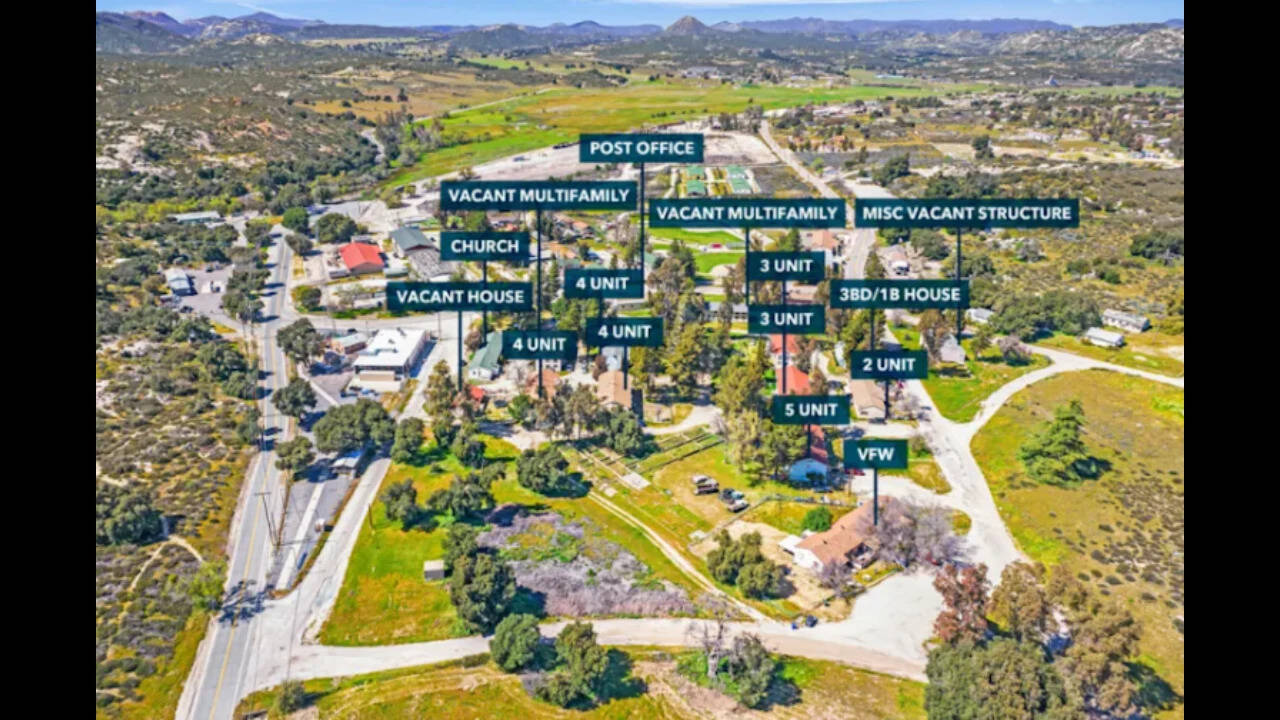
The key squeaks in the lock of the local post office just the way it has every morning since the Eisenhower administration. It is a dry, metallic sound, accompanied by the heavy groan of a brass-hinged door swinging open to catch the dry Sierra Nevada wind. Nobody is waiting in line. Nobody is tapping a foot or checking a watch. There are twenty-seven apartments resting quietly under the dust of the California foothills, a handful of mailboxes, and a price tag that has just quietly slipped down to $5.9 million.
Think about what $5.9 million buys you in the coastal zip codes of this state. A modest penthouse with shared walls in Santa Monica. A stucco tear-down on a postage-stamp lot in Silicon Valley, where the neighbors' hedge touches your kitchen window.
Here, your money buys the horizon.
It buys a settlement. It buys an entire operational ecosystem where the person sorting the letters might also know how to fix your water pump and tell you which way the deer are moving before the first snow hits the peaks.
To understand what is happening in Nipton or these microscopic private hamlets scattered across the California map, you have to throw away everything you know about real estate valuation. This is not about square footage. This is not about stainless steel appliances or quartz countertops. This is about buying an entire social contract, packaged neatly into an acreage that fits in the palm of a billionaire's hand.
I remember standing on a gravel road in a similar speck of a town years ago, listening to the absolute, suffocating silence. It is a sound that city dwellers mistake for emptiness. But if you stand there long enough, the silence peels back. You hear the creak of old cedar under a desert sun. You smell sage crushed beneath a truck tire. You realize that space—real, uninterrupted, unzoned-to-death space—is the ultimate luxury left on the American continent.
Yet, the market is hesitating.
Why? Because owning an entire town is terrifying.
When you buy a single-family home, your problems end at the property line. When you buy a town, you inherit the plumbing of human dependency. You own the sewer lines. You own the post office contract. You own the psychological weight of being the landlord to people who have lived in those twenty-seven apartments for decades, watching the world race past them on the nearby highway while they stay anchored in amber.
The listing price dropped from a higher number, as reality set in. Five point nine million dollars sounds like a lot until you divide it by the sheer audacity of what is included. But the sellers are wrestling with a modern paradox. The people who have $5.9 million sitting liquid in a portfolio usually want a glass tower in Century City or a vineyard in Napa where they can host charity galas. They do not want to manage a rural zip code where the most pressing daily crisis is a jammed sorting box or a stray coyote.
And the people who love these towns—the ones who understand the creak of that post office door—rarely have five thousand dollars, let alone five million.
Consider the hypothetical buyer. Let us call him Arthur. Arthur made his fortune in logistics software, staring at glowing monitors in San Francisco until his eyes burned. He retired early, wealthy beyond reason, but profoundly tired. He drives up the highway, sees the hand-painted sign, and pulls over. He walks the gravel perimeter. He looks at the twenty-seven doors.
In that moment, Arthur is not calculating return on investment. He is looking for redemption. He wants to step out of the frantic stream of digital life and build something tangible. He imagines painting the trim. He imagines turning one of the vacant spaces into a communal bakery. He feels, briefly, like a pioneer.
Then reality taps him on the shoulder.
He remembers he doesn't know how to maintain a well pump. He realizes that municipal bonds and remote property management are entirely different beasts. The romantic fantasy collides with the administrative ledger. He gets back into his electric sedan, turns the air conditioning down, and drives back to the coast.
This is why the town lingers on the market. It sits in the awkward chasm between the old West and the new economy.
These tiny settlements were often born of extraction. A railroad needed a water stop. A mine needed bodies. A highway bypassed a settlement, and time simply forgot to turn off the lights. They survived through sheer stubbornness, kept alive by residents who refused to scatter to the sprawling suburbs of the Central Valley or the coast.
Now, they are novelty items for the ultra-wealthy or desperate conservation projects for historic preservationists.
At $5.9 million, the price is practically a rounding error for institutional wealth. But the responsibility is monumental. Whoever signs the deed does not just acquire asphalt and drywall. They become the custodian of a living museum. They dictate whether the post office stays open, whether the aging tenants can stay in their homes, whether the desert reclaims the asphalt or human hands push back the dust for another generation.
The wind kicks up again outside the empty mercantile. A tumbleweed bounces across the empty asphalt lot, indifferent to the price drops, the real estate listings, or the ambitions of men who want to own a piece of the map. The mailboxes wait. The twenty-seven doors remain closed. Somewhere out there, the right eccentric is packing a bag, entirely unaware that a whole world is waiting for someone to finally turn the key.