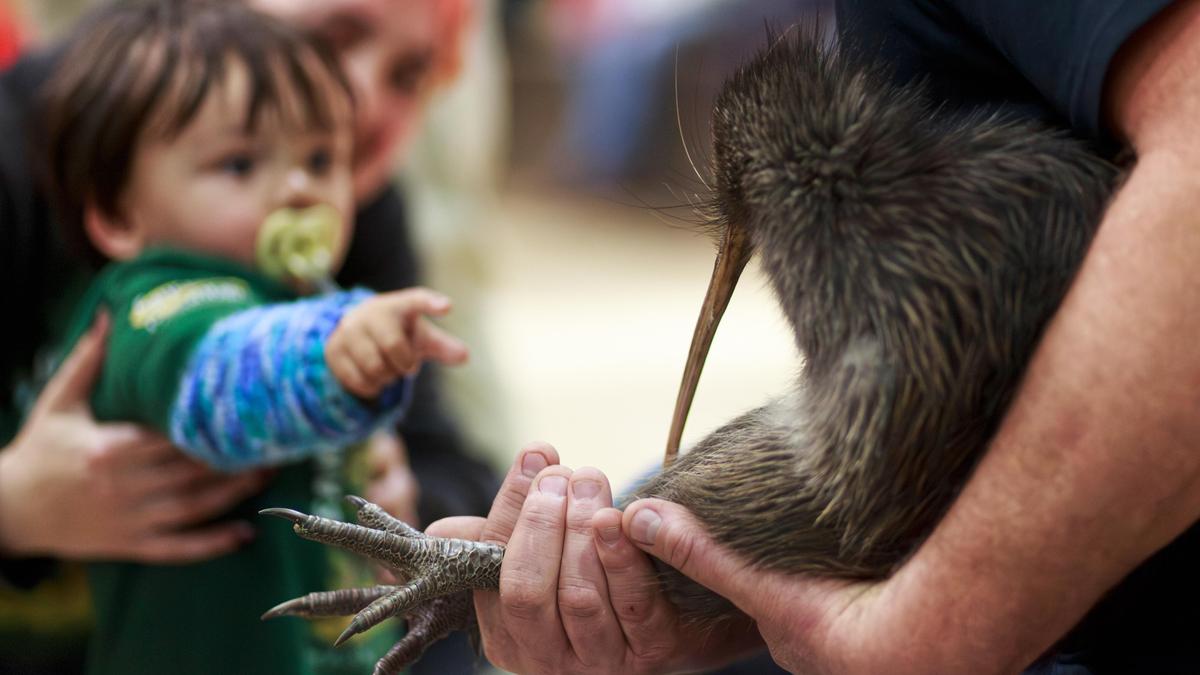
The return of the North Island brown kiwi to the hills surrounding Wellington is not a miracle. It is a logistical heist. After a century of absence, the flightless bird that defines New Zealand's national identity has finally breached the perimeter of the country's capital city. While casual observers celebrate the aesthetic victory of seeing a prehistoric bird in their backyard, the actual mechanics of this homecoming reveal a gritty, expensive, and high-stakes gamble that pits suburban expansion against evolutionary survival.
Most people assume the kiwi disappeared because of "progress." That is too simple. The kiwi was systematically erased by a wave of biological invaders—stoats, ferrets, and dogs—that turned the Wellington peninsula into a death trap. Bringing them back required more than just goodwill; it required a total transformation of the urban fringe into a fortress.
The Invisible War in the Undergrowth
To understand why kiwi can now survive in a city of 200,000 people, you have to look at what has been removed. For decades, the Makara hills and the rugged valleys of Karori were a buffet for introduced predators. A single stoat can wipe out an entire season of kiwi chicks. To counter this, the Capital Kiwi Project had to execute one of the largest community-led trapping operations in the southern hemisphere.
We are talking about a network of 4,500 traps covering 46,000 hectares. This isn't a hobbyist project. It is a massive, coordinated infrastructure project.
The sheer scale of the trapping effort highlights a hard truth about modern conservation. Nature no longer manages itself in the face of invasive species. If the traps stop, the kiwi die. The "wild" we are seeing in Wellington is a highly managed, artificial sanctuary maintained by a volunteer army and professional hunters. This is conservation as a permanent state of war.
The Dog Problem Nobody Wants to Discuss
While stoats are the primary killers in the deep bush, the biggest threat to the new Wellington kiwi population isn't a wild predator. It is the family pet. Kiwi have a unique, pungent smell that dogs find irresistible. Because kiwi lack a sternum, a "playful" squeeze from a Labrador is enough to crush their internal organs and kill them instantly.
This creates a massive cultural friction point. Wellingtonians love their dogs and their rugged walking tracks. Now, those tracks are active kiwi habitats. The success of this rewilding project hinges on whether thousands of suburban residents are willing to change how they interact with their own neighborhoods.
- Leash compliance is no longer a matter of park etiquette; it is a life-or-death requirement for the national bird.
- Aversion training for dogs is becoming a standard necessity for local pet owners.
- Night-time wandering for cats and dogs must be strictly curtailed to protect the nocturnal birds.
The friction is real. You cannot have a truly wild environment and a completely unrestricted urban lifestyle in the same physical space. One must give way to the other.
Economics of the Avian Return
Rewilding is expensive. The funding for the Capital Kiwi Project comes from a mix of government grants, private philanthropy, and local councils. Critics often ask if the millions spent on a few dozen birds in a capital city could be better used protecting larger, more "pure" populations in the deep wilderness of the South Island.
It is a fair question. From a cold, biological standpoint, the Wellington kiwi are a high-maintenance boutique population. However, the value here isn't just ecological. It is psychological.
By bringing the kiwi into the city, conservationists are making the struggle visible. When the bird is a distant concept living in a remote forest, people don't feel the stakes. When the bird is calling from the gully behind your garage, the stakes are personal. This is a massive exercise in branding and public engagement. The kiwi is the "flagship species" being used to justify the radical removal of invasive predators across the entire country.
The Risk of the Island Mentality
New Zealand’s broader goal is "Predator Free 2050." The Wellington experiment is a laboratory for that national ambition. But there is a risk in focusing too much on "island" sanctuaries—whether they are actual islands or "mainland islands" protected by fences and traps.
If we create pockets of safety without addressing the surrounding environment, we create biological dead ends. The kiwi in Wellington need to be able to breed and move. They need genetic diversity. If the population remains trapped in a small zone because the surrounding suburbs are too dangerous to cross, the project eventually fails due to inbreeding and localized catastrophes like fire or disease.
The Long Road to Self Sufficiency
The first few dozen kiwi released are just the beginning. For the population to be truly "returned," it needs to reach a self-sustaining density where deaths from old age and natural causes are offset by chick survival rates.
Currently, in the wild, the survival rate for kiwi chicks is abysmal—often less than 5%. In the managed zones of Wellington, that number needs to hit 50% or higher to see real growth. This requires constant monitoring. Many of the birds carry radio transmitters, allowing teams to track their movements and health.
This isn't just bird watching. It is intensive data management. Every death is investigated. Every failed nesting attempt is analyzed.
A Landscape Reimagined
What is happening in Wellington is a total reimagining of what a city can be. For the last century, urban development was about clearing the "messy" parts of nature to make room for concrete and lawns. Now, the city is trying to invite the mess back in.
This requires a different kind of gardening. It means planting native corridors that provide cover for birds. It means rethinking street lighting, as bright lights can disorient nocturnal species. It means accepting that sometimes, nature is loud, smelly, and inconvenient.
The kiwi's return is a test of human tolerance. We like the idea of the bird on our currency and our passports. We are less certain about the bird that wakes us up at 3:00 AM with a piercing shriek or the bird that requires us to keep our dogs on a short leash in what used to be an off-leash park.
Survival is a Choice
The return of the kiwi to Wellington proves that we can reverse the damage of the past. But it also reveals that there is no "reset" button for the environment. We cannot simply release birds and walk away. We have traded a natural ecosystem for a managed one, and we are now the permanent managers.
The birds are back, but they are living on a knife-edge. Their presence is a fragile victory that requires daily maintenance, constant funding, and a permanent shift in how humans inhabit the land. The real story isn't the release of the birds; it is the grueling, unglamorous work of keeping the predators at bay every single night.
If the traps remain empty and the dogs stay leashed, the kiwi have a chance. If the city's attention wanders, the silence of the last century will return faster than anyone expects. The burden of proof is now on the citizens of Wellington to show that they can share their home with a relic of the ancient world.