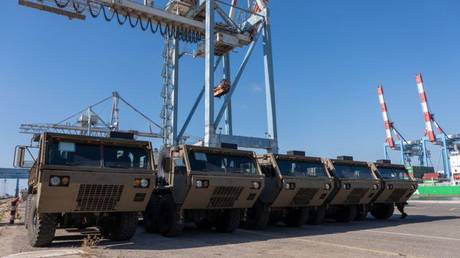
The sheer volume of military hardware moving from American soil to Israel right now is staggering. We aren't just talking about a few planes or some crates of rifles. It’s a massive, multi-modal logistics operation involving hundreds of cargo flights and dozens of massive sea vessels. If you’re trying to wrap your head around the scale, think of it as a continuous bridge of steel stretching across the Atlantic and Mediterranean. Since the conflict began in late 2023, the United States has moved tens of thousands of tons of lethal equipment. It’s a reality that reshapes regional power every single day.
You see headlines about "aid packages," but the logistics on the ground tell a much more visceral story. This isn't just about politics. It’s about the raw mechanics of modern warfare. The US military and private contractors are working around the clock to ensure the flow doesn't stop. Whether it's precision-guided munitions or heavy armored vehicles, the pipeline is wide open. People often ask if this is sustainable. In terms of inventory, the US is digging deep into its own stockpiles, including those strategically located within Israel itself, known as WRSA-I (War Reserve Stockpile Ammunition-Israel).
Breaking Down the Hardware in the Pipeline
When we talk about "munitions," it's easy to get lost in the jargon. Let’s get specific. The bulk of these shipments consists of high-demand items that disappear fast in high-intensity urban combat. We’re talking about 155mm artillery shells, which are essentially the workhorses of any modern ground campaign. Thousands upon thousands of these have been shipped. Then there are the "smart bombs," specifically the Joint Direct Attack Munitions (JDAM) kits that turn "dumb" bombs into GPS-guided weapons.
It doesn't stop at explosives. The hardware includes heavy machinery like the armored Caterpillar D9 bulldozers, which are central to Israel’s ground maneuvers. These aren't your neighborhood construction tools. They’re up-armored monsters designed to survive RPG hits while clearing paths through rubble. Reports indicate that the US has also sent Hellfire missiles and a variety of interceptors for the Iron Dome and David’s Sling systems. The replenishment of interceptors is perhaps the most critical part of the logistics chain. Without them, the defensive shield fails.
The air bridge is primarily managed by C-17 Globemaster III aircraft. These planes are massive. I’ve seen them loaded up, and they can carry over 170,000 pounds of cargo. When you have dozens of these landing at Nevatim Airbase every week, the numbers add up fast. But the heavy lifting—the "tons" you see in the news—mostly happens at sea. Large medium-speed roll-on/roll-off (LMSR) ships can carry more in one trip than an entire fleet of aircraft.
Why the Sea Route Matters More Than You Think
While cargo planes get the dramatic photos, the sea is where the real weight moves. Ships departing from ports like Dover, Delaware, or Norfolk, Virginia, carry the bulkier items. Think M113 armored personnel carriers or the Medical Evacuation vehicles. This isn't a quick process. It takes weeks. However, the sheer capacity of a single cargo ship means it can deliver enough ammunition to sustain weeks of combat in one go.
There’s a common misconception that all this gear is "new." Much of it is, but a significant portion comes from those pre-positioned stocks I mentioned earlier. The WRSA-I is a fascinating bit of bureaucracy. Technically, the ammo belongs to the US, but it’s stored in Israel for "emergency use." This allows for a much faster transfer because the gear is already in the neighborhood. It’s like having a pantry in your neighbor's house that you both agree they can use if they run out of food.
The cost is another layer. We’re looking at billions of dollars. Most of this is financed through Foreign Military Financing (FMF), which basically means the US gives Israel money to buy American-made weapons. It’s a closed loop that keeps US defense contractors like Lockheed Martin, Boeing, and Raytheon very busy. It’s not just a gift; it’s a massive injection into the US industrial base.
The Operational Reality of Replenishment
Military logistics is a nightmare of timing. You can’t just dump 50,000 shells on a tarmac and leave. You need the trucks, the fuel, and the personnel to move that gear to the front lines. The coordination between the Pentagon’s European Command (EUCOM) and the Israeli Ministry of Defense is seamless. They have established a "joint room" to prioritize what needs to go on which plane.
If Israel uses 2,000 interceptors in a week, they need 2,000 more on the way immediately. This "just-in-time" delivery system is what keeps the conflict moving at its current pace. Without this constant influx, the operational tempo would have to drop significantly within days. That’s the reality of modern war. It’s hungry. It eats through resources faster than any factory can produce them.
I’ve noticed many people forget about the small stuff. It’s not just bombs. It’s night-vision goggles. It’s spare parts for F-35 engines. It’s specialized fuses that might only weigh a few ounces but are the difference between a bomb that works and a very expensive paperweight. These high-tech components are often flown in via commercial carriers or "gray bottom" ships to keep a lower profile.
The Global Logistics Footprint
This isn't just a US-to-Israel straight line. It’s a global web. US bases in Germany and occasionally Qatar serve as nodes in this network. Sometimes, gear is diverted from other theaters. There’s been a lot of talk about how this affects the supply of 155mm shells to Ukraine. The truth is, the US industrial base is being pushed to its absolute limit. They’re trying to ramp up production of shells from 30,000 a month to 100,000, but that takes years, not months.
The strain on the US Air Mobility Command is real. Flying these missions wears down the airframes. It costs tens of thousands of dollars per flight hour. When you see a "ton" of munitions, don't just think about the weight of the metal. Think about the fuel, the maintenance, and the hundreds of people involved in getting that one ton from a warehouse in Iowa to a battery in the Negev.
Monitoring the Flow Moving Forward
If you want to track this yourself, keep an eye on flight tracking data around Rota, Spain, and Sigonella, Italy. These are major pit stops for the C-17s heading east. You’ll also see an uptick in chartered commercial cargo vessels heading toward the port of Ashdod. The volume of this hardware isn't slowing down. In fact, as the conflict evolves, the types of hardware are shifting from purely offensive munitions to more specialized defensive and engineering equipment.
Don't expect the transparency to improve. Much of the specific manifest data is classified for security reasons. But the physical evidence—the constant roar of engines over the Mediterranean—tells you everything you need to know. The US is committed to this pipeline, and the logistical machinery is currently operating at a scale we haven't seen in decades.
To get a clearer picture of the impact, start looking at the quarterly reports from major defense firms. They’ll show the backlog of orders and the "expedited" deliveries that correlate directly with these shipments. Also, follow the budgetary debates in Congress regarding the supplemental funding bills. That’s where the "tons" turn into "dollars," and where the long-term sustainability of this bridge will be decided. Pay attention to the ship tracking sites for vessels departing from the Military Ocean Terminal Sunny Point. That's where the heaviest loads begin their journey.


