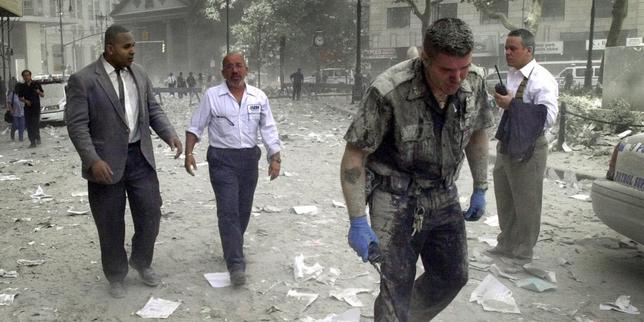
Dust does not merely settle. It lingers. It clings to the wool of winter coats, rests in the furrows of weathered skin, and settles quietly, patiently, at the bottom of the human lung.
For months after the towers fell in the autumn of 2001, New York City tasted like an industrial kitchen after a disaster. The air carried the pulverized history of steel beams, office furniture, electrical wiring, and the microscopic skeletons of thousands of lives compressed into ash. People walked through lower Manhattan wrapped in paper masks, or with no masks at all, coughing into handkerchiefs that turned grey within minutes. They were told it was safe. They were told to open their windows, to sweep their stoops, to return to work because the financial heart of the nation could not afford to miss a single beat.
The air was clean, the officials said. Breathe deep.
Decades later, Zohran Mamdani stood before the public and ripped open that old, carefully bandaged wound. It was not merely an accusation of administrative failure; it was an indictment of convenience. People fell sick not because an invisible enemy struck them down in the dark, but because leaders looked at the smoke, calculated the economic cost of panic, and chose to lie.
Consider the anatomy of a cover-up. It never begins with a dramatic villain twirling a mustache in a smoke-filled backroom. It begins with a spreadsheet. It begins with a calculation of liability.
In the immediate aftermath of September 11, the Environmental Protection Agency issued assurances that the air quality in Lower Manhattan was fine. These statements were rushed, politically expedient, and profoundly wrong. Inside the agency, scientists knew better. They watched the dust samples register off the charts for asbestos, benzene, lead, and crushed concrete. But those memos were rewritten. Words were softened. Reassurances were amplified, while warnings were quietly filed away where the public eye could not reach them.
The logic of the state is often brutally simple: panic is harder to manage than poison.
If you tell a city of eight million people that their very atmosphere has been turned into a slow-acting chemical weapon, the machinery of commerce grindingly halts. Wall Street cannot ring its bell if the brokers are gasping for air. Schools cannot open if the playgrounds are coated in particulate glass. And so, an unspoken bargain was struck. The government traded the long-term health of its citizens for the short-term illusion of normalcy.
Zohran Mamdani’s recent denunciations brought this dark arithmetic back into the light, forcing a reckoning with a city's ghost story. The people who breathed that air—the ironworkers, the schoolteachers, the bodega owners, the children who walked to class through the grey haze—did not realize they were signing a contract with a delayed expiration date.
The symptoms did not appear on September 12. They appeared five years later, ten years later, fifteen years later. They arrived as a persistent, dry cough that no antibiotic could cure. They arrived as a sudden, terrifying shortness of breath while climbing a flight of subway stairs. They arrived in oncology wards where doctors looked at chest X-rays and saw lungs scarred by glass and heavy metals.
This is the cruelty of institutional deception. It robs you quietly, allowing you to believe you have survived the catastrophe unharmed, only to collect the debt years down the line when your guard is down.
When leaders lie about environmental toxicity, they are betting that time will dilute their accountability. They are counting on the fact that human memory is short, that bureaucratic paper trails are hard to follow, and that by the time the victims start dying in droves, the officials who signed the clearance orders will be retired, pensioned, and safely out of reach.
Mamdani’s intervention disrupts that comfortable timeline. It insists that accountability has no statute of limitations.
We live in an era obsessed with transparency, yet we remain astonishingly vulnerable to the quiet omissions of power. Whether it is toxic air rising from ground zero, polluted water flowing through municipal pipes in the rust belt, or industrial chemicals seeping into rural topsoil, the pattern remains identical. The people closest to the source of the harm are the last to be told, and the first to be sacrificed.
To look back at the post-9/11 air quality scandal is to understand that trust between a citizen and a government is not an abstract political concept. It is a biological necessity. When that trust is poisoned, the poison eventually makes its way into the bloodstream.
The dust has long since been washed from the sidewalks of Manhattan by rain and municipal hoses. The skyscrapers have been rebuilt, taller and shinier than before. But beneath the polished glass and the hurried footsteps of millions of commuters, the legacy of those lies remains suspended in tissue and bone.
History is written by the victors, but the health of a city is written in the bodies of its ordinary people. Every wheeze, every scarred alveolus, every early grave is a syllable in a sentence that the powerful tried desperately to erase. The truth, however fine-grained it may be, refuses to settle forever. Eventually, someone kicks up the dirt.