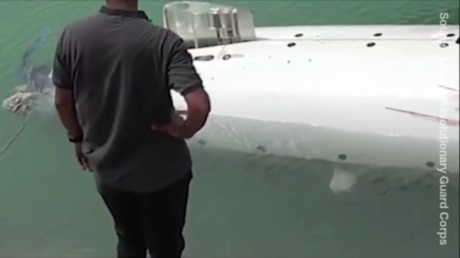
Dawn arrives over the Strait of Hormuz not with a golden whisper, but with the heavy, bruised weight of burning crude and distant thunder. This narrow artery of blue water carries a massive fraction of the planet's bloodline, pumping oil tankers past jagged shores where shadows stretch long and watchful. For months, this corridor has transformed into a high-stakes chessboard. Invisible threats drift beneath the surface, while above it, surface fleets stalk one another through a fog of economic blockades and retaliatory strikes.
Out there, far below the churning white froth of the shipping lanes, silence reigns. It was into this crushing darkness that a three-ton autonomous marvel—an Anduril Dive-LD uncrewed underwater vehicle—drifted during a routine reconnaissance run. Built to mimic the quiet endurance of a deep-sea creature, this robotic sentinel was designed for a singular purpose: mapping the seabed, sniffing out naval mines, and keeping the maritime routes clear of hidden dangers. It had no pulse. It carried no crew. Yet, it represented the bleeding edge of American undersea engineering, a marvel of modular aluminum and silent propulsion dropped into one of the most hostile waters on Earth.
Then, it stopped talking.
According to announcements from Iran's Islamic Revolutionary Guard Corps, naval units intercepted the silent machine at the entrance of the strait during a complex morning operation. State media trumpeted the capture as a major prize, framing the retrieval of the advanced submersible as a trophy won from the depths. Washington officials countered with a pragmatic shrug, noting that the drone was an attritable asset—a piece of expendable hardware engineered precisely to take risks where human sailors cannot tread, carrying no classified vaults or critical secrets that could unravel national security.
Consider what happens next in the quiet rooms of military intelligence.
Even if the core architecture was designed to be risked, losing an intact, modern autonomous underwater vehicle to a rival power is a sharp, stinging blow. Engineers know that hulls speak volumes. Every centimeter of a 3D-printed exterior, every acoustic sensor, and every propulsion nuance tells a story about how Western navies plan to fight the invisible wars of tomorrow. When a machine built for deep-sea surveillance falls into foreign hands, the theater of conflict shifts from the physical waters to the reverse-engineering laboratories of Tehran.
The stakes here extend far beyond a piece of missing marine hardware. They touch the daily anxiety of ordinary citizens thousands of miles away who watch fuel prices spike and supply chains shudder with every tremor in the Gulf. Every time a drone goes dark or a tanker hesitates, the global economy feels the pressure drop. It is a war fought by proxy machines, where steel and silicon absorb the blows so that human casualties might, for a moment, be avoided.
Yet, the capture of the drone lays bare the raw, unsettling truth of modern autonomy. We build machines to operate beyond our reach, trusting them to navigate the abyss alone. We tell ourselves that because there is no sailor inside, the loss is purely economic. But every lost robot carries a piece of our strategic footprint into territory where it was never meant to rest.
The water in the strait closes over the spot where the machine vanished, leaving only ripples on the surface and a new quiet tension settling across the deep.


