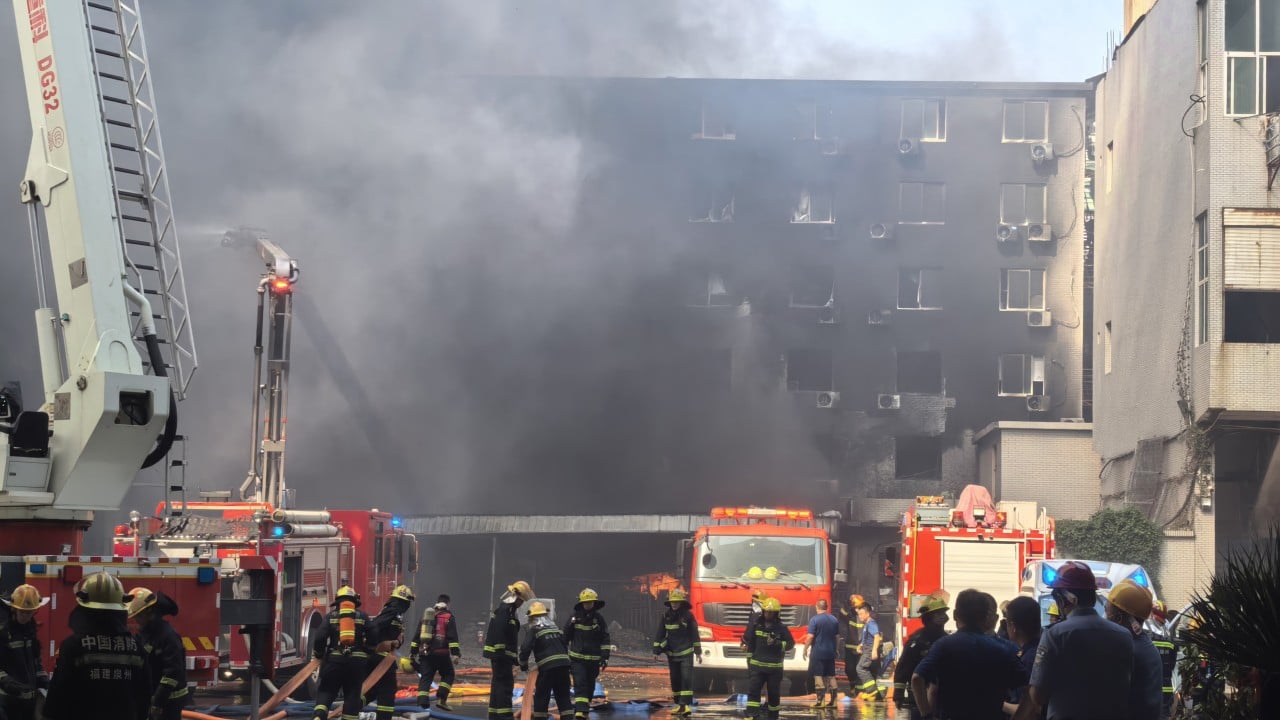
The fatal fire at a footwear production facility in Wenling, Zhejiang province—a hub often designated as China's "shoe capital"—which resulted in 28 fatalities, represents a systemic failure of industrial architecture and localized supply chain economics rather than an isolated operational accident. Superficial journalistic accounts attribute such disasters to immediate ignition triggers like faulty wiring or chemical mismanagement. A rigorous structural analysis reveals that these events are the mathematically predictable output of three intersecting vectors: high-density urban-industrial zoning friction, the economic compression of low-margin contract manufacturing, and the physical choke points inherent in multi-use industrial real estate.
Understanding the root causes of mass-casualty industrial events in specialized manufacturing clusters requires moving beyond retrospective blame. It demands an examination of the operational trade-offs that prioritize short-term throughput over structural survivability.
The Economic Triggers of Substandard Infrastructure
The footwear manufacturing sector operates on highly compressed margins, frequently fluctuating between 3% and 7% for contract producers supplying domestic and mid-tier global markets. Within this economic framework, capital expenditure undergoes severe rationing. Facility managers treat safety infrastructure not as a loss-prevention mechanism, but as a direct deduction from net profitability.
This financial pressure manifests across three distinct operational layers:
- Real Estate Optimization via Vertical Stacking: To minimize land lease expenditures in high-value coastal manufacturing zones, operators utilize "minispec" buildings. These structures typically combine raw material warehousing, chemical processing, assembly line production, and worker dormitories within a single multi-story footprint.
- Inventory Hyper-Accumulation: Just-in-time supply chains require immediate access to volatile precursors. Polyurethane, rubber cements, synthetic leathers, and petroleum-based solvents are frequently stored directly on the production floor to minimize transit times, violating fundamental principles of hazardous material segregation.
- Sub-Utility Electrical Loading: Industrial machinery upgrades routinely outpace the underlying electrical infrastructure of repurposed or low-tier industrial parks. When facilities introduce high-draw automated vulcanization or cutting machinery without upgrading core distribution panels, the probability of catastrophic thermal runaway via arc faulting increases exponentially.
This friction between razor-thin margins and regulatory compliance creates a structural moral hazard. Operators calculate that the statistical probability of regulatory enforcement or catastrophic failure is lower than the guaranteed financial loss incurred by halting production to install compliant fire suppression, ventilation, and egress systems.
The Physical Mechanics of the Urban Industrial Choke Point
When ignition occurs within a dense, multi-use footwear facility, the progression from localized fire to mass-casualty event follows a highly predictable thermodynamic and logistical sequence. The Wenling disaster highlights structural vulnerabilities common across thousands of mature manufacturing clusters globally.
Chemical Accelerants and Toxic Atmospheric Inversion
Footwear production relies heavily on volatile organic compounds (VOCs) and synthetic polymers. The combustion of polyurethane foam and neoprene rubber does not merely generate heat; it produces a dense, highly toxic atmospheric inversion layer within enclosed spaces.
$$\text{Combustion Efficiency} \propto \frac{\text{Ventilation Area}}{\text{Fuel Surface Area}}$$
In typical multi-use facilities, the ventilation area is severely restricted to maintain climate control for sensitive adhesive curing processes. When synthetic polymers ignite under these conditions, the restricted airflow leads to incomplete combustion. This process generates lethal concentrations of carbon monoxide ($CO$) and hydrogen cyanide ($HCN$). Inhalation of these gasses induces incapacitation within 60 to 90 seconds, rendering traditional escape routes useless before physical flames even reach the victims.
The Architectural Trap of the "Three-in-One" Facility
The primary systemic driver of high mortality rates in these incidents is the architectural configuration known colloquially as the sanyihe (three-in-one) structure. This design co-locates workshops, warehouses, and living quarters within a single building envelope.
The structural failure points of this configuration include:
[4th Floor: Worker Dormitories]
       ▲  Vertical Smoke/Heat Shaft (Open Stairwells)
[3rd Floor: Assembly & Finishing]
       ▲
[2nd Floor: Adhesive Application (High VOC Load)]
       ▲  Ignition Point
[1st Floor: Raw Material Storage & Primary Egress Choke Point]
This layout creates a vertical chimney effect. Because open stairwells serve as both the primary logistical pathways for moving materials between floors and the sole means of egress, they function as high-velocity conduits for smoke and superheated gasses during a fire. The pathway to safety is simultaneously transformed into the primary mechanism of hazard distribution.
Egress Impedance and Institutional Blindness
Compounding the vertical chimney effect is the systemic practice of security-driven egress impedance. To prevent inventory shrinkage (theft) and monitor worker movement, facility management frequently locks secondary emergency exits, installs iron grates over windows, and blocks staging areas with palletized raw materials. During an emergency, the time required to locate keys or clear physical obstructions exceeds the structural survival window dictated by the atmospheric degradation rate.
Supply Chain Decoupling and Regulatory Arbitrage
The persistence of these structural risks is directly linked to the dynamics of international and domestic tier-two supply chains. Large-scale global brands enforce strict, multi-layered social compliance audits on their Tier-1 suppliers. However, the cost pressures these brands exert force Tier-1 factories to subcontract low-margin components—such as sole vulcanization, stitching, and adhesive application—to unmonitored Tier-2 and Tier-3 facilities operating within informal industrial clusters.
This structural decoupling creates an information asymmetry:
- Auditing Disconnect: Brand compliance teams audit corporate headquarters and showcase facilities, while the actual physical risk is displaced down the supply chain to localized, under-regulated workshops.
- Regulatory Arbitrage: Local municipal governments in manufacturing-dependent regions face a classic enforcement dilemma. Imposing immediate, rigorous closures on non-compliant "three-in-one" structures threatens the local tax base and risks widespread employment disruption. Consequently, enforcement cycles often become reactive, spikes in inspections occurring only after a high-profile disaster, followed by a gradual return to laissez-faire oversight.
The limitation of current remediation frameworks lies in their focus on punitive post-incident measures rather than addressing the underlying economic realities of the subcontracting ecosystem.
De-Risking the Industrial Cluster Matrix
Mitigating the systemic risk of mass-casualty industrial failures requires shifting from a model of reactive enforcement to one of proactive structural isolation. Municipalities and industrial park operators must recognize that industrial safety is an engineering and economic optimization problem, not a behavioral compliance issue.
Rigid Separation of Commercial and Residential Zones
The absolute elimination of the multi-use corporate-dormitory envelope is non-negotiable. Municipal zoning frameworks must mandate the physical separation of living quarters from production zones by a minimum structural fire break distance of 30 meters, or isolate them in dedicated residential quarters outside the industrial park perimeter. Internal vertical integration of residential space within manufacturing structures must carry severe, immediate operational cessation penalties.
Transition to Decentralized Digital Fire Suppression Systems
Traditional centralized sprinkler systems require significant capital expenditure and consistent water pressure—variables that are notoriously unreliable in aging industrial clusters. The deployment matrix should instead prioritize localized, automated dry-chemical or localized mist suppression systems integrated directly into high-risk machinery zones, such as adhesive application lines and chemical storage lockers. Interlocking these suppression systems directly with the main electrical breakers ensures that any thermal event instantly terminates power to the entire floor, preventing electrical arcing from feeding the ignition source.
Supply Chain Traceability via Immutable Ledger Auditing
To eliminate the opacity of Tier-2 subcontracting, buying organizations must mandate the use of immutable component-level tracking. By linking production volume outputs directly to verified energy consumption and square-footage metrics via automated sensor telemetry, brands can instantly detect when a primary supplier is outsourcing volume to unverified, high-risk facilities. If a Tier-1 factory’s declared internal capacity does not match its energy profile, the system flags a supply chain anomaly for immediate physical intervention.
The optimization of industrial safety in high-density manufacturing corridors cannot rely on the goodwill of low-margin operators or periodic bureaucratic inspections. It requires the systematic application of architectural segregation, automated localized suppression, and algorithmic supply chain transparency to neutralize the economic incentives that make disasters like the Wenling fire inevitable.