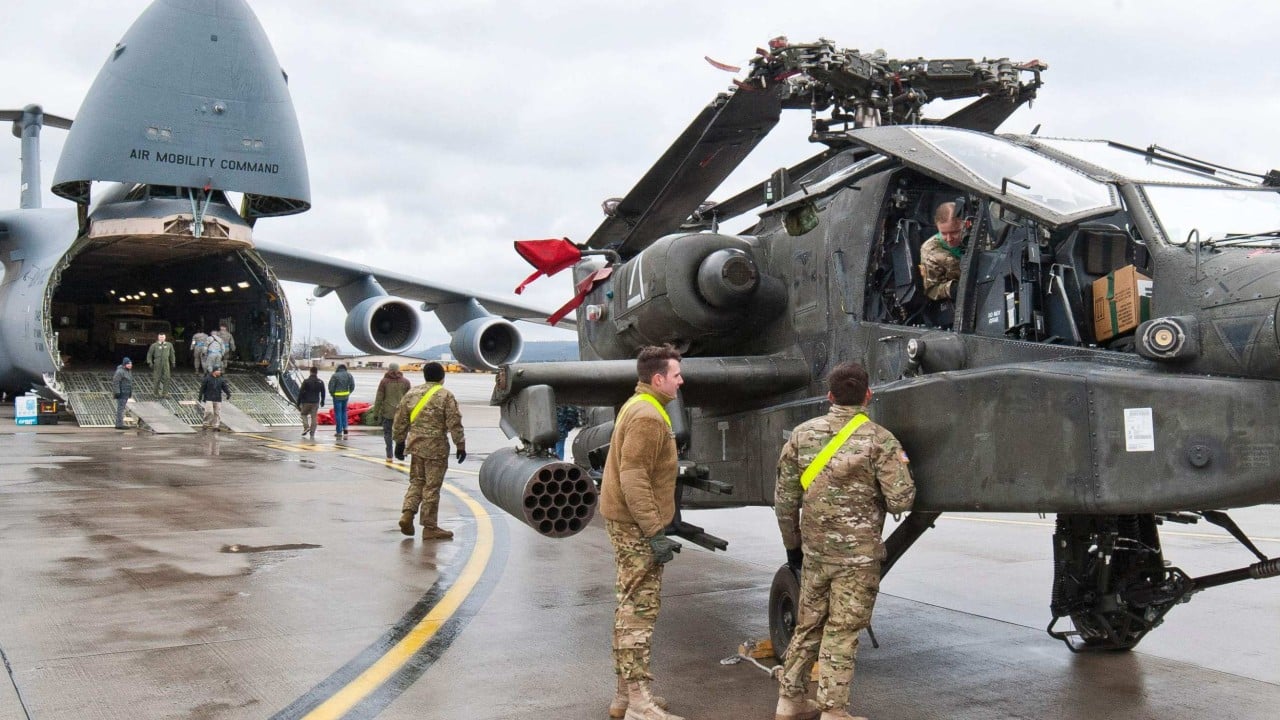
Germany’s commitment to increase its military personnel by 75,000 constitutes a fundamental shift in European security architecture, moving from a "peace dividend" posture to a "deterrence-first" operational model. This expansion is not merely a quantitative adjustment to troop counts but a structural response to the breakdown of the post-Cold War security consensus and the emergence of a multi-polar threat environment where the U.S. security umbrella is no longer a static variable. To evaluate the viability of this 75,000-soldier delta, one must analyze the interaction between demographic constraints, fiscal sustainability, and the technological modernization of the Bundeswehr.
The Tripartite Logic of Force Expansion
The decision to scale the German military—targeting a total force strength of approximately 275,000—rests on three distinct strategic pillars: If you enjoyed this piece, you might want to check out: this related article.
- The NATO Readiness Gap: The transition from high-readiness task forces to large-scale divisional combat readiness requires a depth of personnel that current German levels cannot sustain. NATO’s New Force Model (NFM) demands that Germany provide three fully equipped army divisions by 2031. Current staffing levels provide the "head" of these units but lack the "tail" necessary for prolonged high-intensity conflict.
- Geopolitical Hedging: The "Trump-EU rift" serves as a catalyst for strategic autonomy. Berlin is pricing in the risk of a "dormant NATO" or a U.S. pivot to the Indo-Pacific. Expanding the domestic force is a hedge against a reduction in American forward-deployed assets in the European theater.
- The Industrial Base Feedback Loop: Large-scale troop increases necessitate massive procurement cycles. By committing to a specific headcount, Germany signals long-term demand to defense contractors like Rheinmetall and Hensoldt, stabilizing the domestic defense industrial base (DIB).
The Mathematical Constraints of Recruitment
The primary bottleneck for Germany is not capital, but the labor market. Germany faces a severe demographic deficit. The "Working Age Population" is projected to shrink significantly over the next decade. To add 75,000 soldiers, the Bundeswehr must compete with a high-wage private sector for the same pool of technically skilled labor required for modern electronic warfare, cyber defense, and logistics.
The Bundeswehr currently faces a vacancy rate that complicates this expansion. If the organization cannot retain its current 181,000 personnel, the 75,000-target becomes a moving goalpost. The "Churn Rate Factor" suggests that for every 10 new recruits, several experienced NCOs or officers reach retirement or exit for private sector roles. Without a return to conscription—a politically volatile lever—the military must pivot to a "Value Proposition" model, offering technical certifications and housing benefits that rival the Mittelstand (Germany's SME sector). For another look on this story, refer to the recent update from Associated Press.
Capital Allocation and the 2% Threshold
The "Zeitenwende" fund of €100 billion was designed as a bridge, not a permanent floor. The fiscal challenge of adding 75,000 soldiers lies in the long-tail costs of personnel. In military economics, personnel costs typically account for 40% to 50% of a defense budget.
- Fixed Costs: Salary, healthcare, and pensions for 75,000 additional units.
- Variable Costs: Training cycles, ammunition consumption, and wear-and-tear on hardware.
- Infrastructure Costs: The reactivation of dormant barracks and the expansion of training grounds.
If Germany intends to meet the NATO target of 2% of GDP on defense while simultaneously funding this expansion, the regular defense budget (Einzelplan 14) must grow significantly once the special fund is exhausted in 2027. This creates a "Fiscal Cliff" scenario. To avoid this, the German government must either reform the "Debt Brake" (Schuldenbremse) or cannibalize other social spending, which introduces domestic political risk.
Technological Displacement and the Force Multiplier Effect
A critical error in standard analysis is treating 75,000 soldiers as a static unit of power. Modern warfare relies on the "Force Multiplier" effect of technology. The integration of unmanned systems (UAVs/UGVs) and AI-driven command and control (C2) can, in theory, reduce the number of humans required for certain roles.
However, Germany’s expansion is focused on "Heavy Brigades"—units defined by tanks, infantry fighting vehicles, and artillery. These units are personnel-heavy. The "Digitization of Land-Based Operations" (D-LBO) program is the technological backbone intended to make these 75,000 soldiers more effective than their predecessors. By networking every individual soldier and vehicle, Germany aims to shorten the "Sensor-to-Shooter" link.
The friction point remains the "Technological Debt" of the current fleet. The Bundeswehr is currently managing a heterogeneous mix of legacy systems and new prototypes. Adding 75,000 soldiers into a system with low equipment availability (Klarstand) results in a "hollow force." Personnel can only be converted into combat power if the hardware readiness rates exceed 70%.
Strategic Dependencies and the European Pillar
Germany’s rearmament does not happen in a vacuum. It is the linchpin of the "European Pillar" within NATO. Poland, the Baltic States, and France are recalibrating their own forces based on the assumption of a capable German center.
The "Logistical Throughput" of Germany is as vital as its troop count. Germany serves as the "Hub" for NATO reinforcements moving from West to East. A significant portion of the 75,000 new troops will likely be dedicated to "Joint Support and Enabling Service" (SKB), ensuring that fuel, ammunition, and medical services can flow to the front lines. This is the unglamorous but essential "Rear Area Security" that prevents a front-line collapse.
Operational Risks and Limitations
The expansion strategy faces three primary failure modes:
- The Recruitment Paradox: Increasing standards to handle high-tech equipment while needing to lower standards to meet high-volume recruitment targets.
- Procurement Lead Times: Even if 75,000 soldiers are recruited tomorrow, the lead time for Leopard 2A8 tanks or PzH 2000 artillery pieces is measured in years. This creates a "Capability Gap" where troops exist without the tools of their trade.
- Political Volatility: A shift in the governing coalition could lead to a "Budget Freeze," leaving the expansion half-finished and the military in a state of organizational paralysis.
The "Three-Division Goal" is the metric by which success will be measured. If Germany can field these divisions with the requisite 75,000-soldier increase, it re-establishes itself as the conventional military hegemon of Europe. If it fails, the burden of European defense shifts irrevocably to a "Frontline State" coalition led by Poland and the UK, marginalizing German influence in Brussels and Washington.
The Strategic Directive
Germany must prioritize "Retain over Recruit." The cost of training a new soldier is exponentially higher than the cost of retaining a seasoned specialist. To achieve a functional 275,000-strong force, the Ministry of Defense must implement a tiered readiness model where the 75,000-soldier delta is integrated into high-readiness brigades first, rather than being spread thin across the entire force structure.
The move toward 75,000 additional soldiers is a recognition that the "End of History" has been replaced by the "Return of Geography." Success depends on whether Berlin can transform its economic power into kinetic readiness before the geopolitical window of opportunity closes. The focus must shift from "Gross Personnel Count" to "Combat-Ready Formations," ensuring that every Euro spent on a new salary is matched by an equivalent investment in the platform that soldier will operate.