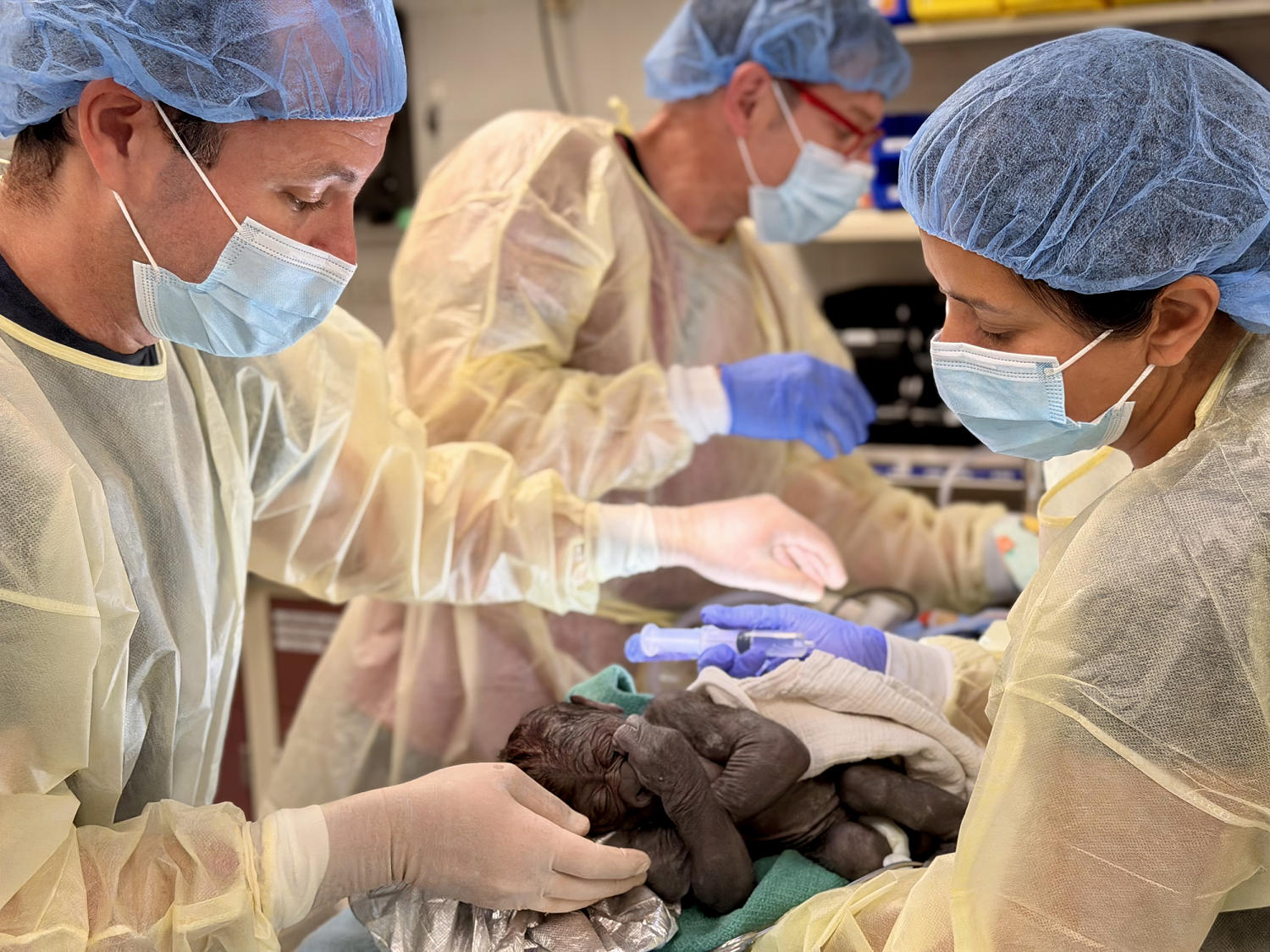
The mainstream media is currently swooning over a "miracle" birth at a Washington State zoo, where a baby gorilla was delivered via a rare emergency Cesarean section. The headlines are predictably saccharine, dripping with manufactured triumph about saving an endangered species. It is a heartwarming narrative designed to make human consumers feel good about buying zoo tickets.
It is also an absolute distraction from the reality of primate conservation.
While the public applauds the medical team that intervened to save a single infant gorilla, they miss the systemic failure staring them in the face. Celebrating a zoo C-section as a victory for wildlife is like celebrating a bandage on a severed limb. It mistakes high-tech medical intervention for genuine ecological preservation. We need to stop treating these captive medical dramas as wins for biodiversity. They are expensive, artificial maintenance loops for animals that should not be needing human surgeons to propagate their species in the first place.
The Illusion of Captive Propagations
The lazy consensus dominating zoo public relations goes something like this: every captive birth is a vital genetic insurance policy for an endangered species. This argument collapses under the slightest scrutiny of population genetics and evolutionary biology.
True conservation requires the maintenance of wild populations within functioning ecosystems. A gorilla born in a highly sterile, climate-controlled facility in Washington, delivered by a team of human OB-GYNs, veterinarians, and neonatologists, is functionally decoupled from the natural selection pressures of the African rainforest.
When humans routinely step in with advanced surgical interventions to bypass reproductive complications in captivity, we are not preserving a wild species. We are beginning the subtle process of domesticating it. In the wild, a gorilla unable to deliver naturally would succumb to natural selection. In a zoo, we intervene, pass those exact genetic traits down to the next generation, and create a lineage increasingly dependent on human medical technology.
"We are creating populations of wild animals that can only exist with round-the-clock human management."
This is not a theoretical risk. Wildlife biologists studying captive breeding programs have long pointed out the rapid behavioral and physiological shifts that occur when animals are removed from their native habitats. From jaw structure changes due to soft captive diets to the loss of maternal instincts, the "insurance policy" zoo advocates love to cite is often a depreciating asset.
The Opportunity Cost of High-Tech Interventions
Let’s talk about the economics of this emergency surgery. A team of top-tier medical professionals, specialized anesthesia, neonatal intensive care infrastructure, and around-the-clock monitoring costs an exorbitant amount of money.
Where does that capital come from, and where does it go? It goes into a localized spectacle that generates foot traffic and donor dollars for a single western institution.
If that same capital were deployed directly to in-situ conservation—funding anti-poaching patrols in the Democratic Republic of Congo, establishing contiguous habitat corridors, or supporting community-led preservation initiatives in Gabon—the return on investment for the actual species would be orders of magnitude higher. Protecting a single acre of intact rainforest protects not just gorillas, but thousands of interconnected species, from insects to apex predators.
Instead, the conservation industry routinely prioritizes the hyper-visible, photogenic individual over the invisible, grinding work of habitat protection. We choose the drama of the operating room over the policy work of stopping illegal mining and logging. It is a classic misallocation of resources driven by emotional marketing rather than ecological data.
Dismantling the Humanized Narrative
People constantly ask: "But shouldn't we do everything we can to save an endangered animal's life?"
The premise of the question is flawed because it applies human medical ethics to a non-human ecological problem. We look at a baby gorilla through a lens of intense anthropomorphism. We see a cute infant that mirrors our own biology, so we deploy human surgeons and celebrate the outcome as if it occurred in a human hospital.
This emotional projection blinds us to the downside of the intervention. A gorilla infant delivered via C-section misses out on critical early biological milestones. In primates, the vaginal birth canal seeds the infant’s microbiome, establishing the foundation for a robust immune system. C-section infants, both human and non-human, start life with compromised microbial diversity.
Furthermore, the immediate separation of the mother and infant for medical recovery severely disrupts the critical maternal bonding window. Zoos frequently have to spend months attempting to reintroduce a hand-raised infant to its mother or a surrogate, a process fraught with behavioral risks, stress, and potential rejection. The mother gorilla at the Washington zoo was reported to be recovering, but the long-term behavioral toll on both animals is routinely minimized in public updates.
The Grim Reality of Reintroduction
The ultimate defense of captive breeding is the promise of eventual reintroduction to the wild. This is the grand justification used to sell tickets to families looking at primates behind glass.
But ask any honest field biologist about the success rate of reintroducing captive-born, medically intervened megafauna into the wild. For complex social primates like gorillas, the success rate is catastrophically low. A gorilla raised in an environment where food appears on a schedule and medical teams intervene during illness does not possess the cultural knowledge required to survive in a dynamic, predator-filled jungle. They do not know how to forage across seasons, navigate complex wild troop dynamics, or avoid localized diseases.
The reality is that this newborn gorilla will almost certainly spend its entire life in a cage. It will be moved from one zoo to another via the Species Survival Plan (SSP) computer algorithm to optimize genetic diversity coefficients. It will never see an African rainforest. It is a resident of an urban amusement park, serving as an ambassador for a wild world it will never experience.
Shifting the Question Entirely
We are asking the wrong questions about wildlife preservation.
- Wrong Question: How can we advance veterinary medicine to ensure every captive gorilla pregnancy is successful?
- Right Question: Why are we still relying on captive exhibition as a proxy for conservation while wild habitats are decimated with impunity?
If we want to save the western lowland gorilla, the answers are not found in an operating room in Washington State. They are found in aggressive geopolitical pressure to halt deforestation, the enforcement of strict anti-poaching laws, and the systemic economic support of the human communities living alongside these animals in their native ranges.
Stop letting the heartwarming PR campaigns of modern zoos absolve you of the harder truth. The survival of a species is not measured by how well we can perform human surgery on them in captivity. It is measured by our willingness to leave them alone, in a wild habitat that we haven't destroyed.
The next time you see a viral news story about a miracle animal birth via C-section, don't celebrate. Question the system that requires a wild animal to be born under fluorescent lights, surrounded by scalpels and heart monitors, thousands of miles away from its true home.