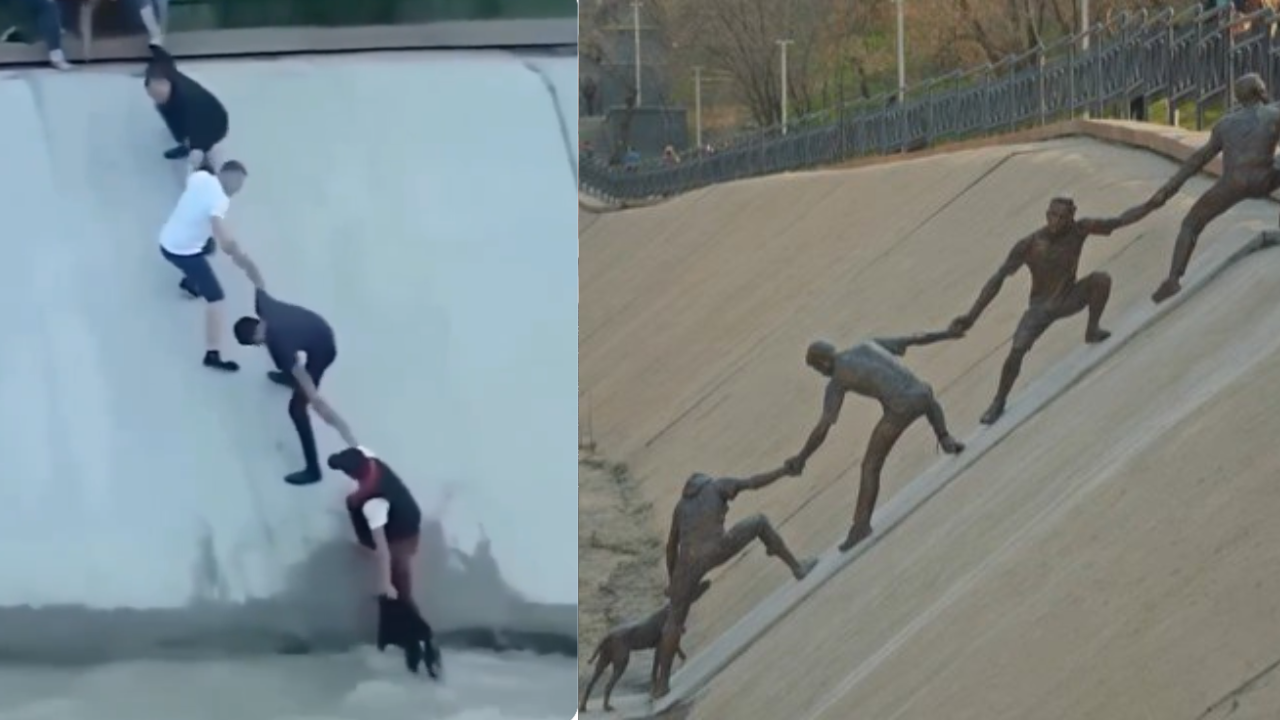
It happened on a Tuesday. Not a holiday, not a planned media event, and certainly not something anyone expected to trend globally. A stray dog, a busy intersection, and a handful of people who actually stopped. We see thousands of clips every day, but this one stuck. It didn't just go viral; it anchored itself in the collective conscious because it reminded us of something we’re terrified of losing.
Humanity.
When you strip away the algorithms and the political noise, you’re left with a raw, unscripted moment where biology and empathy collided. That’s what we saw in the video of the strangers and the dog. It wasn't about the act itself—rescuing animals happens every hour—it was about the choice to pause. In a world that demands we move faster, these people stood still.
The Science of Why We Can't Stop Watching
You might think you’re just a sucker for a cute animal. It’s deeper than that. Evolutionary psychologists have long studied the "Kindchenschema" or baby schema. It's a set of physical features—large eyes, round faces—that triggers a nurturing response in humans. When we see a vulnerable creature, especially a dog, our brains flooded with oxytocin.
But there’s a second layer here.
We’re also witnessing "prosocial modeling." When we see strangers cooperate to help a non-human, it reinforces our own social safety net. It tells us that if a dog can be saved by the kindness of people who don't even know each other’s names, maybe we’ll be okay too. We aren't just watching a rescue; we’re watching a proof of concept for society.
Breaking Down the Moment of Impact
The footage starts like any other dashcam or phone recording. Grainy, shaky, and mundane. Then, the dog enters the frame. It’s clearly lost, clearly terrified, and weaving through traffic that has no intention of slowing down.
Then, the first car stops.
This is the "bystander effect" in reverse. Usually, the more people there are, the less likely anyone is to help. Everyone assumes someone else will call the cops or grab the leash. But once that first person stepped out, the spell broke. Within seconds, three different people from three different walks of life formed a human semi-circle.
They didn't talk. They didn't coordinate. They just moved.
Why Strangers Cooperate Without Words
Biologists call this "spontaneous cooperation." It’s seen in species ranging from ants to primates, but in humans, it’s driven by shared intent. You see a problem, I see a problem, and we both recognize that the other person is trying to solve it.
Most people get this wrong. They think these moments require a leader. They don't. They require a lack of ego. In the video, nobody was trying to be the hero for the camera. They were just trying to keep a tail wagging. That lack of performance is why the footage feels so visceral. It’s the opposite of a "staged" influencer rescue.
The Role of the Dog in Our Shared History
Dogs have been our evolutionary shadow for at least 15,000 years. Some estimates push that back to 30,000. We didn't just domesticate them; we grew up together.
When we see a dog in distress, it hits a different neurological button than seeing a bird or a squirrel. We feel a historical debt. This specific video captured a dog that looked remarkably like a "common" pet—not a high-fashion breed, but a mutt. That's a huge factor in the relatability. It could have been your dog. It could have been mine.
Digital Echoes and the Power of Shared Content
Why did this specific moment go further than others?
It’s the "High-Arousal Emotion" theory. Content that triggers high-arousal emotions—like awe, anger, or anxiety—is significantly more likely to be shared than "low-arousal" content like sadness. This video started with high anxiety (the dog in traffic) and ended with high awe (the strangers helping).
That emotional arc is a dopamine goldmine.
Social media platforms are designed to reward this. When you hit "share," you aren't just sending a video to a friend. You’re signaling your own values. You’re saying, "I’m the kind of person who cares about this." It’s a form of digital virtue signaling that, for once, actually has a positive net result. It spreads a template for how to behave the next time you see something small and scared in a big, fast world.
Stop Waiting for a Reason to Act
We spend a lot of time analyzing these moments because they feel like anomalies. They shouldn't be.
The real takeaway from the strangers and the dog isn't that those people were special. It’s that they were ordinary. They had jobs to get to, groceries in the trunk, and probably a dozen reasons to keep driving. They just didn't.
If you want to see more of this in the world, you have to be the one who stops first. Don't wait for a crowd. Don't wait for someone to pull out a phone to record it. The "bystander effect" only lives as long as the first person stays in their car.
Next time you see a small opportunity to intervene—whether it’s an animal, a person struggling with a door, or just a situation that looks "off"—take the hit on your schedule. The world remembers these moments because they’re rare. Let's make them boring again by doing them more often.
Check your local shelters. Volunteer for a transport run. Or just keep a spare leash in your trunk. Being prepared to help is half the battle.