The grass at the Normandy American Cemetery does not look real. It is a shade of green so deep, so perfectly manicured, that it feels like a stage set. But beneath that turf lie 9,387 Americans who crossed an ocean to die on a strip of French sand they had never heard of before June 1944. When the wind blows off the English Channel, it carries a bitter salt spray that hits your face and forces your eyes to water. Standing there, looking at the endless geometry of white marble crosses and Stars of David, you realize that this cliffside is not just a graveyard. It is the geographic anchor of the modern Western world.
For eighty-two years, that anchor held. It signaled a simple, unbreakable pact: America would bleed so that Europe could breathe.
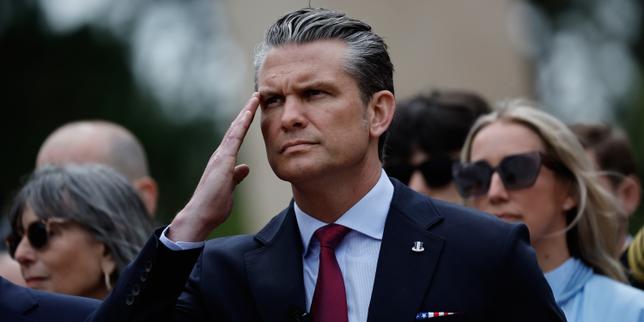
But a few days ago, a different kind of wind blew through Normandy. Pete Hegseth, the American Secretary of Defense, stood in that very region and delivered a message that chilled the bone far more than the Atlantic breeze. He spoke of a "strategic necessity." He used the polished vocabulary of a Pentagon briefing, but the subtext was raw, blunt, and undeniable.
The American umbrella is closing. Europe is on its own.
The Ghost in the Room
To understand why Hegseth’s words carry the weight of a tectonic shift, we have to look past the diplomatic handshakes and the commemorative wreaths. We have to look at the quiet panic currently rippling through the ministries of defense in Paris, Berlin, and Warsaw.
Imagine a fictional bureaucrat named Tomasz. He sits in a poorly lit office in Warsaw, Poland, staring at a spreadsheet that tracks artillery shell production. Tomasz is not a politician; he does not care about campaign speeches or cable news talking points. He cares about numbers. For decades, Tomasz and his predecessors worked under a comforting assumption. If the worst happened—if the bear across the eastern border decided to move—the Americans would arrive. The sky would fill with American jets, the sea with American carriers, and the warehouses with American ammo.
Hegseth’s speech shattered that assumption.
When the American Defense Secretary stood on Norman soil and declared that Europe must become the primary custodian of its own security, he was not making a casual suggestion. He was issuing an ultimatum wrapped in a historical reality check. The message was clear: Washington is tired of paying the security premium for a continent that can afford its own insurance.
The irony of making this declaration in Normandy was heavy. This was the place where American blood bought European freedom. By choosing this backdrop, the message became clear. The sacrifice of 1944 was a rescue mission, not a permanent subscription service.
The Arithmetic of Comfort
For generations, Western Europe enjoyed a luxury unique in human history. It grew rich, built vast social safety nets, and cultivated an enviable lifestyle of long vacations and universal healthcare, all while outsourcing its ultimate defense to taxpayers in Ohio, Texas, and California.
It was a brilliant deal while it lasted.
Let us look at the cold arithmetic that led to this breaking point. Consider the North Atlantic Treaty Organization. The agreement has a famous benchmark: every member country should spend at least two percent of its gross domestic product on defense. For years, that target was treated by many European capitals as a polite suggestion, a chore to be ignored until the teacher walked into the room.
The United States spends roughly 3.5 percent of its massive GDP on its military. It maintains a global logistics network that can move an entire army across the planet in days. Meanwhile, until very recently, major European powers struggled to keep their own fighter jets operational or their submarines out of dry dock.
The problem is not a lack of wealth. The European Union possesses a collective economy that rivals or exceeds that of almost any other global power. The problem is habit. Security is like oxygen; you only notice it when it starts running out.
Tomasz, looking at his spreadsheet in Warsaw, knows this better than anyone. His country, living in the shadow of a revanchist Russia, has ramped up its defense spending to over four percent of its GDP. They are buying tanks, artillery, and air defense systems at a feverish pace. But Poland cannot carry the continent. The economic engines of Europe—the nations further west, shielded by geography—have been far slower to wake from their long postwar nap.
Hegseth’s intervention was designed to abruptly end that slumber.
The Great Pivot Eastward
Why now? Why would an American administration choose to draw this line so starkly, risking the fracture of an alliance that won the Cold War?
The answer lies thousands of miles away from the quiet fields of France, across the vast expanse of the Pacific Ocean.
Washington is gripped by a bipartisan realization that the defining conflict of the twenty-first century will not be fought over the plains of Europe, but over the waters of the South China Sea and the semiconductor factories of Taiwan. The American military machine is stretching thin. It cannot simultaneously deter a rising superpower in Asia, manage a volatile Middle East, and act as a permanent garrison for a wealthy Europe.
When Hegseth talks about "strategic necessity," he is speaking from the perspective of an American strategist looking at a global map. He sees a world where America must prioritize. If Europe, with all its financial might, technological sophistication, and educated population, cannot secure its own backyard against a degraded Russian military, then America cannot save it without sacrificing its own position in the Pacific.
It is a brutal, transactional view of global politics. It lacks the romanticism of the Marshall Plan or the idealistic rhetoric of the Atlantic Charter. But it possesses the unyielding logic of gravity.
The Invisible Cost of Dependence
What does a self-reliant European defense actually look like? It is much more than buying American F-35 fighter jets or German Leopard tanks. It requires a fundamental rewrite of the European psyche.
Right now, Europe's defense infrastructure is a patchwork of competing corporate interests and national pride. Every country wants to build its own tanks, its own rifles, and its own communication systems. The result is a logistical nightmare. If a coalition of European armies had to deploy together tomorrow without American assistance, they would find that their radios cannot talk to each other, their ammunition is not interchangeable, and their command structures are tangled in red tape.
To fix this, Europe must do something it has historically resisted: integrate its military industrial complex. It means factories in France building components for ships designed in Italy, using steel forged in Germany, to be deployed in the Baltics. It means giving up pieces of national sovereignty for the sake of collective survival.
It also means making hard choices at home. Every Euro spent on a long-range missile artillery system is a Euro that cannot be spent on upgrading a hospital, subsidizing green energy, or funding pensions. This is the hidden cost of security that Europe has avoided paying for nearly a century.
The political class in Europe knows this change will be deeply unpopular. Voters do not like losing benefits to pay for ammunition they hope will sit in a warehouse forever. But the alternative is far worse. The alternative is a continent that exists at the mercy of its neighbors, a giant with clay feet, unable to defend its own values because it lacks the muscle to back them up.
The Quiet at the Cliff's Edge
Back at Colleville-sur-Mer, the afternoon sun begins to dip toward the horizon, casting long, dark shadows behind the rows of marble crosses. Visitors walk through the paths in near-total silence. Even the children seem to understand that this is a place where loud noises do not belong.
For decades, Europeans visited these graves with a sense of profound gratitude, viewing them as a monument to a permanent shield. Today, those graves look more like a reminder of a temporary reprieve.
The era of the American protectorate is drawing to a close. It is not ending with a sudden tear in the treaty or a dramatic exit from NATO, but with a steady, calculated withdrawal of American focus. The responsibility is shifting, sliding across the Atlantic, landing squarely on the shoulders of a continent that has forgotten what it feels like to stand completely alone in the dark.
The wind from the sea continues to blow, indifferent to the shifting alliances of men. It sweeps over the sand of Omaha Beach, up the steep bluffs, and through the rows of white stone. The dead have done their part. The living are now being asked to find out if they possess the strength to preserve what was bought here, or if they will simply watch the horizon, waiting for a rescue party that is never coming back.