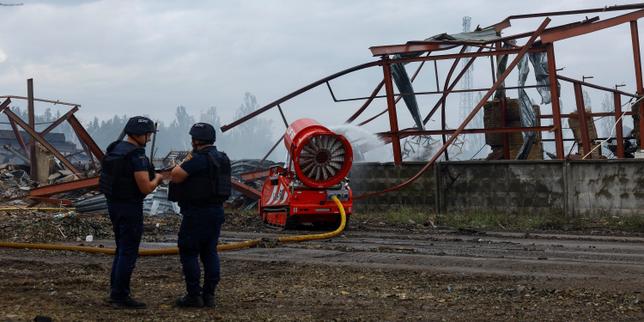
The map of a country at war does not look like geography anymore. It looks like a fever chart, jagged and red, pulsing with numbers that represent things human minds struggle to hold at once. When you stare at the live updates long enough—the shifting frontlines, the artillery tallies, the grim accounting of intercepted steel—the screen begins to flatten the catastrophe. It turns suffering into a stock ticker.
I remember the sound of a distant thud that wasn't thunder. It rattles the windowpanes just enough to make you check the glass, not for breaks, but for the vibration. That is how millions live now. Not as combatants in grand cinematic clashes, but as civilians caught in the long, gray drag of attrition.
Consider what happens in a single kitchen in Kharkiv when the power grid fails for the third time in a week. There is no dramatic swelling of orchestral strings. There is only the sudden, absolute flatline of the refrigerator hum, the abrupt darkness, and the practiced, quiet sigh of a mother who already knows where she put the candles three winters ago. This is the invisible frontline. It does not run through trench lines or riverbeds. It runs right down the center of domestic life, dividing yesterday from an uncertain tomorrow by a razor’s edge.
The official bulletins call it the war in Ukraine. The live feeds stream raw data with sterile efficiency: grain corridors threatened, supply lines strained, diplomatic communiques issued from mahogany rooms thousands of miles away. But data is a ghost of an event. To understand the gravity of the current hour, you have to look past the scrolling banner headlines and into the mechanics of endurance.
Take, for instance, the logistics of keeping a nation warm while its infrastructure is systematically dismantled. This is not a matter of abstract political strategy. It is measured in centimeters of insulation, liters of diesel for backup generators, and the sheer psychological stamina of engineers who descend into smoking craters before the smoke has even cleared to splice copper wires back together. They do not wear capes. They wear high-visibility vests covered in soot, and they work in silence because sound travels too far when the sky belongs to drones.
History is heavy. We tend to forget that until it trips us.
For months, the cadence of the conflict has settled into a brutal rhythm of push and pull, a grinding war of position where every meter of mud gained or lost is paid for in currency too terrible to audit properly. Observers in distant capitals debate packages of aid as if they were line items in a corporate budget, weighing fiscal caution against human survival. Yet, down on the ground, the math is devastatingly simple. Delay equals destruction. Hesitation equals funerals.
To watch the live updates from afar is to engage in a peculiar kind of modern psychological torture. You refresh the page. You look for the breakthrough that never quite comes, the sudden collapse that doesn't materialize, the diplomatic miracle that remains perpetually just out of reach. You watch analysts with laser pointers trace arrows across digital maps, explaining tactical depth and artillery-barrel wear coefficients.
Stop for a moment and listen to what the analysts leave out.
They leave out the sound of school children learning geometry in damp subway stations. They leave out the farmers who calculate the risk of stepping on a mine every time they turn the ignition on a tractor, desperate to harvest wheat before it rots in unplowed earth. They leave out the profound, crushing weight of exhaustion that settles over an entire population like a permanent winter fog.
We are witnessing a stress test of the international order, yes. But more than that, we are watching a massive, agonizing collision between human resilience and industrial-scale cruelty. The technological sophistication of modern warfare has created a terrifying paradox: it is now possible to witness a tragedy in real-time, in high definition, from a smartphone screen while sitting in a quiet suburban kitchen thousands of miles away, and yet remain entirely insulated from its true texture.
The numbers climb. The casualty reports are updated with bureaucratic coldness. Millions displaced. Billions in damages. Strategic positions consolidated.
Behind every digit is an address. Behind every strategic retreat is a family leaving behind a house that is now only rubble and memory.
When we look at the ongoing conflict, the temptation is to treat it as a spectator sport of geopolitics—a match between forces where we pick a side and cheer for the offensive surge. That is a dangerous luxury. The reality is a grinding, unromantic slog where the most courageous act often has nothing to do with firing a rifle. It is the decision to wake up tomorrow morning in a freezing apartment, brew tea over a camping stove, and refuse to let the darkness win.
The sirens will wail again before dusk. The live feeds will continue to refresh, ticking over to the next hour, the next report, the next fragment of news from a fractured land. And somewhere in the dark, a generation is learning how to rebuild the world one brick, and one heartbeat, at a time.