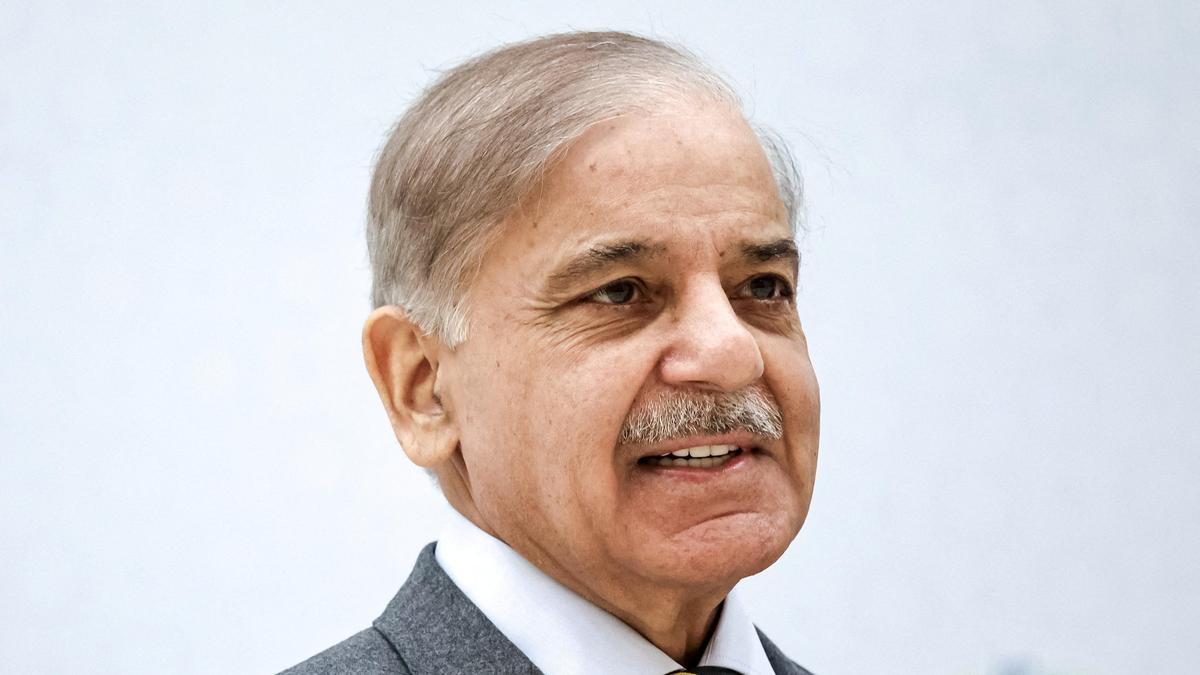
The air in the Prime Minister’s House in Islamabad often carries a specific kind of stillness. It is the silence of a room where every word spoken is weighed against the hunger of 240 million people and the cold arithmetic of global debt. When Prime Minister Shehbaz Sharif sat across from the Chinese envoy, the cameras captured the standard tableau of modern diplomacy: the flags, the floral arrangements, the stiff posture of men who know they are being watched.
But diplomacy is rarely about the photograph. It is about the unspoken tension in the grip of a handshake.
Pakistan currently finds itself in a position that would make even the most seasoned economist sweat. Inflation has not just knocked on the door; it has kicked it down and made itself at home in the kitchens of every household from Karachi to Peshawar. To the man selling fruit on a wooden cart in Rawalpindi, "macroeconomic stability" is a phrase that means nothing. What means everything is the price of flour, which has climbed with a persistence that feels like a slow-motion disaster.
The Chinese envoy did not just bring greetings. He brought the promise of "continued support." In the dry language of a press release, that phrase is a placeholder. In the reality of a struggling nuclear power, it is a lifeline.
The Architect and the Foundation
To understand why this meeting matters, we have to look past the mahogany tables. Imagine a young engineer named Bilal. He works on a segment of the Karakoram Highway, a ribbon of asphalt that cuts through some of the most unforgiving terrain on the planet. For Bilal, China isn't a geopolitical concept. It is the source of the heavy machinery he uses, the funding for his paycheck, and the reason his village finally has a reliable power grid.
When the envoy speaks of the China-Pakistan Economic Corridor (CPEC), he is speaking about Bilal’s life.
The relationship between these two nations is often described with poetic flourishes—higher than the Himalayas, deeper than the Arabian Sea. Strip away the poetry, and you find a foundation built on mutual necessity. Pakistan needs a window to the world and a way to power its industries. China needs a shortcut to the warm waters of the south, bypassing the crowded and contentious shipping lanes of the Malacca Strait.
During the meeting, Shehbaz Sharif emphasized the "all-weather" nature of this partnership. It is a telling choice of words. It implies that while other allies might be fair-weather friends—disappearing when the political clouds darken or when the IMF demands its pound of flesh—the dragon remains.
The Invisible Ledger
There is a shadow that follows every promise of support. Critics often point to the "debt trap," a narrative that suggests China is simply buying up the sovereignty of developing nations. But the view from inside Islamabad is different. It is the view of a person who has run out of options and finds one door still open.
The Prime Minister’s task is a balancing act that would baffle a tightrope walker. He must satisfy the rigorous, often painful requirements of Western financial institutions to keep the economy from total collapse, while simultaneously ensuring that the Chinese-funded projects—the literal engines of future growth—do not stall.
The envoy’s assurance of "continued support" is a signal to the markets. It says that despite the security concerns that have plagued Chinese workers in Pakistan, and despite the political turbulence that seems to be the only constant in Pakistani governance, the strategic gamble remains in play.
Consider the energy sector. For decades, Pakistan has been haunted by "load shedding," a polite term for the lights going out for twelve hours a day. It kills productivity. It makes the summer heat unbearable. It turns hospitals into danger zones. Much of the Chinese investment has flowed into coal, wind, and solar projects designed to end this darkness. When the envoy speaks of support, he is talking about keeping the turbines spinning.
The Human Cost of Security
There was a moment during the meeting, perhaps unscripted, where the conversation likely turned to the safety of Chinese nationals. This is the friction point. In recent years, several attacks have targeted the very engineers and builders sent to help construct Pakistan’s future.
For the envoy, "support" is not a one-way street. It requires a guarantee of safety. For Sharif, providing that safety is a matter of national honor and economic survival. He knows that if the workers leave, the money stops. If the money stops, the vision of a modernized Pakistan evaporates.
This isn't just about soldiers on the ground. It’s about the psychological weight of being a guest in a land that is struggling to secure its own borders. It’s about the Chinese technician who leaves his family in Chengdu to work in the heat of Sindh, wondering if his contribution is worth the risk.
Beyond the Billions
We often get lost in the sheer scale of the numbers. Forty billion here, sixty billion there. These figures are so large they become abstract, losing their ability to move us.
The real story is found in the shifting geography of trade. It’s found in the port of Gwadar, once a sleepy fishing village, now positioned to become a central hub of global commerce. The transformation of Gwadar is a metaphor for the entire relationship: a slow, grueling, and often controversial attempt to turn potential into reality.
The envoy’s visit serves as a reminder that the world is no longer unipolar. Pakistan is the primary laboratory for a new kind of global alignment. It is where the "Belt and Road" meets the reality of a complex, fractious democracy.
If the "continued support" results in the completion of the Main Line-1 (ML-1) railway project, it will change how millions of people move. It will shave hours off journeys that currently take days. It will allow a farmer in the Punjab to get his produce to a market in Karachi before it rots. These are the stakes. They are not academic. They are visceral.
The Long Game
The meeting ended, the statements were issued, and the envoy departed. The flags were likely folded and stored for the next dignitary. But the implications of that afternoon remain.
Pakistan is not looking for a handout; it is looking for a bridge. The Chinese envoy is the architect of that bridge. Whether it can hold the weight of Pakistan’s ambitions and China’s strategic needs remains the most important question in South Asia.
Every time a light switch is flipped in a home in Lahore, or a cargo ship docks in the deep water at Gwadar, the answer becomes a little clearer. The relationship is a marriage of convenience that has survived long enough to become a marriage of necessity.
The Prime Minister knows that in the game of global power, you do not choose your siblings, but you must choose your friends very carefully. For now, the dragon and the crescent remain locked in an embrace that neither can afford to break.
The true test of the envoy’s promise won’t be found in the next press release. It will be found in the noise of the construction sites that continue to hum through the night, and in the steady flow of trade that defies the skeptics. It is a story of survival, written in concrete and steel, signed in the quiet rooms of Islamabad.
The handshake was firm. The cameras are gone. Now comes the work.