The thunder of hooves against Berkshire turf is loud, but it is not the loudest sound at Royal Ascot.
The loudest sound is the collective intake of breath. It happens every year in June, precisely at two o'clock in the afternoon, when the gates of Windsor Great Park swing open and the Royal Procession begins its slow, winding journey down the straight mile. For the spectators lining the rails in the intense summer heat, it is a grand pageantry of top hats, morning coats, and silk dresses. But for the people inside those open-top landaus, the stakes are entirely different.
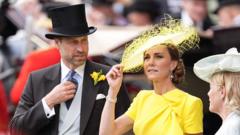
To the casual observer, the appearance of William and Catherine, the Prince and Princess of Wales, at the famous racecourse is a simple matter of calendar management. A box checked. A tradition upheld. The headlines the next morning will inevitably dissect the shade of the Princess’s dress or the angle of the Prince’s silk hat.
Look closer.
Underneath the pristine tailoring and the practiced waves lies a complex, high-stakes exercise in modern monarchy. This is not a holiday. It is an arena where every micro-expression is analyzed, every gesture is coded, and the future of an ancient institution is quietly negotiated in the bright Berkshire sunlight.
The Architecture of a Tradition
Ascot was founded by Queen Anne in 1711, born from a simple realization that the open heath near Windsor was ideal for letting horses gallop at full stretch. Over three centuries, it evolved from a simple race meeting into a rigid cultural ecosystem.
The rules of the Royal Enclosure are legendary in their strictness. Dresses must be of modest length. Straps must be at least one inch wide. Men must wear black or grey morning dress with a waistcoat and a top hat. To step onto this grass is to willingly submit to a time capsule.
For decades, Queen Elizabeth II was the undisputed anchor of this event. Her passion for thoroughbred racing was visceral, joyful, and deeply knowledgeable. When her horses ran, the stoic monarch vanished, replaced by a woman gripping binoculars, her face alive with genuine, unscripted emotion. Her absence still thins the air.
When the landaus rolled into the parade ring recently, the shift in energy was palpable. The King and Queen led the procession, carrying the weight of a new era. But when William and Catherine stepped onto the lawns, the crowd's focus shifted on its axis.
Consider the mechanics of that transition. The Prince and Princess of Wales are no longer just members of the supporting cast. They are the core architecture of the brand. The crowd doesn't just watch them; they look to them for reassurance that the continuity of the realm remains unbroken.
The Invisible Choreography
Imagine standing in a moving carriage, balanced on leather straps, traveling at a brisk trot while thousands of cameras click in unison. Every lens is searching for a flaw. A stray hair. A moment of boredom. A flash of irritation.
The Princess of Wales stepped onto the turf clad in a vibrant, sweeping red dress by Alexander McQueen, topped with a matching hat by Philip Treacy. It was a bold choice, a deliberate contrast to the softer pastels frequently favored by royal attendees. In the language of clothes, it was a declaration of presence. It said, I am here, and I am ready to be seen.
Beside her, William wore the traditional morning coat, navigating the crowd with a relaxed, low-energy confidence that has become his trademark.
But the real magic of the day doesn't happen during the procession. It happens in the Parade Ring, a circular amphitheater of green grass surrounded by tiered brick viewing stands. Here, the royals mix with trainers, jockeys, owners, and aristocrats. It is a masterclass in social navigation.
Watch how they move. Catherine greets Dame Judi Dench with a warm, two-handed clasp, a gesture that immediately bridges the gap between formal royalty and national treasure. William shares a laugh with a prominent horse trainer, leaning in, his body language open and engaged.
This is the hidden labor of the modern royal. They must be accessible yet aspirational. They must exude warmth while maintaining the invisible boundary that keeps the mystique of the crown intact. It is a grueling tightrope walk, performed while walking on soft grass in high heels.
The Real Stakes Beyond the Turf
It is easy to dismiss Ascot as a playground for the ultra-wealthy, a relic of an unequal past where champagne flows and fortunes are wagered on the whims of three-year-old fillies. To an extent, that critique is fair. The Royal Enclosure can feel profoundly disconnected from the struggles of ordinary life.
Yet, dismissing it entirely misses its economic and cultural utility.
British racing is a massive industry, contributing over £4 billion annually to the economy and employing tens of thousands of stable staff, breeders, farriers, and vets. Royal Ascot is its shop window. When international buyers from Kentucky, Dubai, and Tokyo see the Prince and Princess of Wales celebrating the sport, it validates the entire enterprise. It keeps investment flowing into British rural economies.
More than that, events like this serve as a cultural glue. In a world that is increasingly fractured, digital, and hyper-accelerated, there is a strange comfort in an event that looks exactly the same as it did fifty years ago. The brass band still plays around the bandstand after the last race. The crowd still sings along to "Sweet Caroline" and "Land of Hope and Glory" in the pouring rain or the blazing sun.
William and Catherine understand this deeply. Their presence is a form of civic service masquerading as a day out. They are there to lend their star power to a tradition that keeps a vital industry alive, and to offer a sense of stability to a public that has grown weary of constant change.
A Fleeting Moment in the Sun
As the afternoon waned, the shadows lengthened across the Ascot turf. The high-stakes tension of the arrival dissolved into the softer, looser energy of a summer evening.
In the royal box, away from the immediate glare of the trackside cameras, the Prince and Princess stood together, watching the horses sprint toward the finish line. For a brief second, the public masks slipped. A shared look. A private joke. A quiet touch on the arm.
In those fleeting moments, you see the human truth of the matter. They are a young couple carrying an unimaginable burden of expectation, navigating a changing world while anchored to the relentless traditions of the past.
The horses cross the line. The roar of the crowd rises and falls. The top hats are tipped, the champagne flutes are emptied, and the royal party prepares to return behind the castle walls. The golden hour fades, but the impression remains: a modern monarchy, carefully adjusting its weight, ensuring it can still run the distance.