The kitchen clock ticks too loudly when a house is empty. Elena sits at her oak table, staring at a neatly folded spreadsheet. On it, she has mapped out the next thirty years of her life. Career milestones. Travel destinations. Financial milestones. Conspicuously absent from the grid is a column for children. Elena is thirty-three, financially secure, and entirely undecided.
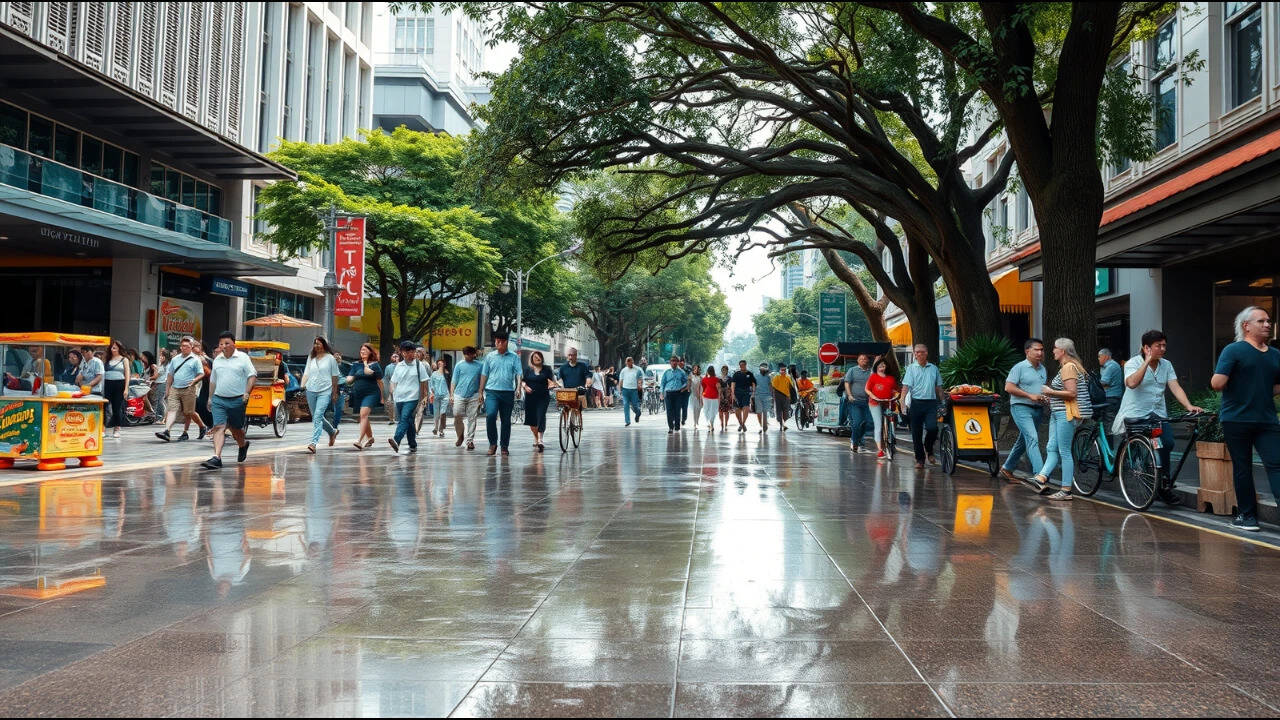
Every Sunday, she visits her grandfather at the care home. The hallways smell of industrial lavender and fading memories. There, she sees a fragile ecosystem hanging by a thread. One nurse manages an entire wing of residents. The math of human care is breaking down in real time. When Elena looks at her grandfather, she sees the past. When she looks at the exhausted staff, she sees her own future. Recently making news lately: Why Singapore is planting one million trees to cool its streets.
A quiet debate is rippling through society, shifting from the private confines of bedrooms to the public squares of economic policy and moral philosophy. It is no longer just a question of whether we want children. The question has curdled into something much heavier. Do we owe the world children?
For decades, the choice to reproduce was viewed as the ultimate personal prerogative. A private dream or a private choice. But as birth rates crater across the globe, a counter-narrative is emerging. It suggests that choosing childlessness is not merely a lifestyle preference, but a breach of a foundational social contract. Further insights regarding the matter are detailed by ELLE.
The Arithmetic of Exhaustion
Look at the numbers, and the anxiety becomes tangible. To maintain a stable population, a nation needs a total fertility rate of roughly 2.1 births per woman. This is the replacement level. Today, the global average is sliding backward. In South Korea, the rate has plummeted to an astonishing 0.72. Parts of Europe and East Asia are watching their demographic pyramids flip upside down.
This is not a distant problem for the year 2100. It is a crisis of the present moment.
Consider a hypothetical community we will call Oakhaven. In Oakhaven, everyone decides to maximize their personal freedom and disposable income. They travel, invest in their careers, and buy beautiful homes. For thirty years, Oakhaven thrives. It is quiet, prosperous, and pristine.
Then, time does what it always does.
The residents grow old. The local hospital finds itself overwhelmed, not by a sudden pandemic, but by the slow, grinding reality of geriatric care. The town tries to hire nurses, but there are no young adults applying for the jobs. They try to maintain the water treatment plant, but the specialized knowledge required to run it retired five years ago. The local businesses close because there is no one to buy goods, and more importantly, no one to sell them.
Oakhaven did not suffer a cataclysm. It simply ran out of people.
The economic engine of modern society is built entirely on the assumption of continuity. Our pensions, our healthcare systems, and our infrastructure maintenance are funded by the young to support the old. When the supply of youth dries up, the system does not just slow down. It collapses.
The Ancestral Ledger
Philosophers argue that we are born into a state of profound debt. This is the concept of intergenerational justice. Every piece of technology we use, the medicine that cures our infections, the roads we drive on, and the legal frameworks that protect our rights were paid for by the sweat and sacrifice of those who came before us.
They did not build this world just for themselves. They built it for their descendants.
When we accept these gifts and choose not to pass them on, we behave like a diner who enjoys a ten-course feast and slips out the back door before the bill arrives. We consume the capital of human civilization without contributing to the labor force that will sustain it next.
But this argument feels cold when applied to something as intimate as parenthood.
Elena feels this tension acutely. She understands the macroeconomics. She knows that without a new generation, the future is a gray, shrinking room. Yet, when she speaks to her friends, the counter-arguments are fierce and deeply felt.
The most common objection is rooted in climate anxiety. Why bring a child into a world that is burning? It seems cruel to introduce a new life to a planet plagued by extreme weather, political instability, and ecological degradation. Some calculations suggest that having one fewer child saves roughly 58.6 tonnes of carbon equivalents per year. To some, childlessness is the ultimate act of environmental stewardship.
Yet, this logic contains a tragic flaw. A world without children is a world without a future. And a world without a future is a world that no one will bother to save.
If we halt reproduction to protect the planet, we are destroying the very entity we are trying to preserve. True sustainability is not the absence of human life; it is the balance of it. History shows that human ingenuity is our most renewable resource. The child unborn today might have been the scientist who engineered the carbon-capture breakthrough of tomorrow.
The Mirage of Autonomy
We live in an era that worships individual autonomy. We are told that our lives are our own to design, free from the dictates of tradition, church, or state. This freedom is a hard-won triumph. No one should be forced into parenthood by coercion or social shame.
But we have confused the absence of coercion with the absence of obligation.
We have duties that we never explicitly signed up for. We have a duty to help a stranger drowning in a shallow pond, even if it ruins our expensive clothes. We have a duty to care for our aging parents, even if it disrupts our weekend plans. Why, then, do we assume our duty to the continuation of our species is entirely optional?
The decision to remain childless is often framed as a radical act of self-determination. But sometimes, it looks less like freedom and more like isolation.
Imagine a chain stretching back three billion years. An unbroken line of organisms that managed to survive ice ages, plagues, famines, and wars. Every single one of your ancestors successfully reproduced, passing the torch of life forward through unthinkable adversity. To voluntarily break that chain requires a profound certainty that our current moment of comfort is worth more than the infinite potential of the future.
The Hidden Cost of the Empty Stroller
There is a quiet grief that settles over a society that stops having children. It is not something you see in economic charts. It is a vibe. A subtle shift in the cultural atmosphere.
Parks grow quiet. Schools are converted into luxury condominiums. Toy stores vanish, replaced by boutique coffee shops and pet grooming salons. Dogs in strollers become a common sight, a poignant substitute for the messy, loud, unpredictable reality of human infancy.
Children bring an irreplaceable energy to a community. They force us to look outward. They demand that we think in time horizons that extend far beyond our own mortality. A man planting an acorn does so because he knows his grandchildren will enjoy the shade. Without grandchildren, why plant the tree?
Elena walks through her neighborhood on a Tuesday evening. She sees couples her age dining at expensive restaurants, scrolling through their phones in a state of quiet luxury. They look happy. They look rested.
But she also notices a strange uniformity to the neighborhood. There is no laughter echoing from the backyards. There are no chalk drawings on the sidewalks. It is a world designed for the present tense. It is comfortable, but it feels like a waiting room.
Parenthood is undeniably difficult. It demands the surrender of sleep, disposable income, and personal spontaneity. It breaks your heart and tests your patience. In a culture that measures worth by personal optimization and self-care, children are a terrible investment. They offer no immediate return on capital.
But perhaps that is precisely why we need them.
Children are the ultimate antidote to our collective narcissism. They remind us that we are not the main characters of the universe, but rather a single chapter in a much longer story. They anchor us to reality in a way that career achievements and luxury vacations never can.
The sun is setting when Elena leaves the care home. Her grandfather had smiled when she kissed his forehead, a brief flash of recognition in a mind that is slipping away.
She walks to her car, the spreadsheet on her kitchen table still lingering in her mind. The columns and rows suddenly seem incredibly small. They are neat, predictable, and safe. But safety can be a gilded cage.
She looks at a young mother pushing a stroller across the street. The mother looks tired. Her hair is messy, and she is struggling to balance a grocery bag while soothing a crying toddler. It looks chaotic. It looks exhausting.
It also looks undeniably alive.