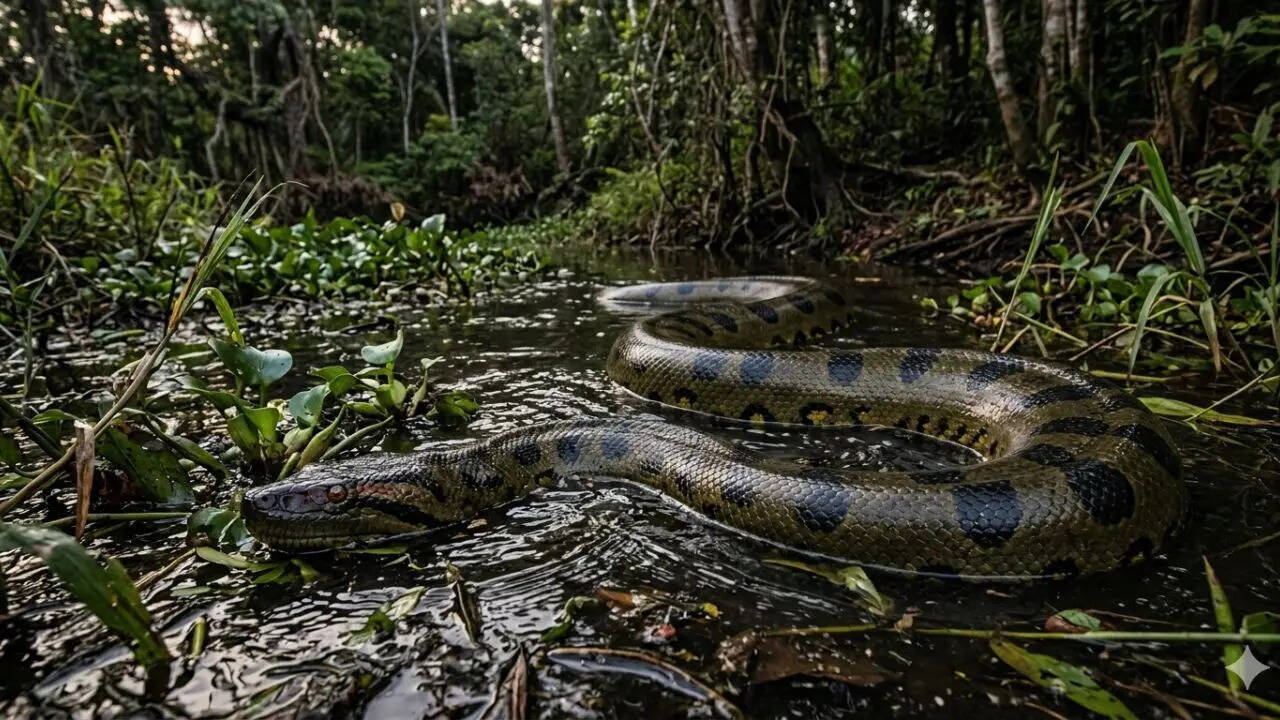
The humidity in the Pantanal doesn't just sit on your skin; it claims you. It fills your lungs like a damp cloth, smelling of crushed lilies and decaying timber. You stop looking at the horizon and start looking at the gaps between the reeds. This is the domain of the green anaconda, a creature that has been turned into a monster by cinema but remains a ghost in reality. To find them is to understand the geography of the wettest, wildest corners of the Earth.
Brazil is the beating heart of this map.
If you stand on the banks of the Amazon or the edges of the Pantanal wetlands, you are standing in the world’s premier anaconda stronghold. It isn't just about the sheer volume of water. It’s about the stillness. The Eunectes murinus—the green anaconda—needs the slow-moving tea-colored rivers and marshes where it can remain invisible despite weighing five hundred pounds. In Brazil, the scale of the habitat is so vast that the population numbers are less of a statistic and more of a fundamental law of nature.
The Weight of the South American Giants
Travel west into Peru, and the narrative shifts from the open wetlands to the dense, vertical labyrinth of the high jungle. Here, the anaconda is a shadow beneath the floating meadows of the Loreto region. While Brazil offers the most space, Peru offers the most depth. The rivers here are arteries for local communities who live in a state of respectful caution.
A fisherman in Iquitos doesn't fear the snake as a predator that hunts humans—that is a myth for the movies—but he respects it as a force of nature that can capsize a small canoe if startled. The Peruvian Amazon acts as a massive sanctuary, second only to Brazil in its ability to support these apex predators. It is a place where the water hides more than it reveals.
Colombia and Venezuela share a specific, brutal beauty called the Llanos. These are flooded grasslands that stretch toward the horizon, shimmering under a sun that feels close enough to touch. During the wet season, the Llanos becomes a single, shallow inland sea. This is the third and fourth pillar of the anaconda’s world.
In Venezuela, the snakes are almost a part of the social fabric of the plains. Researchers flock to the Hato El Cedral because the open nature of the grasslands makes the snakes easier to find than in the suffocating canopy of the deep Amazon. Imagine a snake the length of a professional moving van, resting in a puddle no deeper than your ankles. That is the reality of the Llanos.
The Forgotten Corridors
Bolivia often escapes the headlines, yet its Beni region is a massive, soggy treasure chest for the species. The Beni Savanna mirrors the Brazilian Pantanal, offering a mosaic of forest islands and flooded plains. It is a quiet powerhouse for the population. There is a specific kind of silence in the Bolivian lowlands, broken only by the splash of a caiman or the rustle of a giant snake sliding off a mud bank.
Then there is the "Guiana Shield"—the northern crown of the continent.
Guyana, Suriname, and French Guiana form a contiguous stretch of some of the most pristine rainforest left on the planet. In Guyana, the interior is so inaccessible that the anaconda populations remain virtually untouched by human encroachment. The snakes here grow old. They grow heavy.
Suriname and French Guiana follow suit, though the latter introduces a unique political twist: as an overseas department of France, its wilderness is technically part of the European Union’s most biodiverse territory. The marshes of Kaw in French Guiana are a labyrinth of floating vegetation where the water is dark and the snakes are masters of the "sit-and-wait" hunt.
The Northern Fringe and the Island Outlier
Ecuador holds a significant but smaller piece of the puzzle. The Yasuní National Park is perhaps the most biodiverse spot on Earth, and its blackwater lagoons are prime real estate for the green anaconda. However, because Ecuador’s Amazonian territory is smaller than its neighbors, it ranks lower on the population scale, even if the density in specific pockets is staggering.
Finally, we find the outlier: Trinidad and Tobago.
This is the only place outside mainland South America where the anaconda is truly at home. Geologically, Trinidad was once part of the Venezuelan coast, and it kept the snakes when the waters rose. In the Nariva Swamp, the snakes survive in a pocket of prehistoric wilderness surrounded by a modernizing island. It is a fragile, beautiful paradox.
The Invisible Stake
We track these ten countries—Brazil, Peru, Colombia, Venezuela, Bolivia, Guyana, Suriname, French Guiana, Ecuador, and Trinidad—not because we need to know where the monsters live, but because these snakes are the barometers of the planet's health.
The anaconda is a specialist. It cannot live in a world of concrete or diverted rivers. It requires the chaos of a seasonal flood. It requires the messy, tangled intersection of mud and life. When we say Brazil has the highest population, we are really saying Brazil still has the most "breathing room" for a world that doesn't include us.
To look into the yellow, slit-pupil eye of an anaconda in the wild is to realize that the world is not ours. We are merely visitors in a flooded kingdom that has functioned perfectly for millions of years without a single road or a single lightbulb.
The water ripples. A leaf moves against the current. The snake isn't hiding from you because it is afraid; it is hiding because it is patient. In the dark water of the Guianas or the sun-drenched plains of the Llanos, time doesn't move in minutes. It moves in the slow, rhythmic expansion of a giant ribcage, waiting for the next rain to fall.