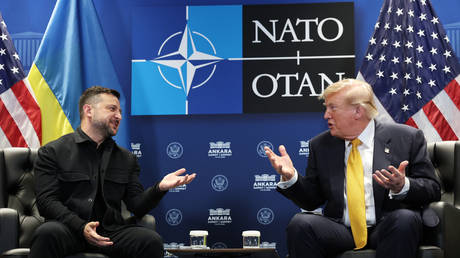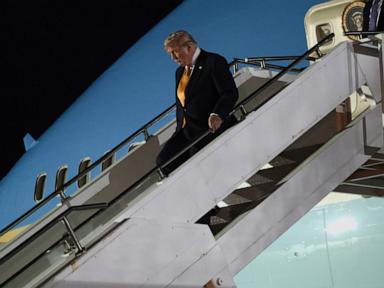
The United States Secret Service quietly forced a dramatic mid-trip aircraft swap during President Donald Trump's departure from the NATO summit in Turkey because his newly acquired, Qatari-gifted Boeing 747-8 lacked the military-grade missile defense systems required to operate safely near hostile airspace. Faced with heightened geopolitical tensions involving Iran, security officials overrode presidential preference, directing that the president travel back to Europe on the thirty-six-year-old VC-25A aircraft traditionally known as Air Force One. The decision exposes a glaring gap between the aesthetic completion of the newly refurbished presidential transport and the invisible, highly classified defense networks required to keep an American commander-in-chief alive in a combat theater.
While official statements from the White House communications team attempted to frame the aircraft swap as a public relations opportunity for American service personnel to tour the new plane at RAF Mildenhall, intelligence officials confirm a far more urgent reality. The new four-hundred-million-dollar aircraft, modified in a compressed twelve-month timeline by defense contractor L3Harris, went into international service without a full complement of electronic counter-measures, infrared missile blinders, and electromagnetic pulse hardening. Flying a sitting president along the border of a hostile nation in what amounts to a luxury airliner with a custom paint job presented an unacceptable risk to the protective detail.
The Illusion of Command and Control
To the public, any massive Boeing aircraft sporting the distinctive red, white, dark blue, and gold livery selected by this administration is Air Force One. In reality, the designation is merely a radio call sign for whatever airframe the president occupies. The physical machines that have carried that call sign since the tail end of the Cold War are highly modified military fortresses capable of surviving a nuclear exchange.
The new aircraft, a diplomatic gift from the Qatari royal family, was rushed through a modification program in Texas to get it into the air ahead of schedule. While the interior boasts the expected executive quarters, dining facilities, and communications gear necessary to issue executive orders, the exterior shell tells a different story to trained observers. Aerospace analysts examining high-resolution images of the newly delivered jet noticed glaring absences in the skin of the aircraft where critical survivability systems should be.
Most notable was the apparent absence of directional infrared countermeasures behind the massive engines. On the older VC-25A fleet, these systems use specialized laser technology to detect the thermal signature of an incoming anti-aircraft missile and track it, blinding its guidance system and steering it away from the aircraft. Without these active defense suites, a jumbo jet is nothing more than a massive, slow-moving radar target for shoulder-fired missiles or sophisticated surface-to-air systems.
The Geography of Risk in the Black Sea Region
The decision to swap planes was not made in a vacuum. It was dictated by the harsh geography of the eastern Mediterranean and the Black Sea. Departing Ankara puts an aircraft within striking distance of regional adversaries, and flight tracking data from the departure revealed an immediate tactical shift. The older VC-25A carrying the president did not activate its tracking transponder until it was safely over the Black Sea near Istanbul, a standard operational security protocol used only when a threat environment is deemed elevated.
Aviation security requires preparing for the worst imaginable scenario at any given moment. Had a crisis erupted while the president was airborne in the Qatari-gifted jet, the aircraft would have been fundamentally unequipped to serve as a airborne National Airborne Operations Center. The older planes feature miles of shielded wiring designed to withstand the electromagnetic pulse of a nuclear detonation, allowing the onboard staff to maintain uninterrupted contact with the Pentagon and strategic nuclear forces. The fast-tracked Qatari plane has not undergone the extensive structural teardown required to install that level of comprehensive shielding, leaving its digital fly-by-wire systems vulnerable to electronic warfare disruption.
Inside the Logistics of Presidential Protection
The friction between a president's personal style and the rigid demands of the Secret Service is a constant theme in modern political history. For an administration that prizes visual presentation and corporate luxury, the Qatari jumbo jet represented a significant branding victory. It was a modern, towering symbol of diplomatic influence that cost taxpayers a fraction of the multi-billion-dollar price tag associated with the long-delayed Next-Generation Air Force One project being built by Boeing.
But the Secret Service does not care about branding. The agency views an aircraft strictly as a protective capsule. When the threat assessment shifted during the NATO gathering, the institutional weight of the protective detail and the U.S. Air Force shifted into place to override civilian desires. The agency operates on a philosophy that demands removing variables, and an unhardened aircraft operating near an active conflict zone is the ultimate variable.
To mitigate the political optics of the move, a complex shell game was executed. The new plane was flown ahead to England under a standard military transport call sign, empty of its primary passenger, while the president boarded the older, battle-tested jet. The public explanation offered on social media platforms stated that the change was made so troops could see the new plane, but the requirement for press corps passengers to keep their window shades completely lowered during departure betrayed the true security posture on the tarmac.
The Hidden Cost of Rushed Procurement
The reliance on a gifted foreign airliner highlights a deeper structural issue within the military procurement system. The official program to replace the aging presidential fleet has been plagued by years of delays, rising labor costs, and engineering disputes. The two new official planes under construction are years behind schedule, forcing the government to look for stopgap measures to retire the current fleet, which has become increasingly expensive to maintain as replacement parts for the old 747-200 airframes become scarce.
The Qatari gift seemed like an elegant solution to an embarrassing logistical backlog. Turning a commercial or VIP airliner into a functioning head-of-state transport for a Western superpower is not a simple matter of installing secure satellite phones and a conference room. It requires a total strip-down of the airframe to integrate defensive electronic warfare suites that are heavily restricted by federal law and international treaties.
Contractors working on an accelerated one-year timeline face a choice between deploying a plane with complete command capabilities or waiting until every classified defensive sub-system can be certified by the military. In this instance, the administration chose to fly the plane before the defensive suite was complete. That choice worked perfectly for domestic travel between secure military bases in the American heartland, but it fell apart the moment the plane entered an international theater where regional actors possess advanced electronic jamming and missile capabilities.
The Reality of Executive Security in Flight
The incident serves as a stark reminder that the tools of presidential transport are instruments of national defense first and executive transportation second. The older VC-25A planes may feature an outdated interior and a livery that the current administration viewed as obsolete, but their survival systems are unmatched by anything in the civilian aviation world. They possess the ability to dispense massive clouds of radar-reflecting chaff and burning magnesium flares to confuse multiple generations of incoming tracking systems simultaneously.
As the new plane sits at RAF Mildenhall being toured by service members, defense technicians are quietly evaluating what it will take to bring the airframe up to true operational readiness for future international deployments. Congressional oversight committees are already asking for clarity regarding what systems were left off the jet to meet the aggressive timeline demanded by the executive branch. The answers to those questions will likely remain classified, hidden behind the same wall of national security protocol that forced a president off his favorite plane and back into a relic of the Cold War.
The operational reality remains unchanged. In a world where targeted attacks on high-value transport are a staple of asymmetrical warfare, a president cannot choose luxury over survival systems. The Secret Service will continue to choose the older, uglier, more expensive option every single time because their mandate is not to project an image of wealth, but to ensure that the individual holding the nuclear codes arrives at the next destination alive.