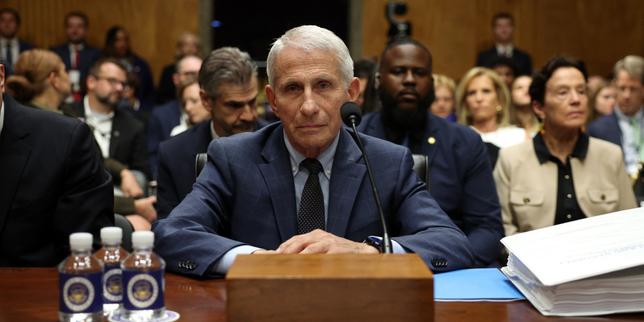
Anthony Fauci isn't just a retired public health official. He's a lightning rod for political fallout. When a US Senate subcommittee recently recommended criminal charges against him, the news shocked healthcare professionals and politicians alike. You probably heard the headlines. But what actually triggered this escalation? Let's break down the mechanics behind the move, the arguments from both sides, and why this fight over pandemic origins won't fade away anytime soon.
Politics and public health rarely mix well. During a global crisis, officials make split-second decisions with incomplete data. Years later, investigators comb through emails, meeting transcripts, and congressional testimony to find discrepancies. That is exactly what happened here. Investigators argue that the former chief medical advisor misled Congress about federal funding for coronavirus research in Wuhan. Fauci denies these accusations entirely. He maintains that his testimony was truthful and that funding guidelines were followed correctly.
Congressional oversight committees hold immense investigative power. They can subpoena documents, grill high-ranking officials under oath, and refer cases to the Department of Justice for potential prosecution. But a referral doesn't equal an indictment. Lawmakers write criminal referrals when they believe a witness lied to Congress, which violates federal statutes. Yet, prosecuting a prominent scientist who spent decades heading the National Institute of Allergy and Infectious Diseases sets a monumental precedent. The Department of Justice faces a steep hurdle if it decides to pursue charges. Proving intentional deception during high-stakes testimony is notoriously difficult.
The Core Allegations Against Fauci
The entire controversy hinges on a specific set of documents, grants, and emails. Critics point to past research projects involving bat coronaviruses. They claim that money from US agencies filtered into labs in China without adequate oversight. Fauci testified under oath that the National Institutes of Health never funded gain-of-function research at the Wuhan Institute of Virology.
Critics argue otherwise. They highlight internal communications where scientists debated the risks of manipulating certain viral structures. If investigators can prove that the research funded by US grants met the technical definition of gain-of-function, and that Fauci knew about it while denying it to lawmakers, the legal jeopardy becomes real.
On the flip side, defenders argue that the scientific definitions are being weaponized for political theater. In the world of virology, academic terminology gets dense and heavily nuanced. What a politician calls dangerous modification, a researcher might describe as basic surveillance of natural viral evolution. This semantic gap fuels most of the debate. When politicians ask binary questions about complex scientific processes, misunderstandings are practically guaranteed.
The Broader Impact on Public Health
This situation damages trust in institutions. When public health leaders face criminal probes, the average person starts questioning every guideline issued during a crisis. Mask mandates, vaccine rollouts, and social distancing policies already divided public opinion. Adding criminal investigations into the mix deepens that partisan split.
Future pandemics require public compliance. If citizens believe scientific advisors lie to protect their budgets or reputations, compliance drops sharply. We saw hints of this erosion during the rollout of boosters. Rebuilding that institutional credibility will take decades. It requires absolute transparency, which has been severely lacking on both sides of the political aisle.
What Happens Next
The Department of Justice reviews these congressional referrals, but prosecutors rarely jump into high-profile political disputes without airtight evidence. The statute of limitations, the ambiguity of testimony, and the sheer complexity of scientific terminology make a successful trial a long shot.
You should expect the political rhetoric to intensify as campaign cycles progress. Both sides view this issue as a referendum on how the government handled the worst health emergency in a century. Don't expect a neat conclusion anytime soon. The fallout from these investigations will shape federal science funding, congressional oversight rules, and the public perception of scientific authority for years to come. Look past the cable news shouting matches and focus on the document trails, because that is where the truth actually lives.