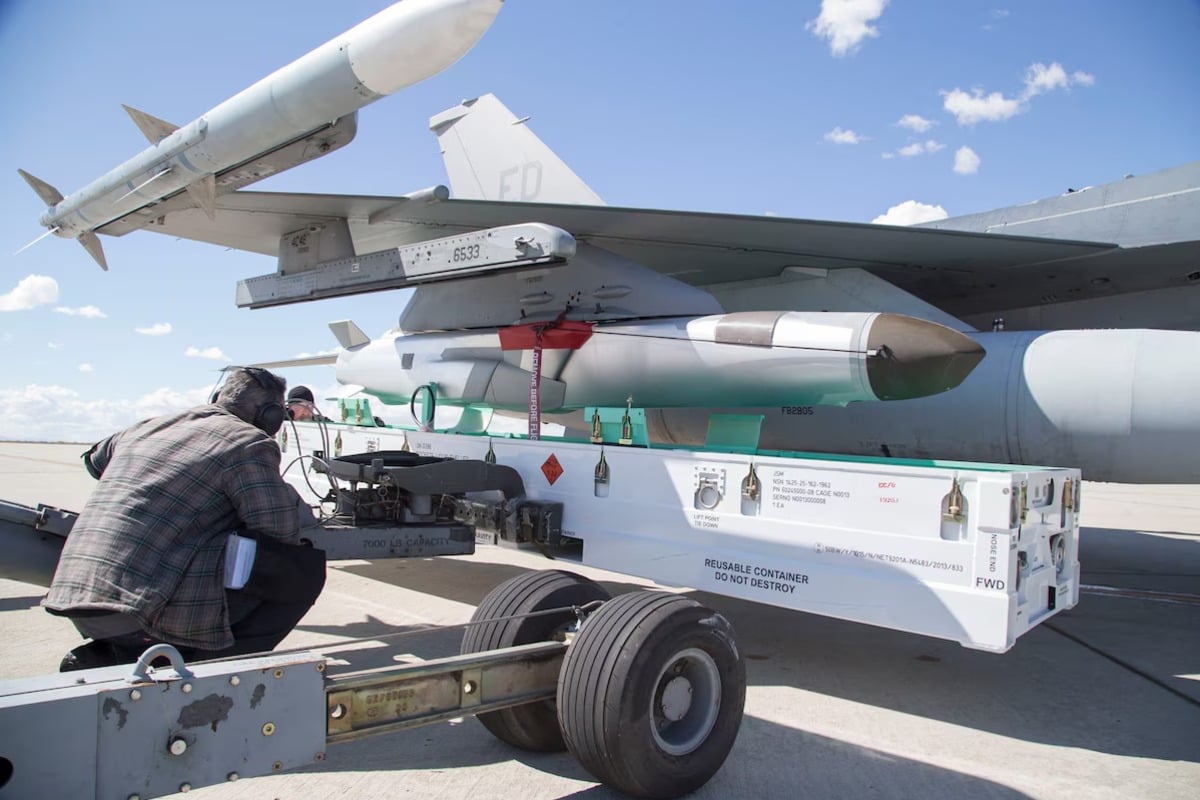
The United States Air Force just wrote another massive check to Norway's Kongsberg Defence & Aerospace. They are buying more Joint Strike Missiles (JSM) to stuff into the internal weapons bays of the F-35A. The defense establishment is celebrating this as a major win for Allied interoperability and fifth-generation stealth lethality.
They are celebrating a fundamental failure of strategic imagination.
The defense media is running the usual copy-paste press releases about how the JSM is a "critical gap-filler" that provides the F-35 with a much-needed maritime strike and land-attack capability. They talk about its low-observable profile, its advanced imaging infrared seeker, and its ability to fit snugly inside the F-35's belly to preserve its radar-evading shape.
What they are not telling you is that the Pentagon is spending millions of dollars per round on an exquisite weapon designed for a conflict paradigm that is already obsolete. We are buying highly specialized, boutique hardware for a war of attrition where mass, cheap manufacturing, and sheer volume are the only things that will actually matter.
The Stealth Trap: Why Internal Carriage Is a Design Dead End
The entire selling point of the Joint Strike Missile is its form factor. Because the standard Naval Strike Missile (NSM) is too bulky to fit inside the F-35A’s internal weapons bay, Kongsberg had to redesign the airframe, shrinking the inlets and reshaping the body so the F-35 doesn't have to carry it externally. Carrying weapons externally ruins the aircraft's stealth signature.
This is a classic engineering triumph that masks a catastrophic tactical vulnerability.
Let us look at the raw math of a near-peer conflict in the Indo-Pacific.
An F-35A can carry exactly two JSMs internally. That is it. Once those two missiles are launched, that hundred-million-dollar asset has to fly all the way back to a highly vulnerable forward operating base or an aircraft carrier, land, get rearmed by a specialized crew, and fly back.
In a high-intensity conflict against a peer adversary with dense, layered air defense networks, two missiles per sortie is an absurdly low rate of fire. To saturate a modern destroyer's Aegis-equivalent air defense system, you do not need two stealthy missiles. You need dozens of threat-representative targets arriving simultaneously from multiple vectors to overwhelm the system's radar processing and ammunition capacity.
By prioritizing "stealth-on-stealth" integration, we have built a weapon system that optimizes for survival at the expense of mission success. What good is a stealthy launch platform if the payload it delivers is too small to actually penetrate or saturate the target's defense envelope?
I have watched defense contractors spend a decade and hundreds of millions of dollars tweaking a fin design by two millimeters just to fit an internal bay. Meanwhile, adversaries are building thousands of long-range, cheap, "good enough" land-attack and anti-ship cruise missiles that can be launched from the back of a commercial shipping container. We are bringing a scalpel to a sledgehammer fight.
The Myth of Allied Interoperability
The defense establishment loves to throw around "interoperability" as a shield against criticism. The narrative is simple: because Norway, Australia, and Japan are also buying the JSM/NSM family, we are creating a seamless, unified global supply chain.
This is a fantasy.
In a real, hot war with a near-peer adversary, supply chains do not remain global or seamless. Kongsberg’s production facilities in Norway, while highly advanced, represent a massive single point of failure. Even with domestic assembly lines or co-production agreements in the US, the highly specialized components—specifically the advanced infrared seekers and specialized composite materials—rely on fragile, highly centralized supply webs.
If we cannot produce these missiles by the tens of thousands annually on domestic soil using standardized, commercial off-the-shelf components, then the alliance is built on a house of cards.
During the initial phases of any major conflict, precision-guided munition stockpiles deplete in weeks, if not days. This is not a theoretical warning; we saw it play out in early coalition operations over Libya, and we see it daily in Ukraine. The US Air Force’s buy of JSMs is a drop in the bucket compared to the actual consumption rates required in a prolonged Pacific campaign.
The Seeker Fallacy: Overpaying for Over-Engineering
The JSM utilizes an extremely sophisticated dual-band imaging infrared (IIR) seeker backed by an onboard target database. It does not rely on active radar homing, meaning it does not emit signals that the target can detect and jam. It scans the target vessel, compares it to a 3D library of ships, and decides exactly where to strike for maximum damage.
It is a beautiful piece of technology. It is also an incredibly expensive way to solve a problem that software and networked swarm intelligence should have solved years ago.
Instead of buying a small number of highly expensive, autonomous, single-purpose missiles with gold-plated seekers, the smarter path is to buy hundreds of cheaper, dumb missiles that communicate with one another.
Imagine a scenario where a salvo of ten cheap, GPS/INS-guided missiles is launched toward a fleet. Only one of those missiles needs a relatively capable seeker. That single "scout" missile can network with the other nine, passing targeting telemetry and terminal guidance updates via a basic localized data link. If the scout is shot down, another missile in the mesh takes over.
By putting the "intelligence" into the network rather than into every single individual piece of expendable flying metal, you slash the cost per round by 60%. But the Pentagon does not buy networks; it buys platforms and missiles because they are easier to put on a corporate balance sheet and present to Congress.
The Real Question We Should Be Asking
When assessing these multi-million-dollar acquisition programs, the public and the media always ask: "Does the missile work?"
That is the wrong question. Of course it works. Kongsberg is an exceptional engineering firm, and the JSM is a marvel of modern aerodynamics and sensor integration.
The real question is: "Does this purchase lower the cost-per-kill ratio in our favor?"
Right now, the answer is a resounding no. We are spending millions per missile to target vessels that can be built faster than we can replenish our munitions. We are risking fifth-generation stealth fighters to get within launching range of targets that should be addressed by long-range, ground-launched, mass-produced missile artillery or autonomous unmanned surface vessels.
The US Air Force’s continued acquisition of the JSM is not a sign of strategic strength. It is a symptom of an acquisition system trapped in a 1990s mindset—one that believes stealth, exquisite engineering, and low volume will always triumph over mass, speed, and industrial capacity.
We are buying silver bullets in a war that will be fought with lead. Stop celebrating the boutique procurement. Start demanding the industrial scale required to actually win.