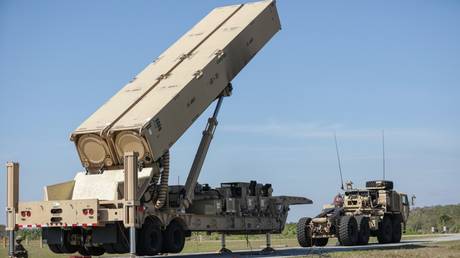
The US military is tired of playing hide-and-seek with Iranian missile crews. As Tehran shifts its ballistic launchers deeper into the rugged interior, safely tucked away from current American reach, US Central Command (CENTCOM) is looking for a sledgehammer that can fly five times the speed of sound. They want the Dark Eagle.
There’s just one massive problem. The weapon isn't actually finished yet.
Bloomberg reported on April 30, 2026, that CENTCOM has formally requested the deployment of the Army’s Long-Range Hypersonic Weapon (LRHW), better known as Dark Eagle, to the Middle East. It's a bold—some say desperate—move to counter Iran's tactical retreats. By moving their launchers beyond the 300-mile range of the existing Precision Strike Missile (PrSM), Iran has created a temporary sanctuary. The Dark Eagle, with a reach of over 1,725 miles, would turn that sanctuary into a bullseye.
The rush to deploy a prototype in a hot war
The Pentagon’s own testing office isn't exactly popping champagne. Even though the Army and Navy managed a successful joint test in March 2026, the Director of Operational Test and Evaluation recently warned that there’s still "insufficient data" to prove this thing actually works in a combat environment.
We’re talking about a weapon system that has seen years of delays and failed tests. To send it into a theater where every miss has massive geopolitical consequences is a hell of a gamble. But if you’re a commander watching Iranian launchers relocate while your current stockpiles dwindle, you’re probably willing to take that risk.
It’s not just about distance. It's about survivability. Iran has been busy bolting Chinese-made surface-to-air missiles onto their defenses. Standard cruise missiles are starting to look like slow-moving targets. A hypersonic glide body, however, doesn't just fly fast; it maneuvers. It skips along the upper atmosphere like a stone on water, making its trajectory nearly impossible for current radar and interceptors to track with any certainty.
Why the Dark Eagle is different
Most people confuse hypersonics with regular ballistic missiles. They both go fast, but the Dark Eagle is a different beast. While a ballistic missile follows a predictable arc—like a thrown football—the Dark Eagle’s Common Hypersonic Glide Body (CHGB) is released from its booster and then glides and weaves toward the target.
- Speed: Mach 5 and beyond.
- Range: Approximately 2,776 kilometers (1,725 miles).
- Platform: Mobile ground launchers that can be hidden and moved quickly.
I've seen plenty of "silver bullet" weapons promised over the years, but the math here is what’s driving the urgency. The US has already burned through a significant chunk of its newer PrSM inventory during this conflict. We’re seeing reports that the supply chain is gasping for air. Integrating a long-range option like Dark Eagle isn't just about tactical superiority; it's about not running out of ways to hit back.
The $25 billion price tag and the political pressure
Secretary of Defense Pete Hegseth is under the gun to show that the US isn't falling behind China and Russia in the hypersonic arms race. President Trump has been briefed on fresh strike options, and the pressure to deliver a "short and powerful" wave of attacks to break the current deadlock is mounting.
But war isn't cheap. Estimates for the conflict's cost have already hit the $25 billion mark, with some analysts suggesting it could double if base reconstructions and asset replacements are factored in. Deploying a weapon that costs roughly $40 million per shot—compared to the $384,000 "Blackbeard" hypersonic the Navy is eyeing for the future—shows exactly how much the US is willing to spend to regain the initiative.
The reality of the Iranian defense shift
You can't blame CENTCOM for being frustrated. Intelligence indicates Iran has moved its most dangerous assets into "dead zones" where existing US tactical missiles can't reach without putting aircraft at extreme risk. If you can't fly a jet over it and you can't reach it with a PrSM, you're stuck. The Dark Eagle would allow the US to strike from across the region, potentially from stable bases or even ships, without needing to loiter in contested airspace.
What happens next
The request is sitting on the desk of the Department of War. If approved, it’ll be the first time a US hypersonic weapon has been deployed in a combat zone. It’s a high-stakes live-fire test. If it works, it changes the geometry of the Middle East overnight. If it fails—or worse, if an "untested" missile goes off course—the fallout will be more than just a headline in Bloomberg.
Keep an eye on these specific movements:
- Production milestones: The Army says they’re in the "final stages" of manufacturing. If those missiles don't roll off the line by September, this deployment is a fantasy.
- Strait of Hormuz status: The naval blockade is still the primary leverage point, but military action is the looming shadow.
- The "Blackbeard" alternative: Watch for the Navy to accelerate its cheaper, air-launched hypersonics if the Dark Eagle proves too cumbersome or expensive to field quickly.
The era of "wait and see" for hypersonic tech is over. The US is ready to skip the final exams and go straight to the battlefield. Honestly, it’s a terrifying shift in how we vet our most powerful tools of destruction.



