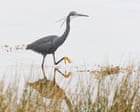
The rain in Norfolk does not fall so much as it hangs. It coats your eyelashes, turns the saltmarshes into a blurred smudge of slate grey, and seeps through the seams of boots you swore were waterproof. On a Tuesday morning, the British coastline feels like the last place on earth where secrets hide. It is predictable in its dampness, comforting in its monotony.
Then, a flash of impossible pink cuts through the reeds. For another perspective, check out: this related article.
For the person holding the binoculars—let us call him David, a man who has spent forty years tracking the predictable, rhythmic migrations of the British seasons—the heart stops. It is a physical jolt. You wipe the lenses. You look again. The mind tries to force the shape into something sensible. A grey heron, perhaps, caught in a strange trick of the morning light? A stray bit of plastic from the shipping lanes?
But the lens does not lie. The bird has legs like stilts, a body like a blush, and a silhouette that belongs in a mangrove swamp, not a Norfolk bog. A squacco heron. Or perhaps something even more far-flung, blown thousands of miles off course from the sun-drenched wetlands of southern Europe or Africa. Similar insight on this trend has been shared by NBC News.
David breathes out. The mist catches his breath. In that single moment, the quiet, insular world of British birdwatching fractures. The exotic has arrived. And it brought the future with it.
The Great Avian Reshuffle
To understand why a single bird can cause a traffic jam of sensible people in Gore-Tex jackets along a narrow country lane, you have to understand the unwritten rules of the sky.
Birds are the ultimate cartographers. They map the planet not by borders, but by thermal drafts, food supplies, and the exact moment the frost thaws. For centuries, the British Isles represented a very specific kind of sanctuary. Cold, wet, predictable. You knew when the swallows would arrive to nest in the barns. You knew when the dark-bellied brent geese would return from the Siberian tundra to spend the winter on the mudflats.
Now, the map is melting.
The headlines call it a "thrill for birdwatchers." They paint a picture of eccentric hobbyists celebrating a rare checkmark on their life lists. There is joy in it, certainly. When news of a rare tropical or Mediterranean visitor breaks on the specialist paging networks, the reaction is instantaneous. People drop their forks. They excuse themselves from board meetings. They drive through the night, fueled by terrible petrol station coffee, just to stand in a muddy field for six hours hoping for a three-second glimpse of a creature that shouldn't be here.
But look closer at the faces in those crowds. Beneath the excitement, there is a quiet, creeping unease.
These birds are not tourists. They are refugees of a changing climate, scouts for an army that is moving northward because the south is burning.
Consider the cattle egret. A few decades ago, seeing one of these small, white herons with their distinctive buff-colored plumes shadowing cows in a British pasture was a once-in-a-generation event. Today, they are breeding here. They are setting up house. The black-winged stilt, with its impossibly long, pink legs that look like thin glass straws, is no longer just an occasional stray blown off course by a southern gale. It is nesting in the western wetlands.
We are witnessing a profound geographic rewrite. The birds are telling us, in a language written in feathers and flight paths, that the climate we thought we knew is gone.
The Invisible Stakes on the Marsh
It is easy to look at a new bird and see only beauty. It costs nothing to admire the elegance of a glossy ibis probing the mud with its curved, sickle-like bill, looking like an ancient Egyptian hieroglyph brought to life against the backdrop of a grey British sky.
But ecology is a game of tight margins.
Imagine a small, local pub that has served the same fifty regulars for decades. The landlord knows exactly how many kegs to order, how many pies to bake. Suddenly, a tour bus empties forty strangers into the bar. They are loud, they are hungry, and they take up the best seats by the fire. The regulars are pushed to the fringes. The kitchen runs out of food.
When exotic species arrive in ecosystems that did not evolve to accommodate them, the balance shifts in ways we cannot always predict. The resident birds—the lapwings, the redshanks, the native herons—are already fighting for survival against habitat loss and industrial agriculture. Now, they must share the remaining slivers of wild land with aggressive, adaptable newcomers from the south.
The stakes are entirely invisible to the casual observer. You see a vibrant new species; the wetland sees a new mouth to feed, a new competitor for the dwindling supply of frogs, fish, and invertebrates.
The warmth that draws these birds across the English Channel is the same warmth that dried up the Spanish wetlands, turning the famous Doñana National Park—once the great staging post for millions of migratory birds—into a dusty, parched floor. The birds did not choose Britain because they fancied a change of scenery. They chose it because their old homes are becoming uninhabitable.
The Human Lure of the Rarity
Why do we care so deeply? Why does a retired teacher from Yorkshire spend his pension money to see a bird that lives abundantly in Spain?
Human beings are wired to seek the exceptional. In a world where every corner of the earth has been mapped by satellites and every street view can be accessed from a glowing screen in our pockets, true surprise is hard to come by. We live highly curated lives. We know what our hotels look like before we arrive. We know the menu of the restaurant before we book a table.
A rare bird breaks the script.
It represents a wild, untamed randomness. It is a reminder that despite our concrete, our optical fiber, and our algorithms, nature still possesses the power to surprise us. When you stand in the reedbeds and watch a tropical heron take flight, its wings catching a rare shaft of British sunlight, you are looking at something that broke through the safety net of the modern world.
It is intoxicating. It feels like magic.
But the magic is bittersweet. The veteran birdwatchers—the ones who have kept journals since the 1970s, written in faded ballpoint pen on lined paper—will tell you that the joy of the rarity has changed. It used to feel like a cosmic lottery win. A strange wind from the Atlantic, a disoriented youngster, a happy accident.
Now, the rarities are turning up in groups. They are staying through the winter. The accident is becoming the norm.
Shifting Horizons
The local tackle and bait shops, the small village pubs near the reserves, the bed and breakfasts that usually sit empty during the shoulder seasons—they all feel the immediate economic lift of a rare bird arrival. The "twitcher economy" is real, bringing thousands of pounds to rural communities within days of a sighting. People need pies; people need pints; people need a place to sleep after twelve hours on a seawall.
But this economic windfall is a symptom of a larger, systemic drift.
We are losing our sense of what belongs. There is a psychological concept known as "shifting baseline syndrome." It means that each generation accepts the world they are born into as the natural baseline, completely unaware of what was lost before they arrived.
A child growing up in southern England today might see little egrets feeding in every roadside ditch and assume they have always been there. They won't know that thirty years ago, seeing one was enough to make a grown man cry with excitement. They won't know that their presence is a monument to a warming continent.
We adapt to the change so quickly that we forget to mourn what is slipping away. As the southern birds move north, where do our northern birds go? The curlews, the dotterels, the golden plovers—the species that need the cold, the peat, and the high, crisp air of the uplands—are being pushed higher and further, until eventually, they will run out of island.
The sun begins to drop behind the Norfolk horizon, bleeding a faint, watery orange into the grey clouds. The crowd of onlookers has grown to a hundred people. They stand shoulder to shoulder, tripod legs interlocking like a forest of metal saplings.
Through the scopes, the heron remains still. It is hunched against the damp chill, a native of the sun-baked south enduring an English evening. It looks small against the vastness of the marsh. It has no idea it is a symbol, a data point, or a herald of a new epoch. It is simply trying to find a meal before the night closes in.
Someone in the crowd offers a flask of tea. The cup is warm against frozen fingers. We watch the bird, together, silent in the gathering dusk, caught between the thrill of the beautiful stranger and the quiet heartbreak of knowing exactly why it came.


